The Fort Worth Press - Drought hits Bishkek, where taps are running dry

USD -
AED 3.672504
AFN 64.503991
ALL 81.046102
AMD 360.780113
ANG 1.789785
AOA 917.000367
ARS 1523.143125
AUD 1.422273
AWG 1.8025
AZN 1.70397
BAM 1.745704
BBD 2.012675
BDT 123.586379
BGN 1.747831
BHD 0.377114
BIF 2995.403222
BMD 1
BND 1.277279
BOB 11.766859
BRL 4.965204
BSD 0.999331
BTN 94.818583
BWP 13.766234
BYN 2.934172
BYR 19600
BZD 2.009729
CAD 1.40025
CDF 2316.000362
CHF 0.825078
CLF 0.025294
CLP 995.510396
CNY 6.67805
CNH 6.670604
COP 3150.41
CRC 456.018209
CUC 1
CUP 23.982684
CVE 98.420137
CZK 21.719504
DJF 177.944392
DKK 6.67165
DOP 61.293346
DZD 134.335699
EGP 55.079216
ERN 15
ETB 162.538225
EUR 0.89267
FJD 2.237204
FKP 0.74735
GBP 0.747692
GEL 2.590391
GGP 0.74735
GHS 11.586558
GIP 0.74735
GMD 74.000355
GNF 8843.664926
GTQ 7.638684
GYD 209.291739
HKD 7.84235
HNL 26.828223
HRK 6.728204
HTG 130.968001
HUF 327.370388
IDR 18093.85
ILS 3.10555
IMP 0.74735
INR 94.945504
IQD 1514.883742
IRR 1832375.000352
ISK 121.780386
JEP 0.74735
JMD 158.593297
JOD 0.70904
JPY 156.860385
KES 129.754095
KGS 87.448604
KHR 4082.652742
KMF 439.503794
KPW 899.999961
KRW 1323.525039
KWD 0.31069
KYD 0.832775
KZT 453.715357
LAK 22486.722899
LBP 89486.053465
LKR 331.81595
LRD 170.375329
LSL 16.556076
LTL 2.95274
LVL 0.60489
LYD 6.399786
MAD 9.815504
MDL 18.037221
MGA 4519.123488
MKD 54.987281
MMK 2100.348965
MNT 3600.056668
MOP 8.073191
MRU 39.936627
MUR 47.160378
MVR 15.460378
MWK 1732.762083
MXN 18.668404
MYR 4.085304
MZN 63.903729
NAD 16.556076
NGN 1332.060377
NIO 36.774222
NOK 9.35739
NPR 151.709734
NZD 1.750854
OMR 0.38297
PAB 0.999241
PEN 3.431874
PGK 4.475387
PHP 63.618038
PKR 276.527424
PLN 3.92999
PYG 5779.443924
QAR 3.642612
RON 4.779804
RSD 105.321038
RUB 80.331771
RWF 1476.413621
SAR 3.751558
SBD 8.07458
SCR 13.982238
SDG 601.503676
SEK 9.931804
SGD 1.276904
SHP 0.7473
SLE 22.950371
SLL 20969.504398
SOS 571.07154
SRD 37.628038
STD 20697.981008
STN 21.868166
SVC 8.743696
SYP 13001.999685
SZL 16.555541
THB 33.770369
TJS 9.208462
TMT 3.51
TND 2.983978
TOP 2.40776
TRY 49.703804
TTD 6.789842
TWD 32.585804
TZS 2645.601821
UAH 45.239791
UGX 4402.195742
UYU 40.076762
UZS 11958.762887
VES 879.788904
VND 25842.5
VUV 118.928057
WST 2.764707
XAF 585.553409
XAG 0.018551
XAU 0.000250266221
XCD 2.70255
XCG 1.800955
XDR 0.707052
XOF 585.553409
XPF 106.448878
YER 236.103589
ZAR 16.57373
ZMK 9001.203584
ZMW 20.091043
ZWL 321.999592
SSP 5745.817056
MXV 2.106972
  • RIO

    -0.3300

    97.04

    -0.34%

  • CMSC

    -0.0400

    20.67

    -0.19%

  • RELX

    0.0000

    33.41

    0%

  • RBGPF

    0.0000

    67.95

    0%

  • BCE

    -0.0700

    21.99

    -0.32%

  • BCC

    -0.0300

    75.66

    -0.04%

  • GSK

    0.8600

    51.08

    +1.68%

  • JRI

    -0.0300

    11.52

    -0.26%

  • NGG

    -0.1200

    76.68

    -0.16%

  • CMSD

    0.0900

    20.54

    +0.44%

  • BTI

    -0.0800

    55.75

    -0.14%

  • AZN

    2.0200

    168.1

    +1.2%

  • BP

    -1.4200

    43.16

    -3.29%

  • RYCEF

    0.4600

    19.7

    +2.34%

  • VOD

    0.0700

    17.02

    +0.41%

Drought hits Bishkek, where taps are running dry
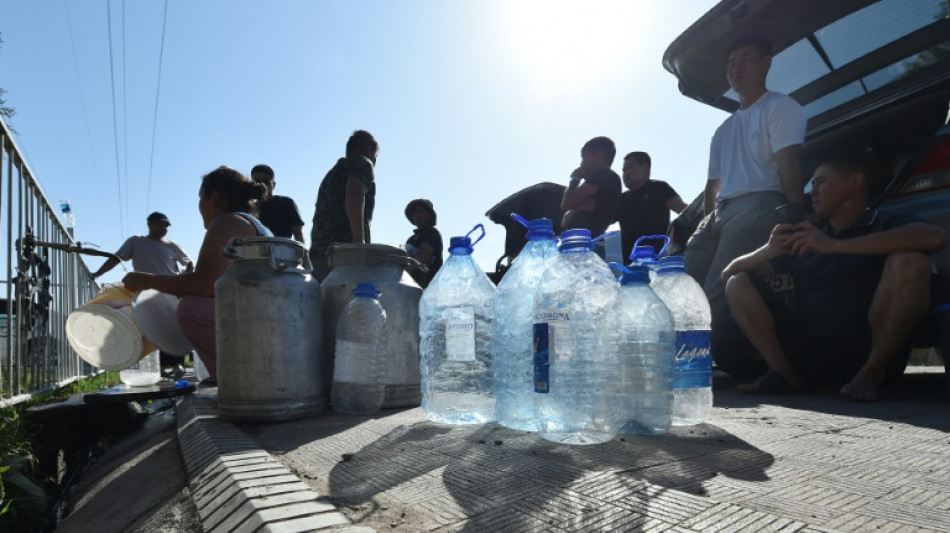
Drought hits Bishkek, where taps are running dry / Photo: © AFP

Drought hits Bishkek, where taps are running dry

For the past month, Bishkek resident Kanychai Bakirova has lived with her family of 11, including young children, in a home with only a trickle of water running from the tap.

Text size:

At the laundrette where she works, she is unable to serve customers who come in with piles of dirty clothes.

"I'm a laundress but I can only run three washing machines," 59-year-old Bakirova told AFP, waiting her turn to collect water at a distribution point as others took the opportunity to wash their faces.

In the south of the Kyrgyz capital, where the water shortage is acute, such scenes are increasingly common.

Drought -- once restricted to the country's villages -- is now drying city-dwellers' taps.

With Soviet-era water infrastructure and few resources, the Bishkek authorities have struggled to keep the water running.

In the southern districts of the city, residents have come to rely on plastic bottles of water distributed by the city as temperatures near 40 degrees Celsius (104 degrees Fahrenheit).

"I haven't had running water for more than three weeks," said Imach Omorov, 61.

"I was able to get 150 litres (33 gallons). Hopefully that's enough for the next three weeks."

At the start of summer, the authorities introduced restrictions to manage water supply.

In some districts of Bishkek, water was cut off at night.

Swimming pools and car washes were closed. Night-time watering was banned.

But residents have struggled to cope.

When Omorov's neighbour died, "it was complicated to wash the body", he said.

- A chronic problem -

Like other city-dwellers, Omorov took part in a protest against the water shortage this week, where demonstrators blocked one of the main avenues south of the capital.

His frustrations are shared across Central Asia, where water shortages are a chronic problem.

According to the World Bank, almost a third of the region's approximately 75 million inhabitants do not have access to water.

In Kyrgyzstan, where one million now lack access to water, consumption levels are rising.

"Daily water consumption per person was around 170 litres.

"But it has tripled -- almost quadrupled -- with the rise in temperatures since May," said Kadyrbek Otorov, chief engineer at the organisation in charge of water distribution in Bishkek.

One cause of the drought this year is the steep drop in the water table.

That, in turn, is caused by the melting of glaciers due to climate change.

"The level of groundwater, which provides water to 40-45 percent of the city, especially the south, has dropped by 15 to 20 metres (50-65 feet) compared to last year," said Otorov.

Bishkek has not seen such water scarcity "for eight to 10 years".

The country's water infrastructure dates back to the Soviet era.

While the authorities have allocated funds to update the water infrastructure, it has suffered from under-investment.

For now, scientist Otorov warns "there isn't an infinite supply of drinking water". Water must be used with "great care".

X.Silva--TFWP