The Fort Worth Press - Pill halves risk of death in type of lung cancer

USD -
AED 3.672504
AFN 64.503991
ALL 81.111622
AMD 361.140403
ANG 1.789785
AOA 917.000367
ARS 1523.143125
AUD 1.422273
AWG 1.8025
AZN 1.70397
BAM 1.747116
BBD 2.014302
BDT 123.686291
BGN 1.747831
BHD 0.377417
BIF 2997.811425
BMD 1
BND 1.278312
BOB 11.776424
BRL 4.977204
BSD 1.000138
BTN 94.895662
BWP 13.777424
BYN 2.936544
BYR 19600
BZD 2.011354
CAD 1.40015
CDF 2316.000362
CHF 0.824985
CLF 0.025294
CLP 995.510396
CNY 6.67805
CNH 6.670604
COP 3150.41
CRC 456.38687
CUC 1
CUP 24.002072
CVE 98.499703
CZK 21.719504
DJF 177.720393
DKK 6.67165
DOP 61.342898
DZD 134.335699
EGP 55.079216
ERN 15
ETB 162.670353
EUR 0.89267
FJD 2.237204
FKP 0.74735
GBP 0.747608
GEL 2.590391
GGP 0.74735
GHS 11.595977
GIP 0.74735
GMD 74.000355
GNF 8850.814466
GTQ 7.64486
GYD 209.461874
HKD 7.84235
HNL 26.849912
HRK 6.728204
HTG 131.07388
HUF 327.370388
IDR 18093.85
ILS 3.10555
IMP 0.74735
INR 94.92835
IQD 1516.108429
IRR 1832375.000352
ISK 121.780386
JEP 0.74735
JMD 158.719383
JOD 0.70904
JPY 156.860385
KES 129.830385
KGS 87.448604
KHR 4085.971557
KMF 439.503794
KPW 899.999961
KRW 1323.720383
KWD 0.31069
KYD 0.833452
KZT 454.080129
LAK 22505.002501
LBP 89558.797256
LKR 332.079753
LRD 170.513828
LSL 16.569461
LTL 2.95274
LVL 0.60489
LYD 6.404988
MAD 9.823308
MDL 18.051883
MGA 4522.797113
MKD 54.978355
MMK 2100.348965
MNT 3600.056668
MOP 8.079754
MRU 39.968913
MUR 47.160378
MVR 15.460378
MWK 1734.170657
MXN 18.668404
MYR 4.085304
MZN 63.903729
NAD 16.569461
NGN 1332.060377
NIO 36.803952
NOK 9.35739
NPR 151.832381
NZD 1.754386
OMR 0.383029
PAB 1.000054
PEN 3.434648
PGK 4.478945
PHP 63.618038
PKR 276.747271
PLN 3.92999
PYG 5784.116236
QAR 3.645557
RON 4.779804
RSD 105.321038
RUB 80.331771
RWF 1477.613807
SAR 3.754258
SBD 8.07458
SCR 13.984422
SDG 601.503676
SEK 9.931804
SGD 1.276804
SHP 0.7473
SLE 22.950371
SLL 20969.504398
SOS 571.530662
SRD 37.628038
STD 20697.981008
STN 21.885845
SVC 8.750765
SYP 13001.999685
SZL 16.568851
THB 33.740369
TJS 9.215947
TMT 3.51
TND 2.986391
TOP 2.40776
TRY 49.696304
TTD 6.795332
TWD 32.585804
TZS 2645.000335
UAH 45.276567
UGX 4405.754637
UYU 40.108624
UZS 11968.430785
VES 879.788904
VND 25842.5
VUV 118.928057
WST 2.764707
XAF 585.553409
XAG 0.018551
XAU 0.000250266221
XCD 2.70255
XCG 1.802403
XDR 0.707052
XOF 585.553409
XPF 106.534935
YER 236.103589
ZAR 16.57565
ZMK 9001.203584
ZMW 20.107375
ZWL 321.999592
SSP 5745.817056
MXV 2.106972
  • RIO

    -0.3300

    97.04

    -0.34%

  • CMSC

    -0.0400

    20.67

    -0.19%

  • RELX

    0.0000

    33.41

    0%

  • RBGPF

    0.0000

    67.95

    0%

  • BCE

    -0.0700

    21.99

    -0.32%

  • BCC

    -0.0300

    75.66

    -0.04%

  • GSK

    0.8600

    51.08

    +1.68%

  • JRI

    -0.0300

    11.52

    -0.26%

  • NGG

    -0.1200

    76.68

    -0.16%

  • CMSD

    0.0900

    20.54

    +0.44%

  • BTI

    -0.0800

    55.75

    -0.14%

  • AZN

    2.0200

    168.1

    +1.2%

  • BP

    -1.4200

    43.16

    -3.29%

  • RYCEF

    0.4600

    19.7

    +2.34%

  • VOD

    0.0700

    17.02

    +0.41%

Pill halves risk of death in type of lung cancer
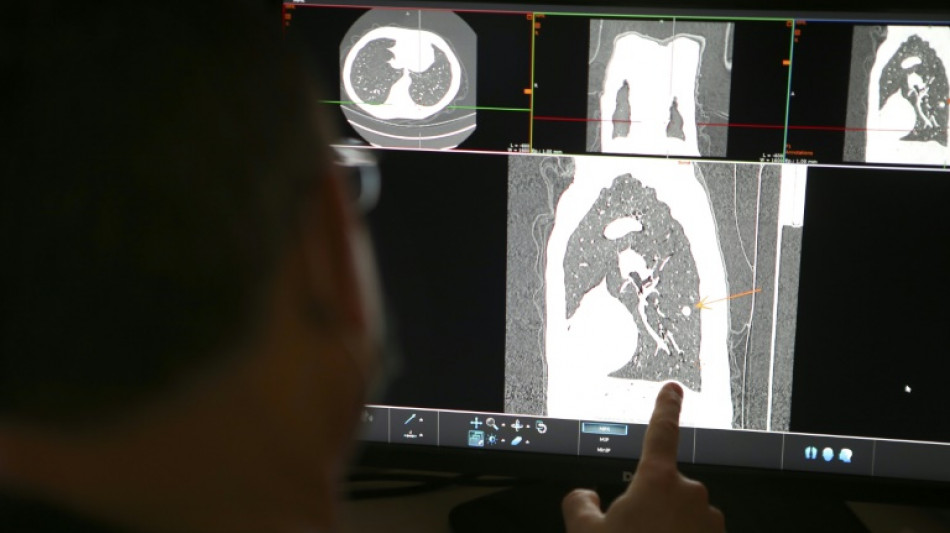
Pill halves risk of death in type of lung cancer / Photo: © AFP

Pill halves risk of death in type of lung cancer

A pill has been shown to halve the risk of death from a certain type of lung cancer when taken daily after surgery to remove the tumor, according to clinical trial results presented on Sunday.

Text size:

The results were unveiled in Chicago at the largest annual conference of cancer specialists, hosted by the American Society for Clinical Oncology (ASCO).

Lung cancer is the form of the disease that causes the most deaths, with approximately 1.8 million fatalities every year worldwide.

The treatment developed by the pharmaceutical group AstraZeneca is called osimertinib and is marketed under the name Tagrisso. It targets a particular type of lung cancer in patients suffering from so-called non-small cell cancer, the most common type, and showing a particular type of mutation.

These mutations, on what is called the epidermal growth factor receptor, or EGFR, affect 10 percent to 25 percent of lung cancer patients in the United States and Europe, and 30 to 40 percent in Asia.

The clinical trial included some 680 participants at an early stage of the disease (stages 1b to 3a), in more than 20 countries. They had to have been operated on first to remove the tumor, then half of the patients took the treatment daily, and the other a placebo.

The result showed that taking the tablet resulted in a 51 percent reduction in the risk of death for treated patients, compared to placebo.

After five years, 88 percent of patients who took the treatment were still alive, compared to 78 percent of patients who took the placebo.

These data are "impressive," said Roy Herbst of Yale University, who presented them in Chicago. The drug helps "prevent the cancer from spreading to the brain, to the liver, to the bones," he added at a press conference.

About a third of cases of non-small cell cancers can be operated on when detected, he said.

- Already on the market -

"It is hard for me to convey, I think, how important this finding is," said Nathan Pennell of the Cleveland Clinic Foundation at the press conference.

"We started entering the personalized therapy era for early stage patients," said Pennell, who did not take part in the trials, and noted that "we should firmly close the door on one-size-fits-all treatment for people with non- small cell lung cancer."

Osimertinib is already authorized in dozens of countries for various indications, and has already been given to some 700,000 people, according to a press release from AstraZeneca.

Its approval in the United States for early stages in 2020 was based on previous data that showed an improvement in patient disease-free survival, that is, the time a patient lives without a recurrence of cancer.

But not all doctors have adopted the treatment, and many were waiting for the data on overall survival that was presented on Sunday, said Herbst.

He stressed the need to screen patients to find out if they have the EGFR mutation. Otherwise, he said, "we cannot use this new treatment."

Osimertinib, which targets the receptor, causes side effects that include as severe fatigue, skin rashes or diarrhea.

A.Nunez--TFWP