The Fort Worth Press - India to pass China this week as world's most populous nation: UN

USD -
AED 3.672501
AFN 65.000326
ALL 80.892919
AMD 361.32971
ANG 1.789785
AOA 916.999859
ARS 1525.770399
AUD 1.426076
AWG 1.80125
AZN 1.700372
BAM 1.745603
BBD 2.015941
BDT 123.789462
BGN 1.747831
BHD 0.377732
BIF 3002.048312
BMD 1
BND 1.278595
BOB 11.765756
BRL 5.0436
BSD 1.000919
BTN 94.841883
BWP 13.749922
BYN 2.959737
BYR 19600
BZD 2.012996
CAD 1.40324
CDF 2316.000101
CHF 0.821855
CLF 0.024903
CLP 980.119732
CNY 6.67805
CNH 6.673525
COP 3197.66
CRC 456.813374
CUC 1
CUP 24.020564
CVE 98.41267
CZK 21.64665
DJF 178.22224
DKK 6.669799
DOP 61.426136
DZD 134.856023
EGP 55.181899
ERN 15
ETB 163.9445
EUR 0.89233
FJD 2.24975
FKP 0.746996
GBP 0.747575
GEL 2.590175
GGP 0.746996
GHS 11.600632
GIP 0.746996
GMD 72.99968
GNF 8858.324817
GTQ 7.649259
GYD 209.368334
HKD 7.83968
HNL 26.867244
HRK 6.728601
HTG 131.144176
HUF 326.895018
IDR 18074
ILS 3.107096
IMP 0.746996
INR 94.803897
IQD 1517.355874
IRR 1832375.000007
ISK 121.479582
JEP 0.746996
JMD 158.89648
JOD 0.709062
JPY 157.024498
KES 129.806428
KGS 87.449101
KHR 4071.869115
KMF 439.501063
KPW 899.999961
KRW 1324.496669
KWD 0.31046
KYD 0.834099
KZT 448.369735
LAK 22529.164472
LBP 89631.371779
LKR 332.234038
LRD 170.644961
LSL 16.508029
LTL 2.95274
LVL 0.60489
LYD 6.41191
MAD 9.82386
MDL 17.976204
MGA 4538.679186
MKD 54.926488
MMK 2100.035197
MNT 3598.866322
MOP 8.08237
MRU 39.995002
MUR 47.11987
MVR 15.459594
MWK 1735.587351
MXN 18.75362
MYR 4.083994
MZN 63.903439
NAD 16.507071
NGN 1331.889945
NIO 36.836045
NOK 9.35976
NPR 151.747191
NZD 1.760055
OMR 0.384506
PAB 1.000919
PEN 3.438519
PGK 4.482268
PHP 63.519501
PKR 277.015213
PLN 3.898945
PYG 5738.944945
QAR 3.658368
RON 4.769403
RSD 104.893972
RUB 81.501091
RWF 1479.33272
SAR 3.742715
SBD 8.07458
SCR 13.775995
SDG 601.503214
SEK 9.91506
SGD 1.277575
SHP 0.7473
SLE 23.920227
SLL 20969.504398
SOS 572.043164
SRD 37.735503
STD 20697.981008
STN 21.867776
SVC 8.757313
SYP 13001.999685
SZL 16.505197
THB 33.741501
TJS 9.203388
TMT 3.51
TND 2.982913
TOP 2.40776
TRY 49.617098
TTD 6.792399
TWD 32.558968
TZS 2646.654982
UAH 45.101592
UGX 4288.761748
UYU 40.127988
UZS 11917.905419
VES 879.788897
VND 25851.5
VUV 118.676507
WST 2.769234
XAF 585.330098
XAG 0.017878
XAU 0.000245845518
XCD 2.70255
XCG 1.803868
XDR 0.707052
XOF 585.330098
XPF 106.446977
YER 236.097801
ZAR 16.5147
ZMK 9001.198572
ZMW 20.093362
ZWL 321.999592
SSP 5745.343966
MXV 2.116716
  • RIO

    -0.3300

    97.04

    -0.34%

  • CMSC

    -0.0400

    20.67

    -0.19%

  • RELX

    0.0000

    33.41

    0%

  • RBGPF

    0.0000

    67.95

    0%

  • BCE

    -0.0700

    21.99

    -0.32%

  • BCC

    -0.0300

    75.66

    -0.04%

  • GSK

    0.8600

    51.08

    +1.68%

  • JRI

    -0.0300

    11.52

    -0.26%

  • NGG

    -0.1200

    76.68

    -0.16%

  • CMSD

    0.0900

    20.54

    +0.44%

  • BTI

    -0.0800

    55.75

    -0.14%

  • AZN

    2.0200

    168.1

    +1.2%

  • BP

    -1.4200

    43.16

    -3.29%

  • RYCEF

    0.4600

    19.7

    +2.34%

  • VOD

    0.0700

    17.02

    +0.41%

India to pass China this week as world's most populous nation: UN
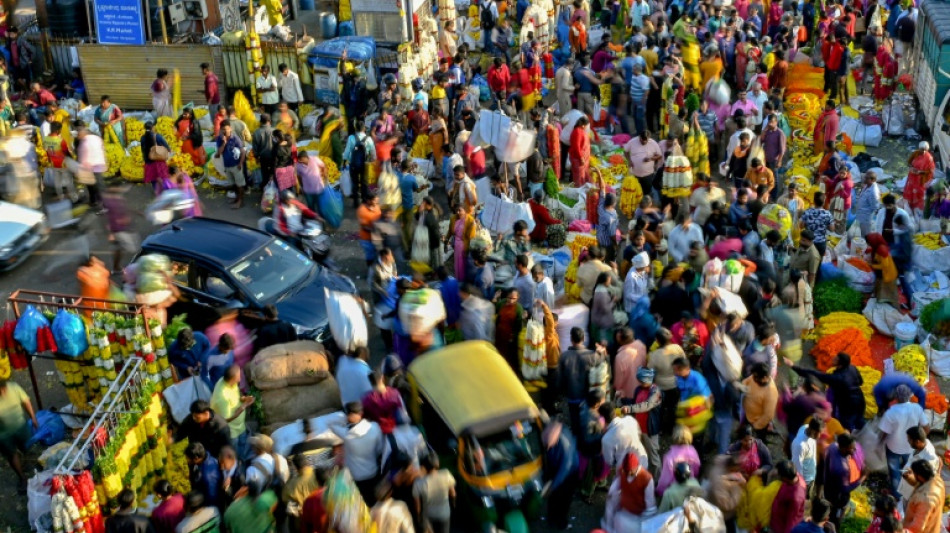
India to pass China this week as world's most populous nation: UN / Photo: © AFP/File

India to pass China this week as world's most populous nation: UN

India will overtake China as the world's most populous country in the coming week, hitting almost 1.43 billion people, the United Nations said Monday.

Text size:

"By the end of this month, India's population is expected to reach 1,425,775,850 people, matching and then surpassing the population of mainland China," the UN Department of Economic and Social Affairs said.

Last week the UN's annual State of World Population report had said the milestone would come by midyear 2023.

India is topping China due to both rapid growth in its own population and a decline in China's after hitting 1.426 billion last year.

Regarded as the world's most heavily populated country since the fall of the Roman Empire in the 5th Century CE, China is expected to decline steadily to around one billion people by the end of this century, according to UN projections.

China's fall is heavily tied to decades of maintaining a strict one-child policy for married couples, which ended in 2016.

In addition, its falling birth rates are also attributed to the rising cost of living and the growing number of Chinese women going into the workforce and seeking higher education.

Meanwhile, India's population "is virtually certain" to continue to grow in the coming decades, according to the United Nations.

Last year, China's fertility rate fell to one of the lower levels in the world at 1.2 births per woman.

For India, which has taken much longer than China to get population growth under control, the fertility rate was 2.0 births per woman, just below the 2.1 replacement level.

"India's lower human capital investment and slower economic growth during the 1970s and 1980s contributed to a more gradual fertility decline than in China," the UN said.

Both countries must confront rapidly ageing populations, China more so than India.

India faces huge challenges providing electricity, food and housing for its growing population, with many of its massive cities already struggling with water shortages, air and water pollution, and packed slums.

Surpassing China shines a spotlight on the challenge facing Prime Minister Narendra Modi to provide jobs for the millions of young people entering the job market every year.

Meanwhile China's economy is increasingly challenged to fill positions due to its ageing population.

Beijing said last week that its national strategy is designed "to actively respond to population ageing, promotes the three-child birth policy and supporting measures, and actively responds to changes in population development."

"China's demographic dividend has not disappeared. The talent dividend is taking shape, and development momentum remains strong," said foreign ministry spokesman Wang Wenbin.

M.Cunningham--TFWP