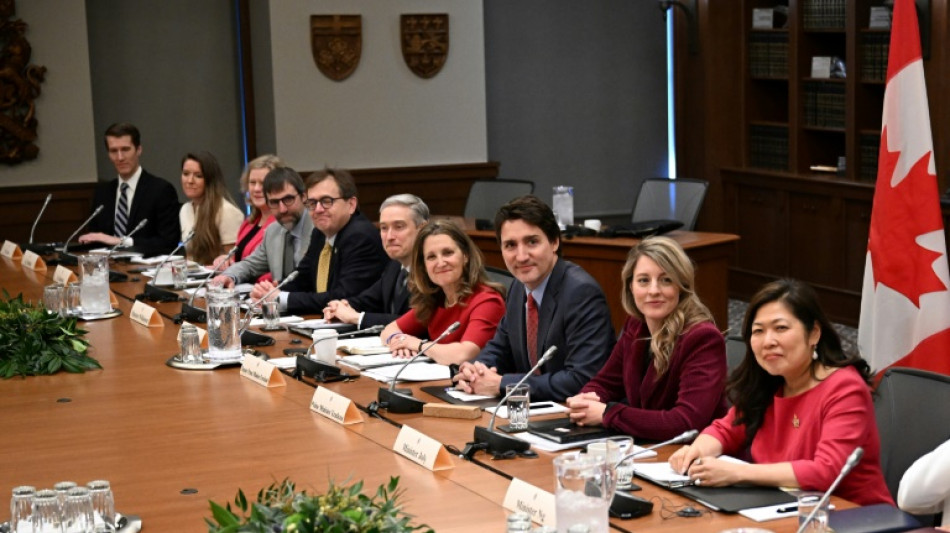
Canada budget doles out incentives for clean economy / Photo: © AFP

Canada unveiled a budget on Tuesday that aims to make it a clean energy "superpower" and secure a leading place in global supply chains for critical minerals and electric vehicles.
The basket of measures -- including 15 to 30 percent tax credits to spur new investments in tidal and nuclear energy, for example, as well as the extraction of critical minerals for EV batteries -- seeks to narrow a gap with major US subsidies.
The Canadian incentives, expected to cost about Can$80 billion (US$50 billion) over a decade, build on previous tax credits and investments in "clean economy" projects such as the production of hydrogen from renewable sources.
The upbeat budget however included scaled back expectations for economic growth this year, including a possible worst-case scenario of a shallow recession.
Finance Minister Chrystia Freeland said in a speech to parliament that the world is undergoing "the most significant economic transformation since the Industrial Revolution" as it moves to fight climate change.
"Today, and in the years to come, Canada must either meet this historic moment -- this remarkable opportunity before us -- or we will be left behind as the world's democracies build the clean economy of the 21st century," she said.
Green technology production has taken on greater urgency after the United States unveiled a US$370 billion program of tax credits and subsidies for electric vehicles, batteries and renewable energy projects.
According to the International Energy Agency, the clean technology sector is expected to be worth over US$630 billion worldwide by 2030, more than three times the current level.
China currently dominates in many of the sectors including semiconductors, critical minerals, batteries and solar panels.
Freeland noted that Canada's allies are moving to "friendshore their economies" and build critical supply chains with likeminded democracies.
Ottawa has been wooing investments in advanced lithium-ion batteries manufacturing for electric vehicles and critical minerals mining.
Earlier this month, German auto giant Volkswagen announced it was building its first North American battery factory in St. Thomas, Ontario.
Stellantis and LG Energy Solution have also partnered on a new battery plant in Canada.
Ottawa's budget earmarked billions of dollars to lure more private investments in the sector, and announced it would backstop future energy and tradable carbon credit prices in case market rates fall below contracted minimums.
"We are going to make Canada a reliable supplier of clean energy to the world, and, from critical minerals to electric vehicles, we are going to ensure that Canadian workers mine, and process, and build, and sell the goods and the resources that our allies need," Freeland said.
- Recession fears -
According to a worst-case scenario outlined in the budget document, Canada could fall into a "shallow recession" this year, but Ottawa is planning for a slightly brighter outlook.
Private sector economists surveyed by Ottawa forecast gross domestic product ranging from a contraction of 0.2 percent to growth of 1.6 percent.
The government pegged growth at just 0.3 percent this year, rebounding to 1.5 percent in 2024 -- both down from previous estimates -- following 3.4 percent in 2022.
Freeland's budget offers targeted inflation relief such as a grocery rebate for "the most vulnerable (Canadians) still feeling the bite of higher prices."
She also highlighted monies recently announced for health care, and a new dental care plan for up to nine million uninsured Canadians.
The government, meanwhile, vowed to crack down on unexpected hidden fees for services and predatory lending, and to bring in "right to repair" rules for electronics and home appliances, as well as common charging standards for phones and computers -- similar to the EU -- to cut consumer costs and electronics waste.
Freeland had already hugely slashed spending in previous years after doling out significant pandemic aid that pushed the national debt to a record Can$1.2 trillion (US$880 billion).
On Tuesday, she reported a lower deficit in fiscal 2023-2024 than originally expected to Can$40.1 billion (US$29.5 billion).
Canada's debt-to-GDP ratio, meanwhile, is expected to rise slightly to 43.5 percent before falling in subsequent years.
J.M.Ellis--TFWP