The Fort Worth Press - Let them eat bread: the origins of the baguette

USD -
AED 3.673008
AFN 64.503214
ALL 80.819685
AMD 361.405228
ANG 1.789785
AOA 917.000132
ARS 1525.743205
AUD 1.42204
AWG 1.80125
AZN 1.694926
BAM 1.741787
BBD 2.015015
BDT 123.745402
BGN 1.747831
BHD 0.377604
BIF 3000.997453
BMD 1
BND 1.278059
BOB 11.730759
BRL 5.0336
BSD 1.000472
BTN 94.559477
BWP 13.70595
BYN 2.971479
BYR 19600
BZD 2.012094
CAD 1.40468
CDF 2315.999614
CHF 0.823985
CLF 0.02484
CLP 977.639757
CNY 6.67805
CNH 6.673855
COP 3194.48
CRC 455.529135
CUC 1
CUP 24.010794
CVE 98.199695
CZK 21.58565
DJF 177.720049
DKK 6.651515
DOP 61.440772
DZD 134.600855
EGP 54.383604
ERN 15
ETB 163.87083
EUR 0.88984
FJD 2.253797
FKP 0.747587
GBP 0.74635
GEL 2.589651
GGP 0.747587
GHS 11.660299
GIP 0.747587
GMD 73.49688
GNF 8854.987666
GTQ 7.645587
GYD 209.311853
HKD 7.846885
HNL 26.857072
HRK 6.703799
HTG 131.084908
HUF 325.065498
IDR 18027.05
ILS 3.088402
IMP 0.747587
INR 94.43255
IQD 1516.6493
IRR 1832374.999738
ISK 121.269746
JEP 0.747587
JMD 158.780625
JOD 0.709015
JPY 158.134988
KES 129.859579
KGS 87.449845
KHR 4068.146802
KMF 439.503571
KPW 899.999961
KRW 1325.979763
KWD 0.31018
KYD 0.833753
KZT 446.890557
LAK 22518.390538
LBP 89591.044298
LKR 332.14739
LRD 170.580744
LSL 16.412051
LTL 2.95274
LVL 0.60489
LYD 6.419294
MAD 9.819615
MDL 17.998442
MGA 4521.489767
MKD 54.903951
MMK 2099.21541
MNT 3597.533576
MOP 8.085932
MRU 40.128421
MUR 47.319959
MVR 15.459751
MWK 1734.751129
MXN 18.645615
MYR 4.081198
MZN 63.902977
NAD 16.412051
NGN 1331.830194
NIO 36.816372
NOK 9.371645
NPR 151.295341
NZD 1.75332
OMR 0.384501
PAB 1.000481
PEN 3.438421
PGK 4.479652
PHP 63.399499
PKR 276.89823
PLN 3.87625
PYG 5756.677086
QAR 3.647261
RON 4.753003
RSD 104.53802
RUB 82.104013
RWF 1478.615162
SAR 3.748965
SBD 8.07458
SCR 13.97401
SDG 601.492558
SEK 9.878845
SGD 1.27707
SHP 0.7473
SLE 23.919966
SLL 20969.504398
SOS 571.749178
SRD 37.735499
STD 20697.981008
STN 21.819089
SVC 8.754392
SYP 13001.999685
SZL 16.418788
THB 33.570497
TJS 9.214157
TMT 3.51
TND 2.986543
TOP 2.40776
TRY 49.598465
TTD 6.792416
TWD 32.411301
TZS 2644.999678
UAH 45.047334
UGX 4207.076509
UYU 40.164934
UZS 11975.562621
VES 879.788897
VND 25856.5
VUV 119.136032
WST 2.774679
XAF 583.696876
XAG 0.017313
XAU 0.000241628771
XCD 2.70255
XCG 1.803058
XDR 0.707052
XOF 583.696876
XPF 106.20998
YER 236.101147
ZAR 16.360597
ZMK 9001.202969
ZMW 20.069287
ZWL 321.999592
SSP 5787.554334
MXV 2.10465
  • RIO

    -0.3300

    97.04

    -0.34%

  • CMSC

    -0.0400

    20.67

    -0.19%

  • RELX

    0.0000

    33.41

    0%

  • RBGPF

    0.0000

    67.95

    0%

  • BCE

    -0.0700

    21.99

    -0.32%

  • BCC

    -0.0300

    75.66

    -0.04%

  • GSK

    0.8600

    51.08

    +1.68%

  • JRI

    -0.0300

    11.52

    -0.26%

  • NGG

    -0.1200

    76.68

    -0.16%

  • CMSD

    0.0900

    20.54

    +0.44%

  • BTI

    -0.0800

    55.75

    -0.14%

  • AZN

    2.0200

    168.1

    +1.2%

  • BP

    -1.4200

    43.16

    -3.29%

  • RYCEF

    0.4600

    19.7

    +2.34%

  • VOD

    0.0700

    17.02

    +0.41%

Let them eat bread: the origins of the baguette
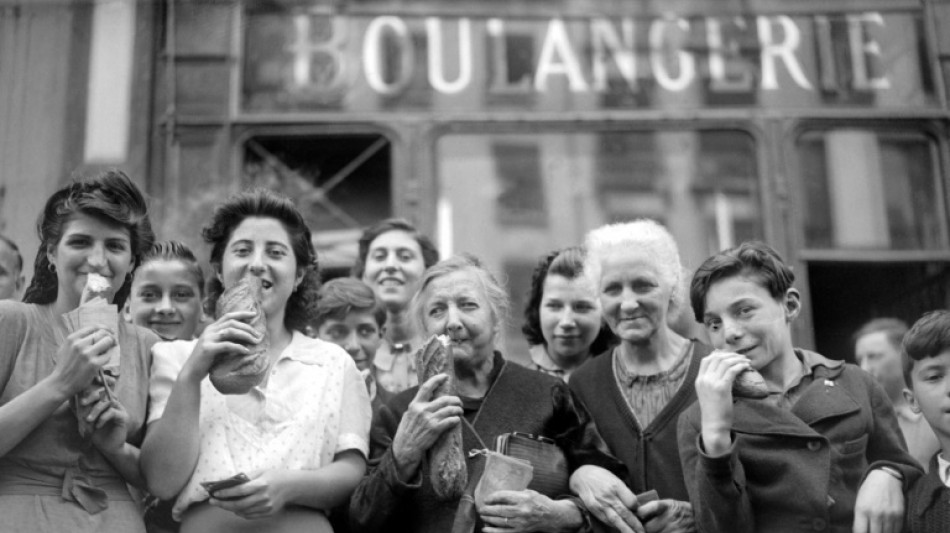
Let them eat bread: the origins of the baguette / Photo: © AFP/File

Let them eat bread: the origins of the baguette

It is as much a part of French culture as the Eiffel Tower or Edith Piaf but the origins of the humble baguette, which UNESCO on Wednesday added to its List of Intangible Cultural Heritage, remain a mystery.

Text size:

Here are some of the more popular theories:

- Napoleon's bread of war -

The oldest tale has the baguette being kneaded by bakers in Napoleon's army. Less bulky than a traditional loaf, the long slim shape of the baguette made it faster to bake in brick ovens hastily erected on the battlefield.

France's most famous man of war was preoccupied with getting his men their daily bread.

During his Russian campaign in 1812, he toured the ovens daily to sample the day's offering and ensure the crusty batons were being distributed regularly, according to historian Philippe de Segur.

He also had portable bread mills sent to occupied Moscow, but the setbacks suffered by the Grande Armee in one of the deadliest military campaigns in history ended his bid to export the doughy staple.

- The Viennese connection -

Another theory has the baguette starting out in a Viennese bakery in central Paris in the late 1830s.

Artillery officer and entrepreneur August Zang brought Austria's culinary savoir-faire to Paris in the form of the oval-shaped bread that were standard in his country at the time.

According to the Compagnonnage des boulangers et des patissiers, the French bakers' network, Zang decided to make the loaves longer to make them easier for the city's breadwomen to pluck from the big carts they pushed through the city's streets.

- Breaking bread -

Another theory has the baguette being born at the same time as the metro for the 1900 Paris Exposition.

People from across France came to work on the underground and fights would often break out on site between labourers armed with knives, which they used to slice big round loaves of bread for lunch.

According to the herodote.net history site, to avoid bloodshed, one engineer had the idea of ordering longer loaves that could be broken by hand.

- Early rising -

In 1919, a new law aimed to improve the lives of bakers by banning them from working from 10 pm to 4 am.

The reform gave them less time to prepare the traditional sourdough loaf for the morning, marked the widespread transition to what was called at the time the yeast-based "flute", which rose faster and was out of the oven in under half an hour.

Standardised at 80 centimeters (30 inches) and 250 grams (eight ounces) with a fixed price until 1986, the baguette was initially the mainstay of wealthy metropolitans, but after World War II became the emblem of all French people.

M.McCoy--TFWP