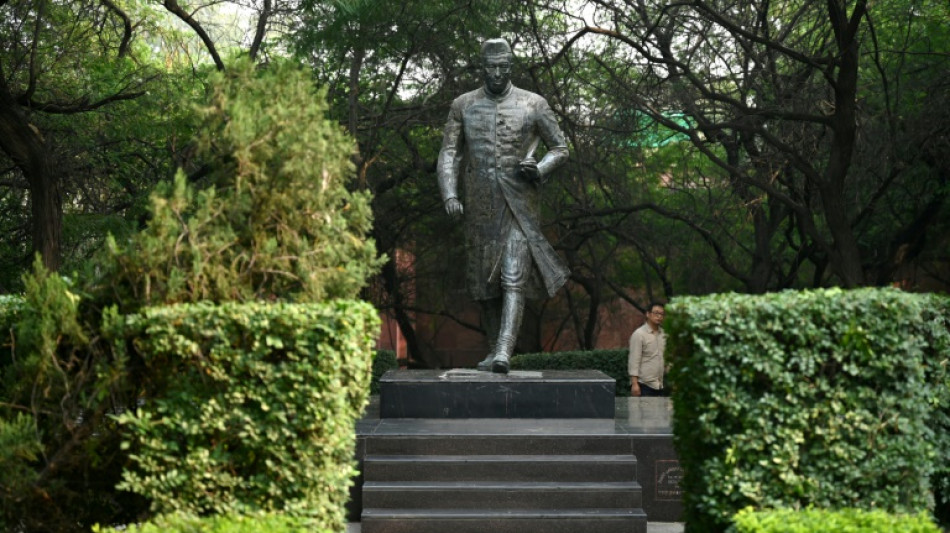
India at 75: upending narratives and rewriting history / Photo: © AFP

The palatial family home of India's first prime minister Jawaharlal Nehru, the freedom struggle stalwart and close confidant of Mahatma Gandhi, is now a museum where loyalists come to pay tribute.
But 75 years after independence, that history is being rewritten across the country as the ruling Bharatiya Janata Party (BJP) seeks to promote its own Hindu nationalist agenda.
Critics accuse the BJP of upending settled narratives to fit its outlook, promoting the roles of its ideological forebears, and downgrading the contributions of Muslims to Indian history and society.
The BJP ousted Nehru's Congress party at elections in 2014, after the dynasty he founded had dominated Indian politics for decades.
His daughter Indira Gandhi, who grew up in the house, and grandson Rajiv both went on to become prime ministers.
Today, whether the emperor Akbar –- of the Muslim Mughal dynasty that ruled India for 300 years –- won or lost a key battle against a revered Hindu king depends on which textbook is being used.
At the launch of a book on Hindu kings' resistance to the Mughals, home minister Amit Shah -- a key ally of Prime Minister Narendra Modi -- declared: "No one can stop us from writing the truth. We are now independent. We can write our own history."
And the city where Nehru's house stands has been renamed Prayagraj, after being known for 450 years as Allahabad, a moniker bestowed by Akbar.
According to Vinod Mishra, who has worked there for 15 years, the building's visitors illustrate the changing approaches to history.
"Earlier everyone came here in awe and admiration but now many look at the home, his belongings, and quip that he too made a lot of money like other [corrupt] politicians," Mishra told AFP.
Older visitors "still enter each room and reverentially touch the feet of Nehru's portraits", he said, but younger generations are more irreverent.
"It's fascinating to see that he had things like a tennis racket, tea kettle, a shaver and even went to London, which most people still can't afford," said engineering student Amar Yadav, 18.
- 'Imaginary barbaric past' -
Often accused of anti-Muslim rhetoric, BJP leaders have described the Mughals as Islamic invaders, increasing the anxieties of the country's 210-million-odd Muslims.
But they say the authors who dominated historiography after independence from Britain in 1947 glorified conquerors over local kings and achievements.
And they say they over-emphasised Congress's role in the independence struggle, denying the more revolutionary or nationalist figures the BJP reveres their due.
Modi often criticises Nehru -- blaming him for the festering dispute over Kashmir, or losing a 1962 war to China -- to target Congress, still the main opposition party and controlled by the Nehru-Gandhi family.
The BJP's efforts to rewrite the past "aren't just about history but securing its own place in the present for the next few decades", S. Irfan Habib, a New Delhi-based historian told AFP.
"It's dangerous as these books mould young minds who'll grow with a very different understanding of India," Habib said.
"The government in power has full majority and there's nothing much one can do," he added.
Contemporary history is also being reworked, say Indian media: a top official body slashed school textbook content this year.
Among the deletions were the Gujarat riots that killed at least 1,000 people, mostly Muslims, in 2002 -- when Modi was the state's premier.
It was one of India's worst outbreaks of religious violence in recent times, and one removed passage reportedly warned that such events "alert us to the dangers involved in using religious sentiments for political purposes".
- 'Insult to India' -
The states of Haryana and Gujarat have announced the addition of a Hindu holy book to the school curriculum, despite the education system being secular.
A Karnataka textbook incorporated a speech by the founder of the right-wing Rashtriya Swayamsewak Sangh, the BJP's ideological fountainhead.
Rahul Gandhi, Nehru's great-grandson and a Congress party leader, slammed it as an "attempt to teach children saffronised lessons... an insult to India, which is the cradle of diversity".
Saffron, the sacred colour of Hindu monks' robes, is a part of the BJP flag.
Another book in the same state claimed that Vinayak Damodar Savarkar, a right-wing revolutionary jailed by the British, made regular excursions from his jail cell on the wings of small birds.
Savarkar's biographer Vikram Sampath condemned the "stupid insertion".
He is one of the young historians who support "decolonisation" of Indian history, but want to see quality maintained during revisions.
India was "slowly maturing as a democracy", he said, hoping for a time when "historical characters won't get caught in the slug fest of contemporary electoral politics".
- 'Greatest con job' -
For some, the history textbook changes fit into the ruling party's agenda of appealing to the country's Hindu majority.
The BJP has backed several big-ticket projects including a grand temple corridor in Varanasi, a mega statue to a Hindu warrior king who successfully challenged the Mughals, and a grand temple at the Ayodhya site where zealots destroyed a Mughal-era mosque three decades ago.
Now emboldened right-wing groups have laid fresh claims to several Muslim sites they say were built atop temples destroyed during Islamic rule, raising fears of violence.
Some of them question the contributions of non-Hindu rulers, and the merits of secularism in an overwhelmingly Hindu country of about 1.4 billion people.
"What did the Islamic invasions do for this country in 1,400 years of onslaught?" said Omendra Ratnu, who wrote the book launched by home minister Shah.
"They built three buildings -- Taj Mahal, Red Fort and the Qutub Minar -- and all three are disputed, have Hindu claims," he told AFP.
Mainstream Indian history was a "con job ... by some very crafty and wicked people", he said, adding textbook revisions were "baby steps -- but steps in the right direction".
N.Patterson--TFWP