Yayoi Kusama: Japan's kaleidoscopic, troubled 'polka dot queen' / Photo: © GETTY IMAGES NORTH AMERICA/AFP

The dotty pumpkins and kaleidoscope rooms of Yayoi Kusama, who has died aged 97, were as vibrant as the artist herself, but her exuberant work was the expression of a long battle with mental illness.
Once a fixture of the 1960s pop and minimalist scenes in New York, Japan's "polka dot queen" found huge commercial success in her later decades.
Her larger-than-life paintings, sculptures and installations -- inspired by vivid hallucinations -- sold for millions of dollars and packed out top galleries.
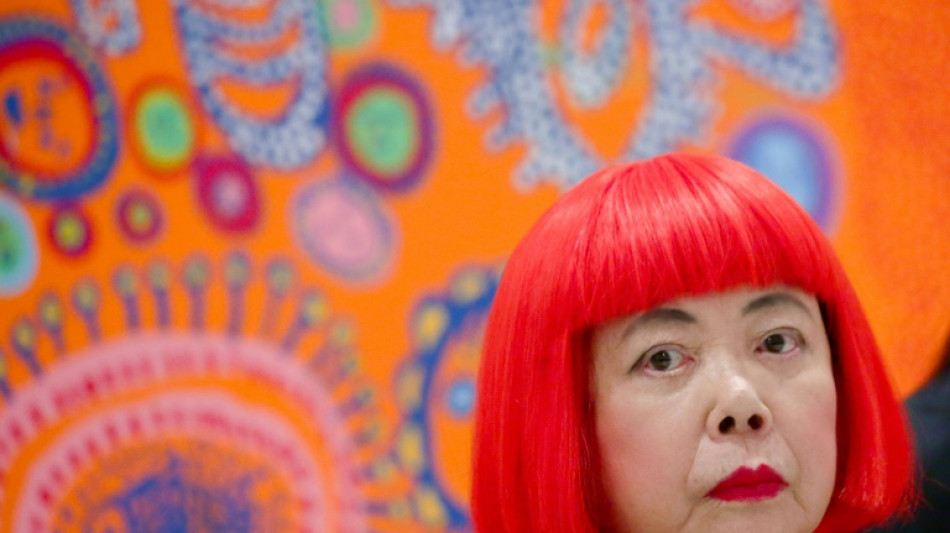
Kusama, instantly recognisable in her bright red wig and bold spotted outfits, worked well into old age from the psychiatric hospital in Tokyo where she lived voluntarily for the second half of her life.
But she also struggled with her feelings for her home country, which she left for decades and once described as "full of disdain for women".
Born in 1929, the youngest daughter of a wealthy but troubled family, Kusama began producing her signature dot and net patterns aged 10.
"My mother had regrets about my birth, and I was driven to the edge psychologically," she wrote in her autobiography, "A Personal History of Polka Dots".
"One day, after seeing a tablecloth with a red flower pattern on a desk, I saw the same red flower pattern all over the ceiling, windows and pillars. It filled the room, and covered my body."
Art provided a release for the young Kusama, whose father, a seedling merchant, was unfaithful to her mother.
"When I was sad or lonely, everything would be cured when I drew pictures," she said.
In the book, Kusama explained her concept of "self-obliteration" -- a recurrent theme throughout her career.
"I put dots all over my body and make all the surroundings dot patterns. By creating the same thing over and over, my own existence is buried in the art."
- 60s 'happenings' -
Kusama studied Japanese painting in Kyoto, against her parents' wishes, and held her first solo exhibition in 1952 in her hometown of Matsumoto in central Japan.
At the show, she met a psychiatrist who advised her to go and work abroad -- an idea that appealed to her.
"Japan was so small, vulgar, feudalistic and full of disdain for women," said the artist.
"I was born and raised in Japan, but I'm not influenced by Japanese culture and tradition."
The decisive push to pack her bags came when she wrote to modernist painter Georgia O'Keeffe, who encouraged Kusama to seek international recognition in the United States.
Kusama moved to Seattle in 1957 and then to New York, where she struggled to find her place as an Asian artist in the city's largely white, male-dominated creative scene.
"I was at the lowest point of poverty. One time, I couldn't eat for three days because I had no money," she once told Japan's Asahi Shimbun newspaper.
"I even ate the breadcrumbs left by the pigeons."
But she persevered, and during her 16 years in New York became a prominent name in the avant-garde world.
At the height of the 1960s sexual liberation movement, she would stage "happenings", where people stripped naked on Wall Street or in Central Park and had their bodies painted with polka dots.
She also launched a fashion line, established a "Church of Self-Obliteration" and styled herself the "High Priestess of Polka Dots" to officiate at a gay wedding.
- Global fame -
By the time she returned to Japan in 1973, however, Kusama was burned out, and checked herself into a psychiatric ward where she lived for the rest of her life.
And it was not until the 1990s that her vivid patterns, bold floral shapes and shiny steel orbs hit the mainstream, later providing the backdrop to countless selfies.
Pumpkins are her most famous motif, featuring heavily in her paintings and giant sculptures.
The artist called them her "life partners", saying she had first grown to love their "generous, unpretentious looks" as a child.
Kusama was named the world's most popular artist in 2014 by The Art Newspaper.
She was also one of the most expensive, with one of her "infinity net" paintings fetching nearly $8 million at a 2019 auction.
But fame and fortune did not affect her remarkable originality, which she once attributed to the "serenity of the soul" that comes from spending time alone.
"Creative thinking is born of loneliness... because I stood before the art all alone, I was able to forge my own path," Kusama said.
She published several novels in her later years, while her exhibitions continued to draw huge crowds.
"My wish after my death is that the eternally bright future, the beauty of human love and my soul will be passed on," Kusama told reporters in 2017.
"Please love my artwork, even after I die."
D.Johnson--TFWP