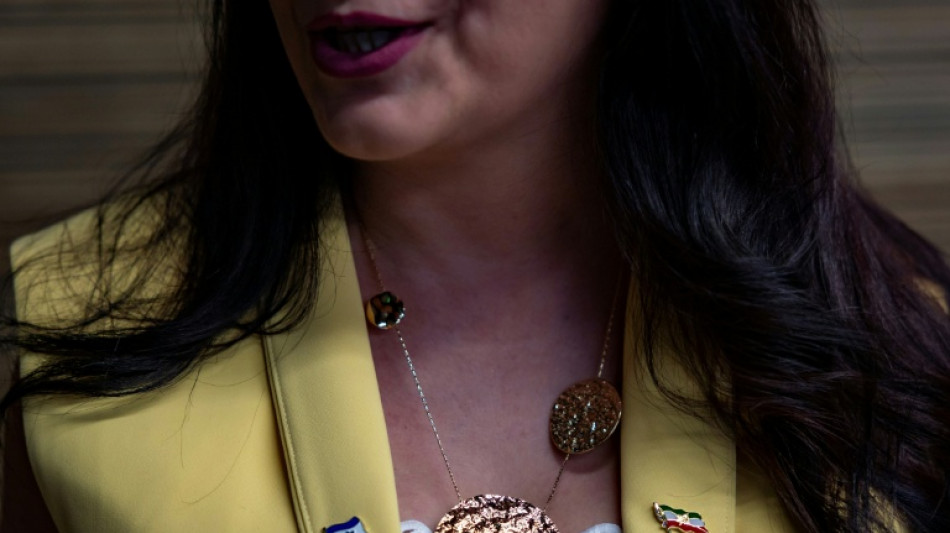
'Ticket to Tehran': Iranian Jews in Israel still long for Iran / Photo: © AFP

For Sahar Saidian, past and present collide every day on the airwaves as she hosts a Persian-language show on Israeli public radio for listeners in Israel and in Iran, the country she left behind years ago.
"After 26 years in Israel, I look more Israeli than Iranian, but even though I left Iran, the country is still part of me," Saidian told AFP.
The two countries are now at war. The Middle East conflict began on February 28 when Israel and the United States attacked Iran.
Saidian, who was wearing two pins on her lapel -- an Israeli flag and an Iranian one from before the 1979 Islamic revolution -- cries openly when talking about her native country, which she said she misses every day.
If there were to be a football match between Israel and Iran, Saidian said she was not sure which side she would support.
"We're like children with divorced parents: you love your mother and father equally," the 45-year-old said.
Born in southern Iran's Shiraz, the hometown of the renowned Persian poet Hafez, Saidian emigrated to Israel in 1998 at the age of 18, followed by her parents a few years later.
Before the Middle East war began, she hosted a one-hour weekly show on Reka radio, part of the public broadcaster KAN, that could be heard between programmes in Spanish and Russian.
But since March 1, she has broadcast from KAN's studios in Jerusalem every day.
"Greetings to all those who seek the path of freedom, and to the loyal listeners of Radio KAN Farsi. This is Sahar, and today we're with you for a special programme packed with content," she begins, before introducing her guests, Iranians in exile like the singer Shahin Najafi.
- 'Jewish in Iran' -
On Wednesday, while Najafi was speaking, Saidian interrupted her when 86-year-old Menashe Amir, a legend among Iranian Jews, visited the studio.
Amir, who created Saidian's radio show in 1960 and recently retired, declared his hope for an uprising in Iran that he believes would save not only "the Iranian nation" but "the world".
"When I was a child, I remember that my dad would take out his radio at 5:00 pm and tell us all to be quiet because he wanted to listen to Mr Amir," Saidian told him.
"My suitcase is packed in my head," she said, explaining that she has yearned to reconnect with everything that she misses about Iran: "the atmosphere, the streets, the neighbours, friends, everything".
More than 300,000 Jews of Iranian origin are thought to live in Israel today, the vast majority of whom are those who arrived after 1979 and their descendants.
Like Amir, Aaron Yaakobi, who runs the only Iranian restaurant in Jerusalem, has called Israel home for far longer, having arrived in Israel at the age of 10.
The 76-year-old offers his diners traditional Iranian cuisine like gondi -- chicken dumplings with chickpeas -- and ghormeh sabzi -- a herby meat stew.
In the cosy eatery he has run for more than 20 years, Yaakobi has a framed photograph of his mother as a child posing with her parents and uncles in Tehran.
Hanging on the wall is a large portrait of Iran's last shah, Mohammad Reza Pahlavi, who was ousted in the Islamic revolution and died in exile.
"This photo is meant to say that we support that regime (the shah) and not the one that today kills and hangs people -- not to mention how hard it is to be Jewish in Iran because (they) make all kinds of trouble for them," he said.
While Yaakobi says he regrets that he did not teach his children Persian, he is hopeful that he passed on a desire to learn more about Iranian culture, especially its poetry and cuisine.
As he watches dishes cook, he hums along in Persian to the music playing in his restaurant.
After more than 65 years in Israel, he said that since February 28 his dream is now "to buy a ticket to Tehran" so he can show his children and grandchildren the country where he was born.
J.P.Estrada--TFWP