The Fort Worth Press - Ethiopia's weavers struggle to keep garment tradition alive

USD -
AED 3.672499
AFN 62.999956
ALL 82.171465
AMD 368.348897
ANG 1.79046
AOA 917.999727
ARS 1398.993986
AUD 1.399071
AWG 1.80225
AZN 1.699807
BAM 1.686369
BBD 2.01471
BDT 122.938169
BGN 1.66992
BHD 0.377275
BIF 2978
BMD 1
BND 1.280857
BOB 6.911715
BRL 5.029702
BSD 1.000285
BTN 96.802814
BWP 13.565621
BYN 2.74451
BYR 19600
BZD 2.011778
CAD 1.37499
CDF 2253.498164
CHF 0.788155
CLF 0.022852
CLP 899.479636
CNY 6.801506
CNH 6.80278
COP 3738.41
CRC 452.072394
CUC 1
CUP 26.5
CVE 95.249965
CZK 20.92995
DJF 178.130146
DKK 6.434335
DOP 58.86512
DZD 132.952599
EGP 53.400898
ERN 15
ETB 162.413668
EUR 0.860802
FJD 2.20175
FKP 0.746313
GBP 0.745085
GEL 2.66981
GGP 0.746313
GHS 11.55001
GIP 0.746313
GMD 72.999872
GNF 8768.980056
GTQ 7.62565
GYD 209.188029
HKD 7.832995
HNL 26.605275
HRK 6.487603
HTG 130.939755
HUF 310.304004
IDR 17661
ILS 2.902895
IMP 0.746313
INR 96.69675
IQD 1310.346017
IRR 1320950.000015
ISK 123.46025
JEP 0.746313
JMD 158.255516
JOD 0.708966
JPY 158.905958
KES 129.564953
KGS 87.45007
KHR 4025.798219
KMF 423.999786
KPW 899.971581
KRW 1498.649709
KWD 0.30926
KYD 0.833614
KZT 471.964269
LAK 21911.241022
LBP 89576.467748
LKR 344.602809
LRD 183.053536
LSL 16.605103
LTL 2.95274
LVL 0.60489
LYD 6.365917
MAD 9.237263
MDL 17.385344
MGA 4199.970684
MKD 53.051985
MMK 2099.263265
MNT 3579.713688
MOP 8.070738
MRU 39.951887
MUR 47.409619
MVR 15.396498
MWK 1734.481837
MXN 17.301603
MYR 3.969202
MZN 63.909653
NAD 16.605103
NGN 1372.870032
NIO 36.809022
NOK 9.27585
NPR 154.884158
NZD 1.705305
OMR 0.384512
PAB 1.000285
PEN 3.424041
PGK 4.36121
PHP 61.522029
PKR 278.657234
PLN 3.657103
PYG 6163.290997
QAR 3.637963
RON 4.508504
RSD 101.091026
RUB 71.246943
RWF 1463.566052
SAR 3.752456
SBD 8.032258
SCR 14.092328
SDG 600.497762
SEK 9.35275
SGD 1.278785
SHP 0.746601
SLE 24.604736
SLL 20969.502105
SOS 571.667536
SRD 37.227505
STD 20697.981008
STN 21.124878
SVC 8.752597
SYP 110.544495
SZL 16.593807
THB 32.580092
TJS 9.292705
TMT 3.5
TND 2.933944
TOP 2.40776
TRY 45.595725
TTD 6.780655
TWD 31.609503
TZS 2610.008049
UAH 44.286108
UGX 3775.74864
UYU 40.326961
UZS 12083.430335
VES 517.314498
VND 26373
VUV 118.270619
WST 2.715865
XAF 565.592316
XAG 0.013185
XAU 0.000221
XCD 2.70255
XCG 1.802771
XDR 0.702153
XOF 565.592316
XPF 102.830734
YER 238.650083
ZAR 16.47815
ZMK 9001.200818
ZMW 18.930478
ZWL 321.999592
  • CMSC

    0.0500

    22.85

    +0.22%

  • NGG

    0.6200

    84.77

    +0.73%

  • RIO

    1.8300

    102.75

    +1.78%

  • BCC

    1.3200

    66.79

    +1.98%

  • BCE

    0.1250

    24.105

    +0.52%

  • JRI

    0.1380

    12.608

    +1.09%

  • RYCEF

    1.1300

    16.5

    +6.85%

  • BTI

    -0.2200

    65.84

    -0.33%

  • GSK

    -0.0600

    50.99

    -0.12%

  • CMSD

    0.0300

    22.78

    +0.13%

  • RBGPF

    0.7200

    63.23

    +1.14%

  • RELX

    -0.1600

    33.42

    -0.48%

  • VOD

    0.0800

    15.23

    +0.53%

  • AZN

    2.6700

    187.31

    +1.43%

  • BP

    -0.9600

    45.18

    -2.12%

Ethiopia's weavers struggle to keep garment tradition alive
Ethiopia's weavers struggle to keep garment tradition alive / Photo: © AFP

Ethiopia's weavers struggle to keep garment tradition alive

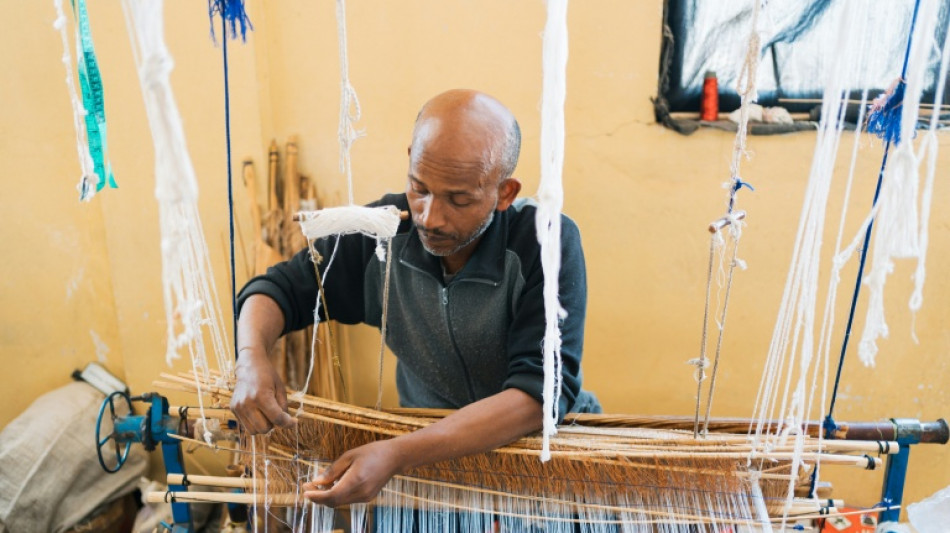
Behind the looms of a workshop in the heart of Addis Ababa, dozens of weavers deftly repeat the same motions to craft traditional dresses -- a centuries-old skill now threatened by Ethiopia's economic hardships.

Text size:

For generations, the "habesha kemis" -- long white cotton dresses often adorned with colourful embroidery -- have been handwoven. Their elaborate designs serve as attire for festivities and religious ceremonies.

It takes a week to weave the simplest dresses, and twice as long for those adorned with intricate embroidery -- a meticulous, painstaking craft, several artisans say in a workshop where the steady clink of looms fills the air.

"The work is exhausting... we live day by day," said Asefaw Yemu, 45, a weaver with three decades of experience who earns between 10,000 and 15,000 birr ($68–102) a month, before deducting the cost of raw materials.

In the dimly lit room, men hunch over their looms, shuttling cotton threads back and forth as their feet work a complex pedal system that never seems to rest.

Asefaw said he works nine hours a day, six days a week -- but with inflation hovering around 21.5 percent this year, according to the International Monetary Fund, demand has slowed sharply.

- 'No Future' -

About 39 percent of Ethiopia's 130 million people lived below the poverty line -- less than $3 a day -- in 2021, a figure the World Bank projected will rise to 43 percent this year.

At the same workshop, Getu Derza, 48, carefully embroiders colourful silk threads into intricate patterns.

"What we produce with so much effort can now be made instantly by machines in factories... It affects our income," said Derza, who began the craft at the age of 14.

An influx of cheaper machine-made habesha kemis from China years ago undercut Ethiopia's traditional weavers. Government restrictions came too late for many, who had already turned to other jobs.

In this struggling economy, Derza said what was once a skill passed down from generation to generation now "ends with us".

At 23, Abush Dubule, the youngest among the weavers, is already considering a career change

"There's no future," he said. "The economy isn't what it used to be... it's not just Chinese products. People are buying less overall."

- 'Special moment' -

A habesha kemis can cost several hundred euros -- a considerable sum in Ethiopia.

Belhu Belta, 48, runs a small shop selling traditional dresses and scarves.

He said he struggles to attract customers but stays in business, hoping there are still those who value handmade garments.

"If the market continues like this, the craft might disappear," Belhu said.

Adanech Daniel, 50, was shopping for a wedding dress and refused to compromise on quality -- representing the kind of customer who keeps Belta optimistic.

"When you wear these traditional clothes together as a family or couple, it brings vibrance and joy to the occasion," she said.

"It's beautiful, it shines and makes the moment special."

L.Davila--TFWP