The Fort Worth Press - Matcha: the Japanese tea taking over the world

USD -
AED 3.673021
AFN 64.500085
ALL 81.04013
AMD 377.570287
ANG 1.79008
AOA 916.999994
ARS 1397.0363
AUD 1.411761
AWG 1.8025
AZN 1.703608
BAM 1.646095
BBD 2.014569
BDT 122.333554
BGN 1.67937
BHD 0.37706
BIF 2955
BMD 1
BND 1.261126
BOB 6.911847
BRL 5.198602
BSD 1.000215
BTN 90.656892
BWP 13.115002
BYN 2.867495
BYR 19600
BZD 2.011792
CAD 1.36276
CDF 2239.999889
CHF 0.769655
CLF 0.021703
CLP 856.959793
CNY 6.90065
CNH 6.899875
COP 3671.49
CRC 487.566753
CUC 1
CUP 26.5
CVE 94.875032
CZK 20.441008
DJF 177.720273
DKK 6.297485
DOP 62.625011
DZD 129.608487
EGP 46.847504
ERN 15
ETB 155.049838
EUR 0.84285
FJD 2.190198
FKP 0.732521
GBP 0.734545
GEL 2.689918
GGP 0.732521
GHS 11.005031
GIP 0.732521
GMD 73.505048
GNF 8779.999507
GTQ 7.671623
GYD 209.274433
HKD 7.816415
HNL 26.505018
HRK 6.350102
HTG 130.97728
HUF 319.496499
IDR 16823
ILS 3.063925
IMP 0.732521
INR 90.598499
IQD 1310.5
IRR 42125.000158
ISK 122.380273
JEP 0.732521
JMD 156.251973
JOD 0.709007
JPY 152.839791
KES 129.000569
KGS 87.450047
KHR 4030.0002
KMF 414.99991
KPW 899.988812
KRW 1440.150231
KWD 0.30671
KYD 0.833596
KZT 494.926752
LAK 21445.000487
LBP 85549.999541
LKR 309.456576
LRD 186.550345
LSL 15.859536
LTL 2.95274
LVL 0.60489
LYD 6.302627
MAD 9.138749
MDL 16.94968
MGA 4429.99998
MKD 51.932021
MMK 2100.304757
MNT 3579.516219
MOP 8.054945
MRU 39.900536
MUR 45.90247
MVR 15.460255
MWK 1736.501794
MXN 17.240225
MYR 3.902498
MZN 63.910195
NAD 15.960282
NGN 1352.320109
NIO 36.715003
NOK 9.53845
NPR 145.04947
NZD 1.658005
OMR 0.384491
PAB 1.000332
PEN 3.35497
PGK 4.298499
PHP 58.090162
PKR 279.600947
PLN 3.553435
PYG 6585.896503
QAR 3.64125
RON 4.291018
RSD 98.911047
RUB 77.223079
RWF 1452.5
SAR 3.750374
SBD 8.048395
SCR 13.452269
SDG 601.510014
SEK 8.92871
SGD 1.26305
SHP 0.750259
SLE 24.250324
SLL 20969.499267
SOS 571.501199
SRD 37.77903
STD 20697.981008
STN 20.95
SVC 8.752299
SYP 11059.574895
SZL 15.859726
THB 31.093501
TJS 9.417602
TMT 3.5
TND 2.83525
TOP 2.40776
TRY 43.647699
TTD 6.776109
TWD 31.448974
TZS 2599.999875
UAH 43.023284
UGX 3540.813621
UYU 38.353905
UZS 12299.999861
VES 388.253525
VND 25960
VUV 119.359605
WST 2.711523
XAF 552.10356
XAG 0.013313
XAU 0.000203
XCD 2.70255
XCG 1.802726
XDR 0.686599
XOF 549.501968
XPF 100.750245
YER 238.403969
ZAR 15.973595
ZMK 9001.200595
ZMW 18.555599
ZWL 321.999592
  • RBGPF

    0.1000

    82.5

    +0.12%

  • RIO

    -1.6100

    97.91

    -1.64%

  • CMSC

    0.0000

    23.7

    0%

  • RYCEF

    -0.0600

    16.87

    -0.36%

  • NGG

    0.5800

    91.22

    +0.64%

  • BCE

    0.1800

    25.83

    +0.7%

  • AZN

    -0.2400

    204.52

    -0.12%

  • CMSD

    -0.1280

    23.942

    -0.53%

  • BTI

    0.2800

    60.61

    +0.46%

  • GSK

    0.0500

    58.54

    +0.09%

  • RELX

    1.0800

    28.81

    +3.75%

  • BP

    -1.3600

    37.19

    -3.66%

  • VOD

    -0.0600

    15.62

    -0.38%

  • BCC

    -1.3500

    88.06

    -1.53%

  • JRI

    0.0300

    13.16

    +0.23%

Matcha: the Japanese tea taking over the world
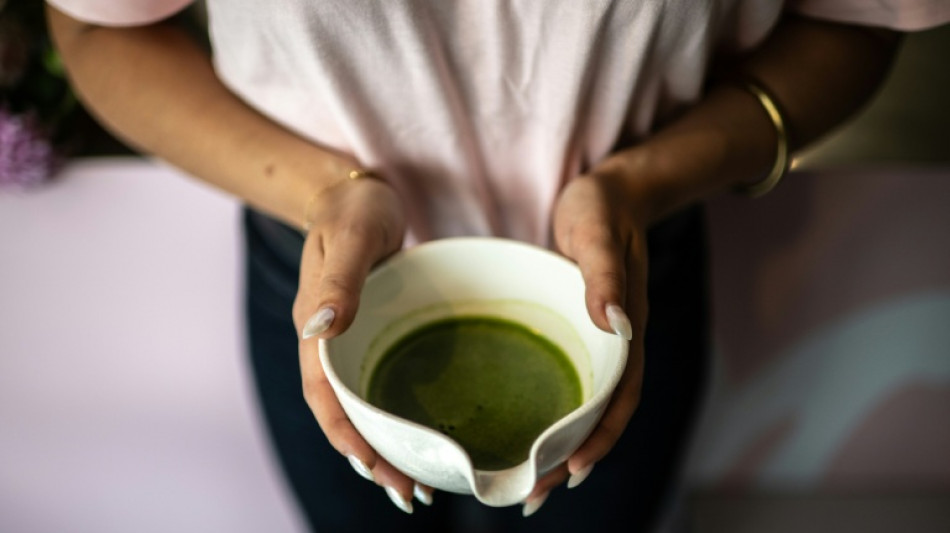
Matcha: the Japanese tea taking over the world / Photo: © AFP

Matcha: the Japanese tea taking over the world

Matcha is the new drink of choice at hip cafes worldwide, but Japanese producers are struggling to keep up with soaring demand for the powdered green tea.

Text size:

Here's what you need to know about the drink beloved of weekend treat-seekers and "wellness" influencers:

- What is matcha? -

The word matcha means "ground tea" in Japanese and comes in the form of a vivid green powder that is whisked with hot water and can be added to milk to make a matcha latte.

Green tea was introduced to Japan from China in the early ninth century, and was first used for medicinal purposes.

Matcha came much later, in 16th century Kyoto -- part of the tea ceremony tradition developed by tea master Sen no Rikyu.

Today, there are different grades of matcha quality, from "ceremonial" to "culinary" types used in baking.

- How is it produced? -

Matcha is made from leaves called "tencha", which are grown in the shade in the final weeks before their harvest to concentrate the flavour, colour and nutrients.

This "requires the construction of a complex structure with poles and a roof to filter the light", explained Masahiro Okutomi, a tea producer in Sayama, northwest of Tokyo.

Tencha leaves, rich in chlorophyll and L-theanine, a compound known for its relaxing effects, are hand-picked and deveined, then steamed, dried and ground between two stone mills to produce an ultra-fine powder.

It can take up to an hour to produce just 40 grams (1.4 ounces) of matcha -- making the powder on average twice as expensive to produce as standard green tea leaves.

- What are its benefits? -

Many drink matcha for its rich grass-like taste, but others are drawn to the drink's nutritional properties.

It is rich in antioxidants, and can aid concentration because of its caffeine content: one cup contains on average 48 milligrams, slightly less than a drip coffee but nearly twice as much as a standardly brewed green tea.

"Matcha is often seen as being good for your health," said Shigehito Nishikida, manager of Tokyo tea shop Jugetsudo.

"But people are also attracted to the Japanese culture around tea: the ritual, the time taken, the aesthetics," he said.

- Why is it so popular? -

Japan produced 4,176 tonnes of matcha in 2023 -- a huge increase from the 1,430 tonnes in 2012.

More than half of the powder is exported, according to the agriculture ministry, mostly to the United States, Southeast Asia, Europe, Australia and the Middle East.

Millions of videos on TikTok, Instagram and YouTube demonstrate how to make photogenic matcha drinks or choose a traditional "chasen" bamboo whisk.

"I feel like Gen Z really drove this enthusiasm for matcha, and they heavily relied on social media to do so," Stevie Youssef, a 31-year-old marketing professional, told AFP at a matcha bar in Los Angeles.

Matcha can also be used in cooking, extending its appeal to others aside from tea lovers.

"Some customers simply enjoy drinking it, others like preparing it themselves. And of course, many buy it as a gift -- Japanese matcha is always appreciated," said Jugetsudo's Nishikida.

C.Rojas--TFWP