Chinese treasures restored in the heart of Beijing / Photo: © AFP

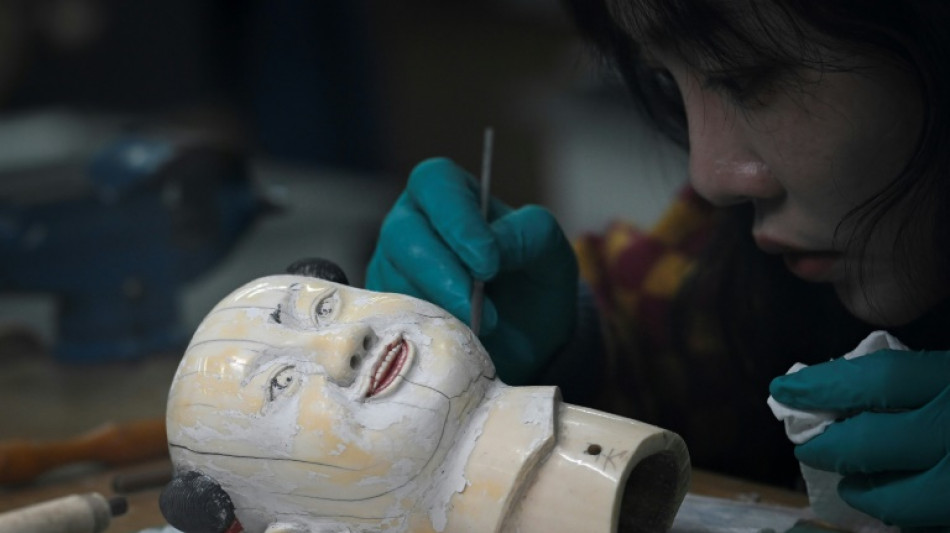
In a workshop tucked away in Beijing's historic Forbidden City, a restorer hunched over a centuries-old figurine, using a cotton bud to delicately clean its dusty crevices after years hidden in storage.
Only a small fraction of the 1.86 million artefacts held by the Chinese capital's Palace Museum is on display at any one time.
But as President Xi Jinping has called for stronger protection of cultural heritage over the past decade, efforts to preserve historical relics have intensified, with thousands of treasures refurbished in the hopes they will be showcased at a later date.
When AFP visited the brightly lit Forbidden City studio on a government-organised media tour last week, workers wearing latex gloves pored over their precious charges, gently dabbing and buffing to return lanterns, jade pendants and timeworn paintings to their former glory.
One restorer used a fine brush to carefully touch up a peeling, disembodied statue head, while another painted a glistening liquid over an ancient scroll from the Qing Dynasty.
"The conservator is currently repairing the edges of the mounting, specifically the floral feather materials used in its decoration," Ma Yue, head of the museum's Calligraphy and Painting Conservation section, told reporters as she gestured towards the worker.
"This restoration is typical because we need to restore each part of the materials based on the original mounting style, material structure and the degree of ageing of the colours," she added.
The opening of a new facility in Beijing this October will significantly boost the number of artefacts restored and displayed annually, according to the museum.
- Keeping time -
Hundreds of tourists lined the red walls of the museum complex last week, some dressed in traditional costumes.
In the sections open to the public, the work of the conservation teams could already be seen.
Visitors flocked through the Gallery of Clocks, stopping to admire the elaborate golden timepieces gleaming softly in the darkness.
The museum -- established in the imperial palace of the Ming and Qing dynasties after the last emperor Pu Yi and his household were evicted from the Forbidden City -- celebrates its 100th anniversary this year.
Its collection includes paintings, calligraphy, bronzeware, gold and silverware, ceramics and textiles, covering nearly all Chinese art forms from prehistoric times to the modern era.
They have faced existential threats during several turbulent periods.
Hundreds of thousands of pieces were removed from the museum in the 1930s to prevent them falling into the hands of invading Japanese troops.
Many were then transported to Taiwan by the Nationalists after they were defeated by Chinese communist forces and fled the mainland at the end of the Chinese Civil War in 1949.
The museum first set up a conservation team in 1952, recruiting craftsmen descended from the Qing dynasty's imperial workshop artisans.
But during the Cultural Revolution in the 1960s and 70s, valuable artefacts were damaged, destroyed or stolen by Mao Zedong's Red Guards, young brigades of communists who violently targeted anything or anyone deemed to be part of the bourgeoisie.
S.Jordan--TFWP