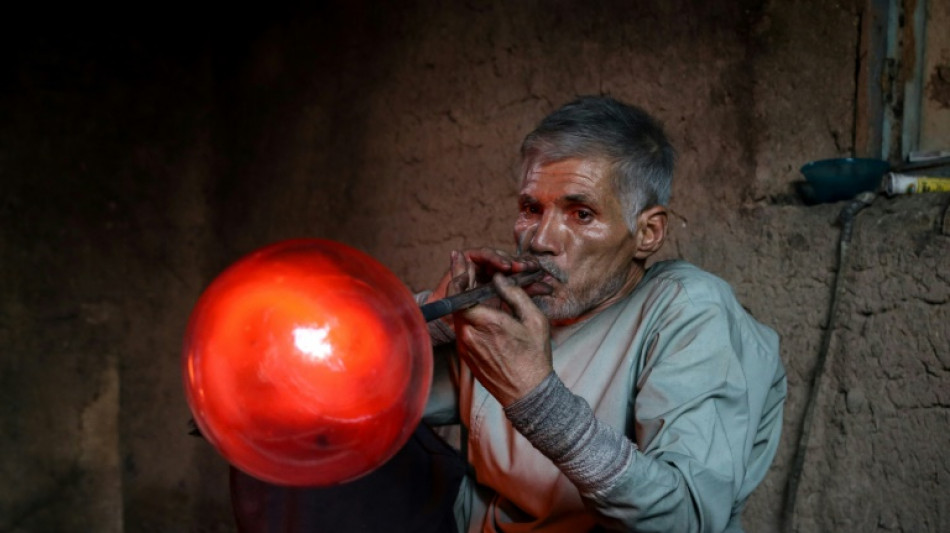
Fragile but unbroken, Afghan glassblowers refuse to quit / Photo: © AFP

Seated in front of a searing furnace, Ghulam Sakhi Saifi teases forth sinews of molten blue glass -- the guardian of an Afghan glassblowing trade refusing to break with tradition.
"This is our art, our inheritance. It has fed us for a long time," he told AFP, resting from the work that has singed his knuckles and calloused his palms.
"We are trying to make sure it is not forgotten. If we do not pass it down, it will disappear from the whole world," said Saifi, who guesses his age is around 50.
Glassblowing in Afghanistan's western city of Herat is an ancient craft. Saifi says it has run in his family for about three centuries.
The last two furnaces in the windswept metropolis near the border with Iran are in his family home and a mud-and-straw shed with a holey roof in the shadow of Herat's citadel.
- 'Slow suffocation' -
Saifi now lights one of the furnaces only once a month -- eking out around $30 from his stock of cups, plates and candleholders after expensive wood for fuel, dyes and other raw materials are accounted for.
He attributes the dramatic downturn to the exodus of already low numbers of foreign customers during the Covid-19 pandemic followed by the 2021 Taliban takeover, which saw many diplomats and aid workers pack up and leave.
Cheaper Chinese-made imports have also dented demand.
"There have been times when we haven't worked for three months -- we sit at home forever," he said.
"Locals have no use for these products, for the price they would first think to buy two loaves of bread for their children."
But when the furnace is lit, Saifi is in his element.
With a crude kitchen knife and a blowpipe he pulls glowing globs of glass out of the mud furnace and inflates them into household wares.
Unlike in the past, when they used quartz, the glassblowers now use easier-to-findrecycled bottles shattered into shards and superheated back into their liquid state.
The green and blue pieces cool into charmingly imperfect shapes, shot through with air bubbles, and are sold from clattering piles in shops in Herat and the capital Kabul for around $3 each.
Outside the shed it is already 36 degrees Celsius (97 degrees Fahrenheit) but stepping over the threshold is like being gripped by a sudden fever.
"Sometimes we really feel the heat, I think I am being slowly suffocated," Saifi said. "But this is our inheritance, we are used to it.
"Today is a bad day, but maybe it will get better in the future. Maybe the day after tomorrow, we hope to God."
- 'Craft needs to endure' -
A gaggle of boys and teenagers assists Saifi in his work, but it is growing hard to tempt the younger generation into a trade they view as a dead end.
His eldest son became an expert in the craft only to abandon it for migrant labour over the border in Iran.
Two cousins who learned to blow glass also saw no future and downed their tools.
His middle son, 18-year-old Naqibullah, vows he will continue the trade, though it's not clear how.
Before the Taliban takeover there was still enough demand for three days of work a week -- a distant prospect for the young man who shares shifts with his father on the rare occasion they light the furnaces.
"We hope that there is a future and that day by day things will get better," Naqibullah said.
"Even if we're not making much money the craft needs to endure," he added. "The art of making things by hand needs to be preserved. We can't let this skill disappear."
S.Rocha--TFWP