The Fort Worth Press - Violin village: Artisanal hub in Bolivian Amazon

USD -
AED 3.672501
AFN 65.000199
ALL 81.25221
AMD 377.970239
ANG 1.79008
AOA 916.999871
ARS 1431.316102
AUD 1.41224
AWG 1.8025
AZN 1.70377
BAM 1.646747
BBD 2.012849
BDT 122.13779
BGN 1.67937
BHD 0.377017
BIF 2957.159456
BMD 1
BND 1.268203
BOB 6.920331
BRL 5.202609
BSD 0.999352
BTN 90.600003
BWP 13.170436
BYN 2.880286
BYR 19600
BZD 2.009919
CAD 1.35806
CDF 2199.999931
CHF 0.767302
CLF 0.021643
CLP 854.629826
CNY 6.93895
CNH 6.91671
COP 3680.95
CRC 495.427984
CUC 1
CUP 26.5
CVE 92.841055
CZK 20.32555
DJF 177.96339
DKK 6.268725
DOP 62.913099
DZD 129.466972
EGP 46.862976
ERN 15
ETB 155.88032
EUR 0.83916
FJD 2.190594
FKP 0.735168
GBP 0.73238
GEL 2.694984
GGP 0.735168
GHS 10.998097
GIP 0.735168
GMD 73.000171
GNF 8773.443914
GTQ 7.666239
GYD 209.083408
HKD 7.814445
HNL 26.398747
HRK 6.317002
HTG 131.056026
HUF 316.210018
IDR 16801.15
ILS 3.08924
IMP 0.735168
INR 90.67025
IQD 1309.202051
IRR 42125.000158
ISK 121.6903
JEP 0.735168
JMD 156.313806
JOD 0.709001
JPY 155.725504
KES 128.950256
KGS 87.449976
KHR 4030.614822
KMF 418.999929
KPW 899.993603
KRW 1457.934986
KWD 0.30689
KYD 0.832814
KZT 493.541923
LAK 21477.436819
LBP 89494.552313
LKR 309.311509
LRD 185.885751
LSL 16.017682
LTL 2.95274
LVL 0.60489
LYD 6.318253
MAD 9.139958
MDL 16.974555
MGA 4387.600881
MKD 51.726887
MMK 2099.674626
MNT 3566.287566
MOP 8.045737
MRU 39.684257
MUR 45.980108
MVR 15.450228
MWK 1732.903356
MXN 17.17654
MYR 3.934502
MZN 63.749962
NAD 16.017682
NGN 1357.829805
NIO 36.777738
NOK 9.58189
NPR 144.959837
NZD 1.652899
OMR 0.38449
PAB 0.999356
PEN 3.35639
PGK 4.347991
PHP 58.426977
PKR 279.449595
PLN 3.53305
PYG 6589.344728
QAR 3.643
RON 4.271901
RSD 98.519014
RUB 77.39937
RWF 1459.087618
SAR 3.750614
SBD 8.058149
SCR 13.856617
SDG 601.50654
SEK 8.93125
SGD 1.265785
SHP 0.750259
SLE 24.450154
SLL 20969.499267
SOS 570.112659
SRD 37.971496
STD 20697.981008
STN 20.628626
SVC 8.744817
SYP 11059.574895
SZL 16.010474
THB 31.123007
TJS 9.359244
TMT 3.505
TND 2.886817
TOP 2.40776
TRY 43.594401
TTD 6.770456
TWD 31.541026
TZS 2583.596971
UAH 43.079799
UGX 3557.370493
UYU 38.318564
UZS 12295.451197
VES 377.985125
VND 25910
VUV 119.675943
WST 2.73072
XAF 552.310426
XAG 0.012258
XAU 0.000199
XCD 2.70255
XCG 1.801105
XDR 0.689856
XOF 552.30345
XPF 100.414676
YER 238.399323
ZAR 15.91755
ZMK 9001.199361
ZMW 18.893454
ZWL 321.999592
  • SCS

    0.0200

    16.14

    +0.12%

  • RBGPF

    0.1000

    82.5

    +0.12%

  • CMSC

    -0.0120

    23.56

    -0.05%

  • JRI

    -0.1530

    12.817

    -1.19%

  • RYCEF

    0.4600

    17.34

    +2.65%

  • BCE

    0.4400

    25.52

    +1.72%

  • RIO

    2.6400

    96.05

    +2.75%

  • NGG

    -0.2200

    87.84

    -0.25%

  • RELX

    -0.1400

    29.24

    -0.48%

  • BCC

    -0.3000

    90.73

    -0.33%

  • CMSD

    -0.0200

    23.93

    -0.08%

  • VOD

    0.3250

    15.435

    +2.11%

  • GSK

    -1.5250

    58.705

    -2.6%

  • AZN

    -4.1300

    188.9

    -2.19%

  • BP

    0.1970

    39.207

    +0.5%

  • BTI

    -1.7500

    61.05

    -2.87%

Violin village: Artisanal hub in Bolivian Amazon
Violin village: Artisanal hub in Bolivian Amazon / Photo: © AFP

Violin village: Artisanal hub in Bolivian Amazon

Nestled in the Bolivian Amazon, the small, majority-Indigenous town of Urubicha has become an unexpected hub of violin makers, also known as luthiers.

Text size:

Out of a population of some 8,000 people, most of whom are native Guarayos, some 40-50 work directly in the trade, local resident Waldo Papu tells AFP.

"I have not seen a place where so many violins are made," he said.

Papu heads up the Urubicha Institute of Artistic Training, Choir and Orchestra -- one of the most well-known baroque music schools in Bolivia with about 600 students.

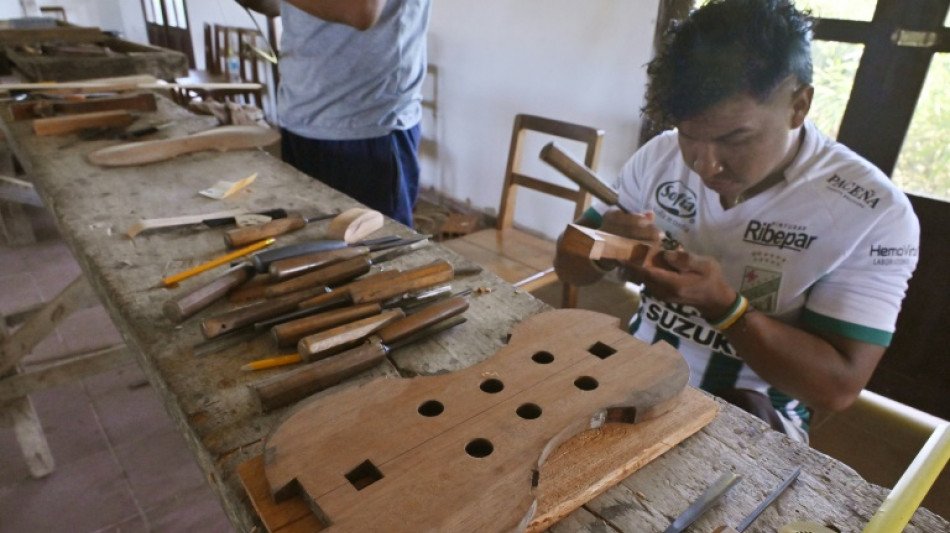
About 20 or so students are learning to make violins, carrying on the tradition practiced by elders such as Hildeberto Oreyai.

The master craftsman, 76, tells AFP he was led into the practice by his father.

He takes two weeks to make a classical four-stringed instrument.

"You have to work with the instrument. It is done with patience, so that it comes out well," he said in a mixture of Spanish and Guarayo, one of Bolivia's 37 official Indigenous languages.

Each violin is made from cedar or mara -- a local hardwood -- and sells for the equivalent of about $580.

- Roots in tradition -

A widower with five children and several grandchildren, Oreyai speaks little and has had hearing problems for a while.

With his luthier's ear impaired, he tunes practically by heart.

"I really like to play," he says, sitting outside his rustic workshop.

Unlike some others in the town, Oreyai has been unable to convince any descendants to take up the violin-making trade he first learned from his grandfather.

Urubicha lies over 300 kilometers (200 miles) north of the departmental capital Santa Cruz.

In the early 19th century, Franciscan missionaries arrived in the area of current-day Guarayo and noticed that the Indigenous peoples were skilled artisans and, above all, musically talented.

Anthropologists believe that may be rooted in the Guarayos' beliefs around death.

For one's soul to reach the Great Ancestor, as they identify their god, it must sing and play the "tacuara" or bamboo flute, historian Juan Uranavi says.

The soul rides on a caiman to the ancestor, but if it does not know how to play the tacuara well, "because of some carelessness in his life," the caiman tips him over into the river to devour him, Uranavi told AFP.

Taking advantage of their musical proclivities, the Franciscans used the violin as a tool to evangelize the local population.

At first, the instruments could only be played in church, but later "the natives themselves learned from the missionaries" to make and play them, Papu said.

One student learning the violin-making trade is 38-year-old Hernan Yarita, who is soon to graduate as a luthier.

He tells AFP he wants his violins to reach his fellow villagers first.

"There are children who do not have a violin and we have this vision of making them for ourselves, for our relatives," Yarita says.

G.Dominguez--TFWP