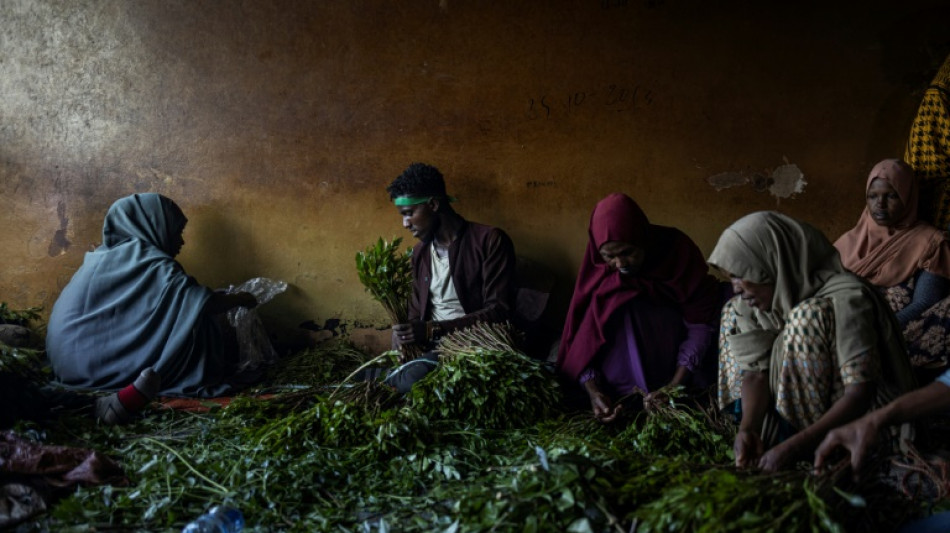
A gloomy season for Ethiopia's 'green gold' at the khat market / Photo: © AFP

"We call it green gold," says Ramadan Youssouf, a khat trader in the Ethiopian town of Aweday, one of the largest markets in the world for the mildly narcotic shrub.
"We use it in the morning to wake up, if you chew (it) you can never get sick," the 30-year-old tells AFP, his dilated pupils reflecting the effect of the stimulant, which is consumed across the Horn of Africa.
But this year, business is not giving khat traders much to smile about.
"The prices are too low," Mohamed Ibro, a 45-year-old trader, says with a grimace, after an unusually rainy dry season resulted in an overly abundant harvest.
Traders also complain about an increase in taxes and the recent tightening of conditions for exporters to obtain a commercial licence.
At the market in Aweday, located about 10 kilometres (six miles) outside the eastern city of Harar, trade is nonetheless in full swing.
Men carrying large green bundles on their shoulders jostle against each other as they walk down the narrow aisles packed with tin-roofed shacks selling khat and other products.
- Key export -
As farmers hand over their harvest, traders examine the leaves and weigh the bundles before they agree on a price.
There are no weighing scales or price lists to be seen: everything is a negotiation.
"My hand is the scale," says Saada, a 30-year-old shopkeeper assessing the quality of a bouquet estimated to weigh several kilos.
The thick pink stems and the intense green hue of the leaves are a sign of superior quality, she says, smiling, as she runs a final check to make sure that no low-calibre stalks are hidden inside.
Wads of bills change hands.
"We make money, but not enough. What we get, we eat," says 50-year-old shopkeeper Iftu, complaining about galloping food inflation.
Chewed as a stimulant and to suppress the appetite, khat is packaged in small sachets and sold on every street corner in Aweday, with the average customer consuming around 250 grams per day.
But its economic significance rests on its status as one of Ethiopia's main exports.
Many of the bundles from the Aweday market will make their way to Wajale, a border town straddling Ethiopia and Somaliland -- a breakaway region of Somalia.
Between 2019 and 2022, khat represented around 10 percent of national exports, according to figures from Ethiopia's Central Bank.
For the 2022-2023 Ethiopian calendar year, which runs from September to September, the trade was valued at more than $217 million, or six percent of total exports.
- 'Not worth it' -
Harar has long been famous for its coffee. But over the last four decades, khat fields have replaced coffee plantations on the hillsides surrounding the city.
The Harar region and the neighbouring areas of East Hararghe and West Hararghe are now home to half of Ethiopia's khat farms, spread across some 281,000 hectares (over 690,000 acres).
But this year, the 1.1 million households who grow the plant are struggling.
Youssouf Mume has long since cut down his mango trees and replaced his peanut, sorghum, corn and coffee plants with khat.
Khat needs much more attention and more water than other plants, yet would always bring in "better money", the 70-year-old farmer tells AFP.
"But now, it's not worth it."
Near the road leading out of Aweday, another farm is overgrown with khat shrubs as the owner, Hawa, admits that she is not harvesting the leaves at the moment.
Prices are too low, she says, and her last delivery of bundles weighing 1.5 kilos (3.3 pounds) did not find a buyer at the market.
"In a good year, we can make 150,000 birr (around $2,600)," selling some 200 kilos of khat, she says -- a significant sum in Ethiopia.
But sinceSeptember, "we have only sold 30 kilos," she says.
G.George--TFWP