Emiratis battle to preserve dying art of embroidery / Photo: © AFP

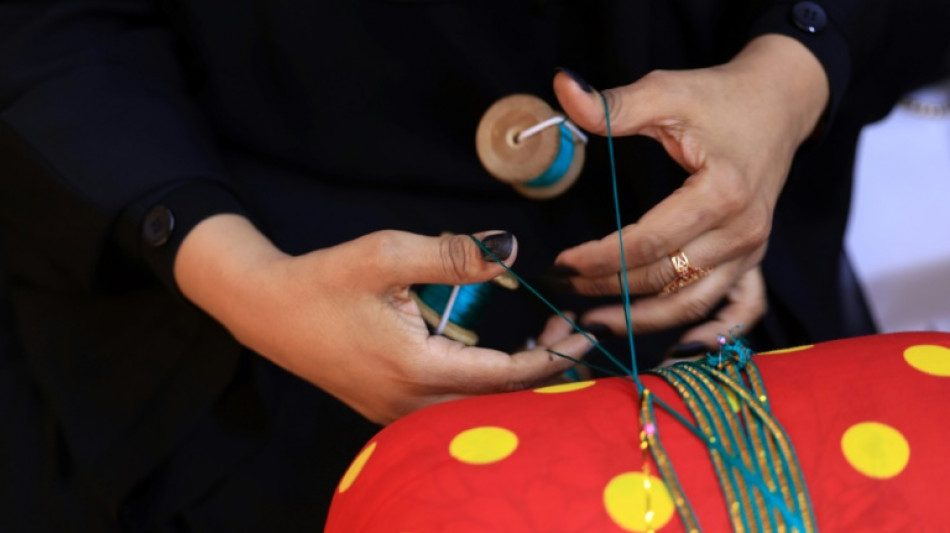
Far from Dubai's glitzy towers, Mariam al-Kalbani's henna-dyed fingers weave brightly coloured threads in a skill she hopes young Emirati women watching her can preserve for the future.
The art of hand-weaving braided shiny ribbons to adorn traditional clothing and bags is called Al Talli, and is on UNESCO's Intangible Cultural Heritage of Humanity list.
But with the relentless pace of change in the United Arab Emirates, its days may be numbered.
"It's a craft of our ancestors and our people," Kalbani told AFP in Al Ain, the UAE's fourth largest city, which sits between mountains and the desert.
"If we do not take initiative and introduce it to them, it will disappear."
The 70-year-old craftswoman, wearing a traditional black abaya robe and golden face covering, has been training students and apprentices in the art for 15 years.
"The goal is to revive the heritage for the next generation," she said.
She emphasised that mastering Al Talli doesn't happen "in a couple of hours -- it could take a year or two, especially if training is done just once a week".
Kalbani has been weaving Al Talli since she was a teenager.
The simplest Al Talli designs are made from six threads -- although they can number up to 50 -- and mastering the process of combining them with beads, ornaments and precious metals such as gold can take a long time.
- 'Rare and special' -
Accounting student Reem al-Ketbi watched Kalbani intently as she worked on a round cushion called a Mousadah, weaving a silver thread back and forth during a recent handicrafts festival.
"Every time I see Al Talli, I remember the Emirati identity -- it's something rare and special," said the 23-year-old, who began learning the craft last year while also pursuing her studies.
No precise information on Al Talli's origins exists.
But Mohamed Hassan Abdel Hafez, a cultural heritage expert at the Sharjah Institute for Heritage, said it has been passed down through multiple generations, "at least from grandparents to grandchildren", in line with UNESCO's listing requirements.
"In the field of intangible cultural heritage, it is very difficult to determine the exact date or when it historically began," he said.
However, the UAE authorities are working to preserve traditions that date from before the development of the oil industry in the country.
Kalbani laments that her own daughters did not take up the craft, but smiled as her three-year-old granddaughter beside her asked questions about the braids and threads.
Al Talli was not the only tradition being highlighted at the Crafts and Traditional Industries Festival.
At the main square in Al Ain, American Katie Gaimer watched men performing the traditional Ayalah dance, wielding bamboo sticks or unloaded rifles to the rhythm of folk songs.
The 35-year-old teacher said she and her friends had just enjoyed an Al Talli workshop, where they had a free lesson on how to make bracelets.
"It kind of felt like we were making friendship bracelets... it was fun and it was nice to learn from somebody teaching it in a traditional way," she said.
- 'Worth preserving' -
Elsewhere, women produced various items including Sadu fabric, which is used for tents, carpets and camel saddles, and is also listed by UNESCO.
Aisha al-Dhaheri, who works to promote traditional crafts at the Department of Culture and Tourism in Abu Dhabi, said authorities hope to support Al Talli by licensing certified experts to expand production and teaching.
"It's considered at risk of disappearance, so we tried to expedite preservation efforts by organising training courses," she said.
Accounting student Ketbi believes that young women these days "are not very interested" in learning craft techniques from long ago.
But she still considers preserving them worthwhile "out of love for the country".
Those who can even remember the UAE before its vertiginous ascent into modernity are increasingly few, however.
Emiratis make up just 10 percent of the federation's 10 million inhabitants, and overwhelmingly the young are focused on the digital future, less so the often impoverished past.
At one shop in the festival area, octogenarian Kulthum al-Mansouri sold bags, incense burners, bracelets, necklaces, medals and key chains -- all adorned with Al Talli which she herself braided under the eyes of passers-by.
She said she felt saddened that young women seem less interested in Al Talli than ever, distracted as they were "by screens and phones".
But she still hoped the skill could be passed on because her generation cannot maintain it forever.
"For how long do we have left to live?" she said.
H.M.Hernandez--TFWP