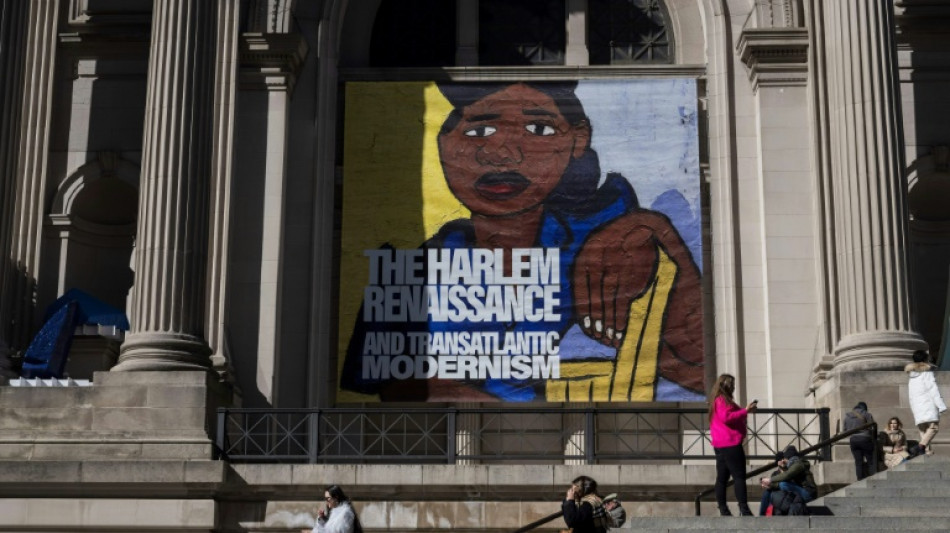
Marginalized no more, expo celebrates Harlem Renaissance / Photo: © AFP

The Metropolitan Museum's new Harlem Renaissance exhibit presents the Twentieth Century movement as a central force in modern art, a bold reframing that many view as long overdue.
The show, "The Harlem Renaissance and Transatlantic Modernism," which opens Sunday, is comprised of some 160 pieces depicting Black American life in the 1920s-1940s, featuring both well-known creators and some appearing in the internationally visited institution for the first time.
Spread across a dozen galleries, there are canvasses of jauntily-dressed Black couples beaming from the dance floor; graphic art-style street scenes with bright colors and forceful lines; and portraits that probe the human psyche.
The show includes a handful of works by European giants including Henri Matisse and Edvard Munch depicting dark-skinned subjects. But these canvasses play a supporting role, allowing visitors to compare contemporaneousness works on parallel subjects.
Met officials describe the show as a landmark in casting the Harlem Renaissance "as the first African American-led movement of international modern art," as Met Chief Executive Max Hollein says in the exhibit's press release.
The show marks an "opening and expanding of the art history and the narratives of art history," Hollein told AFP this week.
- Systemic problem -
While history is rife with now-canonized artists snubbed in their day, Hollein saw the downgrading of the Harlem Renaissance as categorically different, reflecting "certain systems within the cultural infrastructure that suppressed the idea of how to properly present this as a whole movement," he said.
"There are ways to change that, and this exhibition is one of them," he said.
While the Met plans to add more Harlem Renaissance works to its permanent collection, the show relied in part on loans from Historically Black universities and private collections.
At the show's media preview, Darren Walker, president of exhibition sponsor the Ford Foundation, praised those "who have preserved these works during times when what you knew was valuable, was not valued."
These include Madeline Murphy Rabb, who fought tears as she encountered "Girl With Pomegranate," a 1940 canvas by her great aunt, Laura Wheeler Waring, hanging from the Met wall.
"I have been working for decades to get my great aunt the recognition she deserves," Rabb told AFP. "My goal has always been for a broader audience to see this important work. So many whites and some Blacks have stereotypes about what they think Black artists paint about."
- Opening up -
Though commonly referenced as a cultural phenomenon, the Harlem Renaissance's contours are a bit fuzzy, both in terms of geography and duration. Painters like Archibald Motley of Chicago weren't based in New York, while the poet Langston Hughes remained a creative force through the 1960s.
Jacob Lawrence, rare among Harlem Renaissance painters in attaining major recognition during his lifetime, worked until shortly before his death in 2000.
Most accounts place the movement's inception as just after World War I, coinciding with the Great Migration that saw millions of Black Americans leave the southern United States to other US regions that were segregated but not mired in the shadows of the Ku Klux Klan and lynchings.
While this period is associated with thinkers like WEB Dubois who prioritized Black political rights, Alain Locke, a key Harlem Renaissance architect, emphasized aesthetics.
In the 1925 book "The New Negro," Locke described the potential for "the younger generation" of Blacks to lead society through "something like a spiritual emancipation" not centered on conventional political questions.
Locke urged Black painters to open themselves up to African visual tools, as well as idioms of European modernists, said Met curator Denise Murrell.
Key figures following this course included William H. Johnson, who migrated to New York from South Carolina and lived extensively in France and Scandinavia.
Johnson's works in the show have a flattened composition, semi-geometric figures and a limited palette of powerful colors, as in "Woman in Blue" from 1943, which is dominated by the urbane subject's ebony skin, her night blue dress and a lemon-colored background.
Johnson's works echo Matisse and German expressionism, but didn't aim to "imitate" them, but to employ "this international visual language in representation of a very specific local culture that (Johnson) was part of here in New York City," Murrell said.
Johnson contrasts with Waring, who also studied in Paris, but employed a more realistic style with liberal brushstroke and some other modernizing touches.
The Met is learning to be "less dogmatic in terms of what modern art can include," Murrell said before "Girl With Pomegranate," which graces the cover of the exhibition catalogue.
Waring's "subject matter was modern," Murrell said. "It was a representation of a modern Black subject that's not been a part of art history, had been ignored, or marginalized."
P.Navarro--TFWP