The Fort Worth Press - How a Bronze Age rock became a 'treasure map' for researchers

USD -
AED 3.672501
AFN 64.502086
ALL 81.624824
AMD 375.516815
AOA 917.000347
ARS 1387.440076
AUD 1.429195
AWG 1.8
AZN 1.699758
BAM 1.667278
BBD 2.011082
BDT 122.671668
BHD 0.376625
BIF 2967.989429
BMD 1
BND 1.272324
BOB 6.899962
BRL 5.009196
BSD 0.998508
BTN 92.62947
BWP 13.405226
BYN 2.865862
BYR 19600
BZD 2.008184
CAD 1.386455
CDF 2300.000105
CHF 0.79086
CLF 0.022686
CLP 892.843442
CNY 6.827968
CNH 6.837605
COP 3636.503133
CRC 462.128639
CUC 1
CUP 26.5
CVE 93.998551
CZK 20.890598
DJF 177.809983
DKK 6.404505
DOP 60.125314
DZD 132.246707
EGP 53.398304
ERN 15
ETB 156.679852
EUR 0.857125
FJD 2.211498
FKP 0.742933
GBP 0.74665
GEL 2.689655
GGP 0.742933
GHS 10.988449
GIP 0.742933
GMD 73.498147
GNF 8760.922382
GTQ 7.638208
GYD 208.899876
HKD 7.831105
HNL 26.518904
HRK 6.425898
HTG 130.923661
HUF 315.230987
IDR 17089.3
ILS 3.03421
IMP 0.742933
INR 93.0905
IQD 1308.043135
IRR 1316124.999757
ISK 122.190558
JEP 0.742933
JMD 157.870509
JOD 0.709044
JPY 159.652494
KES 129.210179
KGS 87.449811
KHR 3997.272069
KMF 419.999783
KPW 899.998178
KRW 1484.910271
KWD 0.30869
KYD 0.832104
KZT 471.85542
LAK 22019.52176
LBP 89419.71783
LKR 315.118708
LRD 183.726184
LSL 16.382337
LTL 2.95274
LVL 0.60489
LYD 6.347556
MAD 9.280849
MDL 17.20387
MGA 4143.898385
MKD 52.551042
MMK 2100.763326
MNT 3574.006152
MOP 8.05507
MRU 39.91049
MUR 46.520182
MVR 15.459583
MWK 1731.383999
MXN 17.41562
MYR 3.965038
MZN 63.959681
NAD 16.382337
NGN 1359.498022
NIO 36.741827
NOK 9.55276
NPR 148.206811
NZD 1.72387
OMR 0.38463
PAB 0.998508
PEN 3.369933
PGK 4.322066
PHP 59.876504
PKR 278.505946
PLN 3.650695
PYG 6457.525255
QAR 3.640254
RON 4.342299
RSD 100.055411
RUB 77.459115
RWF 1458.164614
SAR 3.748263
SBD 8.058149
SCR 15.185201
SDG 601.000159
SEK 9.33234
SGD 1.276095
SLE 24.625012
SOS 570.649162
SRD 37.449029
STD 20697.981008
STN 20.885725
SVC 8.737053
SYP 110.530532
SZL 16.386343
THB 32.207997
TJS 9.490729
TMT 3.505
TND 2.917693
TRY 44.689971
TTD 6.776352
TWD 31.7418
TZS 2591.108648
UAH 43.382209
UGX 3694.642172
UYU 40.288138
UZS 12141.852436
VES 475.837797
VND 26336
VUV 117.921501
WST 2.734489
XAF 559.189293
XAG 0.01312
XAU 0.00021
XCD 2.70255
XCG 1.799582
XDR 0.695452
XOF 559.189293
XPF 101.666596
YER 237.149651
ZAR 16.57375
ZMK 9001.201579
ZMW 18.996633
ZWL 321.999592
  • RBGPF

    -13.5000

    69

    -19.57%

  • NGG

    -0.0300

    90.29

    -0.03%

  • CMSD

    0.0400

    22.63

    +0.18%

  • RIO

    1.1300

    98.26

    +1.15%

  • GSK

    -0.1500

    58.21

    -0.26%

  • BCC

    -0.4100

    80.17

    -0.51%

  • BCE

    -0.5400

    23.35

    -2.31%

  • RELX

    -0.0400

    33.3

    -0.12%

  • BTI

    -0.0400

    58.81

    -0.07%

  • JRI

    0.0400

    13.02

    +0.31%

  • CMSC

    0.0400

    22.43

    +0.18%

  • BP

    0.5400

    46.44

    +1.16%

  • RYCEF

    -0.2700

    16.96

    -1.59%

  • AZN

    -0.9600

    204.03

    -0.47%

  • VOD

    -0.1600

    15.69

    -1.02%

How a Bronze Age rock became a 'treasure map' for researchers
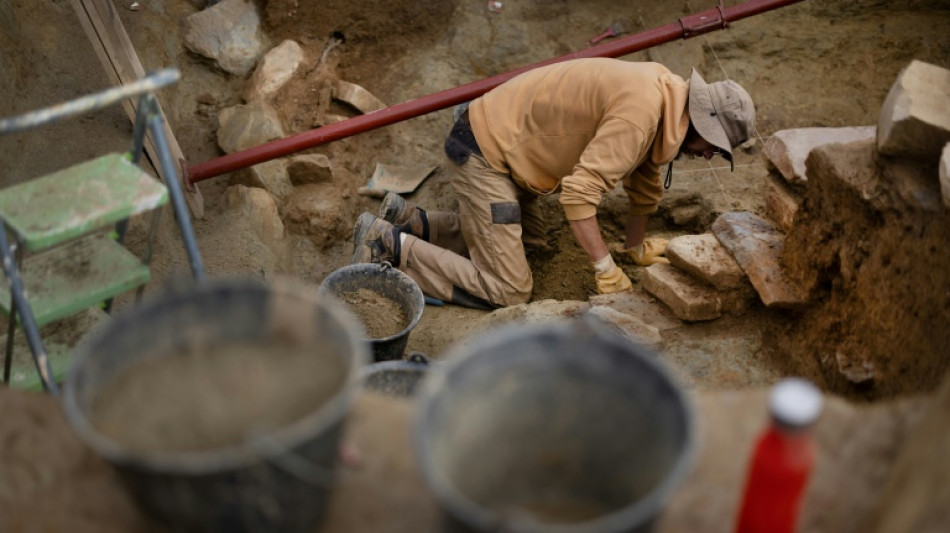
How a Bronze Age rock became a 'treasure map' for researchers / Photo: © AFP

How a Bronze Age rock became a 'treasure map' for researchers

A piece of rock with mysterious markings that lay largely unstudied for 4,000 years is now being hailed as a "treasure map" for archaeologists, who are using it to hunt for ancient sites around north-western France.

Text size:

The so-called Saint-Belec slab was claimed as Europe's oldest map by researchers in 2021 and they have been working ever since to understand its etchings -- both to help them date the slab, and to rediscover lost monuments.

"Using the map to try to find archaeological sites is a great approach. We never work like that," said Yvan Pailler, a professor at the University of Western Brittany (UBO).

Ancient sites are more commonly uncovered by sophisticated radar equipment, aerial photography or by accident in cities when the foundations for new buildings are being dug.

"It's a treasure map," said Pailler.

But the team are only just beginning their treasure hunt.

The ancient map marks an area roughly 30 by 21 kilometres and Pailler's colleague, Clement Nicolas from the CNRS research institute, said they would need to survey the entire territory and cross reference the markings on the slab.

That job could take 15 years, he said.

- Rivers and mountains -

Nicolas and Pailler were part of the team that rediscovered the slab in 2014 -- it was initially uncovered in 1900 by a local historian who did not understand its significance.

The French experts were joined by colleagues from other institutions in France and overseas as they began to decode its mysteries.

"There were a few engraved symbols that made sense right away," said Pailler.

In the coarse bumps and lines of the slab, they could see the rivers and mountains of Roudouallec, part of the Brittany region about 500 kilometres west of Paris.

The researchers scanned the slab and compared it with current maps, finding a roughly 80 percent match.

"We still have to identify all the geometric symbols, the legend that goes with them," said Nicolas.

The slab is pocked with tiny hollows, which researchers believe could point to burial mounds, dwellings or geological deposits.

Discovering their meaning could lead to a whole flood of new finds.

- 'Doomed' slab -

But first, the archaeologists have spent the past few weeks digging at the site where the slab was initially uncovered, which Pailler said was one of the biggest Bronze Age burial sites in Brittany.

"We are trying to better contextualise the discovery, to have a way to date the slab," said Pailler.

Their latest dig has already turned up a handful of previously undiscovered fragments from the slab.

The pieces had apparently been broken off and used as a tomb wall in what Nicolas suggests could signify the shifting power dynamics of Bronze Age settlements.

The area covered by the map probably corresponds to an ancient kingdom, perhaps one that collapsed in revolts and rebellions.

"The engraved slab no longer made sense and was doomed by being broken up and used as building material," said Nicolas.

M.Delgado--TFWP