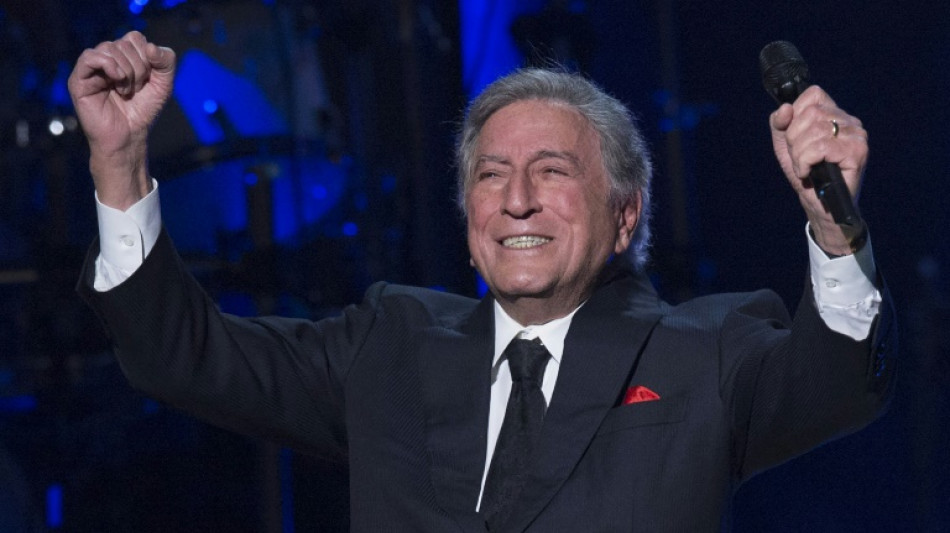
Tony Bennett, last of classic American crooners, dead at 96 / Photo: © AFP/File

Tony Bennett, the last in a generation of classic American crooners whose ceaselessly cheery spirit bridged generations to make him a hitmaker across seven decades, died Friday in New York. He was 96.
Raised in an era when big bands defined US pop music, Bennett achieved an improbable second act when he started winning over young audiences in the 1990s -- not by reinventing himself but by demonstrating his sheer joy in belting out the standards.
And then at age 88, Bennett in 2014 became the oldest person ever to reach number one on the US album sales chart through a collection of duets with Lady Gaga -- who became his friend and touring companion but only one of a long list of younger stars who rushed to work with the singing great.
Bennett's publicist, Sylvia Weiner, announced his death.
Likened since the start of his career to Frank Sinatra, Bennett first tried to distance himself but eventually followed much of the same path as other crooners of yore -- singing in nightclubs, on television and for movies, although his attempts to act ended quickly.
His gift proved to be his stage presence.
With a welcoming smile and dapper suit, he sang with gusto and a smooth vibrato in a strong, clearly enunciated voice, which he kept in shape through training from the operatic Bel Canto tradition.
Starting with his recording of the film song "Because of You" in 1951, Bennett sang dozens of hits including "Rags to Riches," "Stranger in Paradise" and, in what would become his signature tune, "I Left My Heart in San Francisco," which landed him two of his career's 19 Grammy Awards.
But the British Invasion led by The Beatles initially took a toll on the singer, whose music suddenly sounded quaint and antiquated. He nearly died of a cocaine overdose in 1979 before sobering up and eventually reviving his career.
"When rap came along, or disco, whatever the new fashion was at the moment, I didn't try to find something that would fit whatever the style was of the whole music scene," Bennett told the British culture magazine Clash.
"I just stayed myself and sang sincerely and tried to just stay honest with myself -- never compromising, just doing the best songs that I could think of for the public.
"And luckily it just paid off."
- Singing as hardscrabble youth -
Tony Bennett -- his stage name came after advice from showbiz A-lister Bob Hope -- was born Anthony Dominick Benedetto in the Astoria neighborhood of New York's Queens borough.
His father was a struggling grocer who immigrated from southern Italy's Calabria region, to which his mother also traced her ancestry.
He showed early promise as an entertainer, singing at age nine next to legendary New York mayor Fiorello LaGuardia when he ceremonially opened the city's Triborough Bridge, now known as the Robert F. Kennedy Bridge.
But his father's death at age 10, at a time when the United States was still struggling to exit the Great Depression, led him to leave school and earn money through jobs including singing at Italian restaurants and caricature painting, which remained a lifelong side career.
During World War II, Bennett was drafted into the 63rd Infantry Division and was sent to France and Germany. But he was demoted after cursing out an officer from the South who objected to Bennett dining with an African American friend in the then racially segregated army.
As punishment, Bennett spent his tour of duty digging out bodies and shipping them. But after the Allied victory, Bennett found an unexpected break into music as he waited with fellow troops in Wiesbaden, Germany to return home.
With the city's opera house still intact, a US Army band performed a weekly show to be broadcast on military radio across Germany. Taken on as the band's librarian, Bennett quickly impressed with his voice and was made one of four vocalists.
"During this period in the army, I enjoyed the most musical freedom I've ever had in my life," Bennett later wrote in his autobiography, "The Good Life."
"I could sing whatever I wanted, and there was no one around to tell me any different," he wrote.
- Outspoken against racism and war -
When he returned to the United States, he took formal singing lessons through the GI Bill, which covered educational expenses for returning troops.
His experiences made Bennett a lifelong liberal. He became especially enraged in the 1950s when he played in Miami with jazz pioneer Duke Ellington, who was not allowed to attend a press party due to segregation at the hotel.
In a then risky move for a popular entertainer, he accepted an invitation from singer Harry Belafonte to join civil rights icon Martin Luther King in the 1965 march from Selma, Alabama in support of equal voting rights for African Americans.
He later wrote in his memoir that the hostility of the white state troopers reminded him of Nazi Germany.
He was also an outspoken opponent of war, at times raising controversy.
"The first time I saw a dead German, that's when I became a pacifist," he told popular radio host Howard Stern days after the September 11, 2001 attacks.
- Late in life, still cool -
Bennett was married three times and had four children including Antonia Bennett, who has followed his path as a singer of pop and jazz standards.
But his son Danny Bennett was most instrumental in his father's career, aggressively courting MTV and other players in the pop world as a manager for his father.
By the early 1990s, Bennett -- his style and look little changed from the 1960s, except for more gray hair -- was appearing in music videos on MTV and singing warm-up at concerts by alternative rock giants such as Smashing Pumpkins and Porno for Pyros.
Proof that Bennett was back came in 1993 when he presented a prize at the MTV Video Music Awards alongside the Red Hot Chili Peppers, who hailed his cool factor and playfully sang part of "I Left My Heart in San Francisco."
His career only kept building and a decade later, he released three successful albums of duets. On one of them, "Body and Soul," he sang with Amy Winehouse in her last recording before she died in 2011 at age 27.
He marked his 90th birthday with a star-studded concert at New York's Radio City Music Hall, which was turned into a television special and album.
The title was taken from a song popularized by Bennett: "The Best Is Yet to Come."
Bennett toured the United States and Europe into his final decade, playing his last public performance before the coronavirus pandemic halted touring in New Jersey on March 11, 2020.
Soon after, he revealed he had been diagnosed with Alzheimer's disease in 2016. He had kept his condition quiet for years.
Upon turning 95, Bennett played two more birthday concerts, again at Radio City Music Hall, with Lady Gaga -- shows billed as his farewell to New York.
He then canceled the remainder of his 2021 tour dates on "doctors' orders."
"And let the music play as long as there's a song to sing / And I will stay younger than spring," he crooned during the first of his farewell shows, in a rendition of his ballad "This Is All I Ask."
"You've been a good audience," Bennett said prior to his encore. "I love this audience."
W.Knight--TFWP