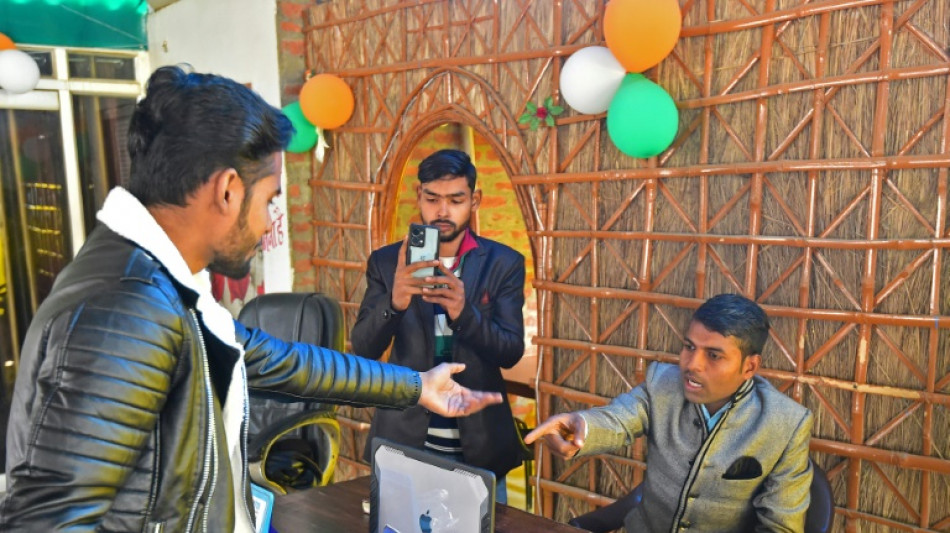
Staged online videos feed Islamophobia in Modi's India / Photo: © AFP

The acting is dire and the scenarios fake, but staged videos are peddling disinformation and fanning sectarian tensions in India, which has seen rising Hindu radicalisation under nationalist Prime Minister Narendra Modi.
One such five-minute film purported to show a Muslim man mixing toilet cleaning liquid into a street snack, before being "confronted" by passersby. The video got more than five million views on Facebook.
Another, seen more than 3.5 million times on YouTube, depicts a fruit-seller -- a trade taken up by many Muslims -- cheating customers out of pomegranates before being accosted and assaulted.
"Before buying anything from Muslim Jihadis, watch this video of a Muslim fruit seller," the accompanying caption says.
- Millions of followers -
Asked about the impact their work may have, the video-makers say the clips are just meant as "entertainment" -- and to make money.
The toilet cleaning liquid video was made by Narendra Verma, who has a Facebook page with 55,000 followers and runs a successful YouTube channel.
The smartly dressed 28-year-old told AFP that his videos can make his six-member team 250,000 Indian rupees ($3,000) a month from YouTube and Facebook, depending on how many views they get.
"Everyone has different responsibilities, from writing the script of the video to shooting it and later editing and uploading it," he said.
"We make these videos (to make) people aware so that they can avoid such incidents happening for real in society," he added.
Raju Bharti runs a YouTube channel with 2.89 million subscribers and has uploaded hundreds of videos, including the one of the "Muslim fruit-seller". He denies accusations of inciting hatred.
"We make videos about digital fraud, child kidnapping and how shopkeepers or hawkers cheat common people," he told AFP.
"Our aim is not to hurt the sentiments of any religion or community, we just want to make people aware."
- 'Hindu brothers' -
Experts say videos like these are shared widely to reinforce negative stereotypes and conspiracy theories about the roughly 210 million Muslims in the world's most populous country.
One with 1.2 million views features a man disguised in a burqa -- a garment worn by some Muslim women -- being pursued with a "stolen" child under his arm.
"Burqa hides terrorist activities. Burqa promotes crime. Burqa should be banned in India," the caption reads.
Others show Hindu women who have supposedly been duped into marrying a Muslim, a common trope with the Hindu far-right.
These videos are often included in social media campaigns to economically boycott or attack Muslims, or when communal tensions flare.
"Wake up... Hindu brothers and sisters, wake up now or never, the economic boycott is the only option for these Jihadis," one user wrote in response to the toilet cleaning liquid clip.
- Disclaimers -
Some content-makers took down their videos after they went viral and were subsequently debunked by AFP and other fact-checking organisations.
When his toilet cleaning liquid video exploded, Verma started getting calls from the media and had to speak to the police.
He was "scared", he said, and has since switched to more innocent themes, like pranks or dancing.
Some producers try to circumvent social media rules by posting quickly disappearing "disclaimer" messages that the content is staged.
Producers then class the videos as "entertainment" on social media, said Paranjoy Guha Thakurta, a journalist, author and film-maker who tracks misinformation and hate speech.
"This is the real loophole... Even after being shared with a false claim, they can spread misinformation by just putting a disclaimer," he said.
When videos are taken down, they can often reappear.
- 'Significant steps' -
Asked about the videos mentioned in this story, Facebook parent company Meta said it was investigating them. YouTube, Twitter and the Indian government did not respond to requests for comment.
"We don't allow hate speech on our platform, and we remove it when we find it or are made aware of it," Meta said in an emailed statement.
Meta said it removes content that violates "Community Standards", reducing the distribution of stories marked as false by third-party fact-checkers, and "informing people so they can decide what to read, trust and share".
One of Facebook's partners is AFP, which has a global team of journalists, including in India, who debunk misinformation as part of Meta's third-party programme.
AFP debunked the toilet cleaning liquid video as "false information" on Facebook, marking posts sharing the video as such.
As per Facebook policy, those posts received lower distribution and were linked to AFP's article debunking them.
However, keyword searches on Facebook and other social media platforms found several posts containing the video still available.
Thakurta said that many Indians often like and share videos that confirm their biases, without checking their veracity.
"We need to cultivate social awareness among people. Social media awareness... (has) to be a part of our education syllabus," he told AFP.
He added that while laws to regulate social media existed, they were not effectively implemented in a country of 1.4 billion people and 600 million smartphones.
"These (social media platforms) are being used or misused to spread Islamophobia and hate against Muslims in India," he said.
L.Davila--TFWP