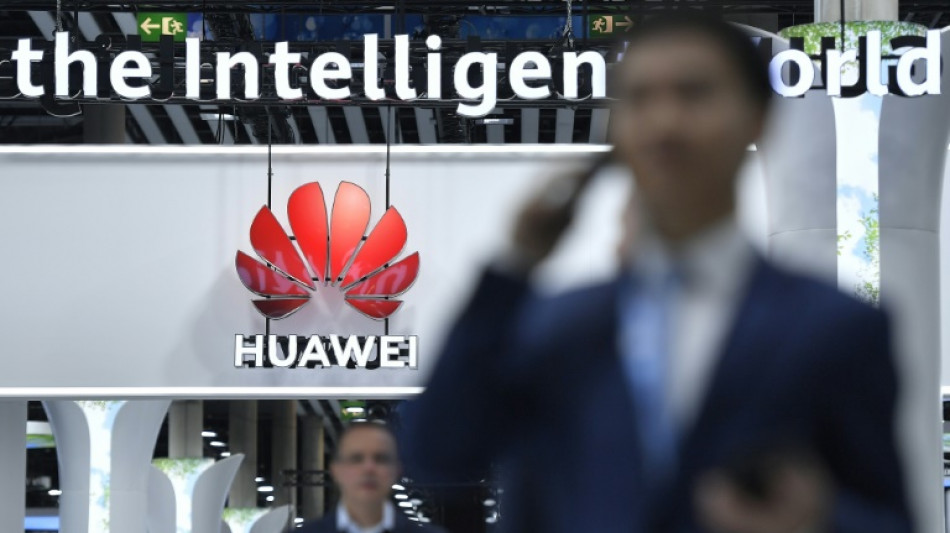
Chinese phone makers emerge from Huawei's shadow / Photo: © AFP

Western governments are falling over each other to restrict social media platform TikTok, but Chinese firms are still huge in sectors from smartphones to network equipment and are only looking to grow.
One of the biggest Chinese companies, Huawei, made its ambitions obvious this week at the telecom industry's biggest annual show, the Mobile World Congress (MWC) in Barcelona.
Its pavilion was by far the biggest and definitely the brightest, with arrays of piercing lights reflecting from polished white surfaces and dazzling floors.
Smartphone makers Xiaomi, Oppo and Honor occupied the most eye-catching stages in the smartphone area, flanking the stand of South Korean firm Samsung, a key rival.
They are seeking to fill the hole left by Huawei, which scaled back its smartphone business in 2020 to concentrate on other sectors like network equipment.
The United States has hugely restricted Huawei's operations and the European Union is trying to do the same, but countries still widely use its products.
"Huawei enjoys a higher market share in Berlin than in Beijing," wrote Danish firm Strand Consult last year, noting that 59 percent of Germany's 5G network equipment was Huawei.
Allowing Huawei to dominate in that way is like giving Beijing a "kill switch" on your communications network, report author John Strand told AFP.
"If it's OK to buy Chinese communication infrastructure, then it should be OK to buy Chinese fighter planes," he added.
- Technology allies -
Huawei's travails in the United States began under former president Donald Trump, whose anti-China stance has since become orthodox in the US Capitol.
US policymakers view Chinese domination of technology as a key global threat and Huawei has long been the poster child, in part because its interests are so closely allied to Beijing's own aims.
Jacob Gunter of the Germany-based MERICS think tank points out that Huawei built China's first major operating system, got deeply involved in semiconductors, network equipment, phones and is now forging ahead with cloud computing and data centres.
"It's exactly the kind of technologies that Beijing really, really desperately wants," Gunter told AFP.
As a result, Huawei dodged the kind of humiliating crackdown suffered by others in the tech sector -- particularly video game firms and Jack Ma, founder of e-commerce giant Alibaba.
Although Huawei is largely locked out of the US market, analysts like Strand say the firm has overplayed the effects of this as it was never a major player there anyway.
And it still enjoys a huge slice of business elsewhere in the world.
"They still have a huge catchment area of customers that are not aligning with their requests of the US," said Dario Talmesio of research firm Omdia.
- Time and money -
Smartphones have not yet been scrutinised in the same way as networks.
Chinese firms are not formally banned from the US market but no major carriers partner with them and their products are not widely sold.
"There are more markets for them to focus on first," said analyst Nicole Peng from Canalys, noting that China was a massive market in itself.
Samsung and Apple consolidated their dominance of handset sales last year, accounting for roughly 40 percent of the market, according to specialist firm IDC.
But Chinese brands Xiaomi, Oppo and Vivo made up the other three spots in the top five.
However, all three had a bleak year, with sales slumping dramatically as demand dropped off after pandemic restrictions were lifted.
Peng pointed out that these firms are all young and have not experienced such a slowdown before, so it was unclear how they would weather the storm.
Ben Wood of research firm CCS Insight reckoned it would be a tall order to dislodge Samsung and Apple any time soon.
"They are going to have to spend a lot of money, and they are going to have to spend a lot of time to try and build some brand presence with consumers in advanced economies like Europe," he told AFP.
T.Harrison--TFWP