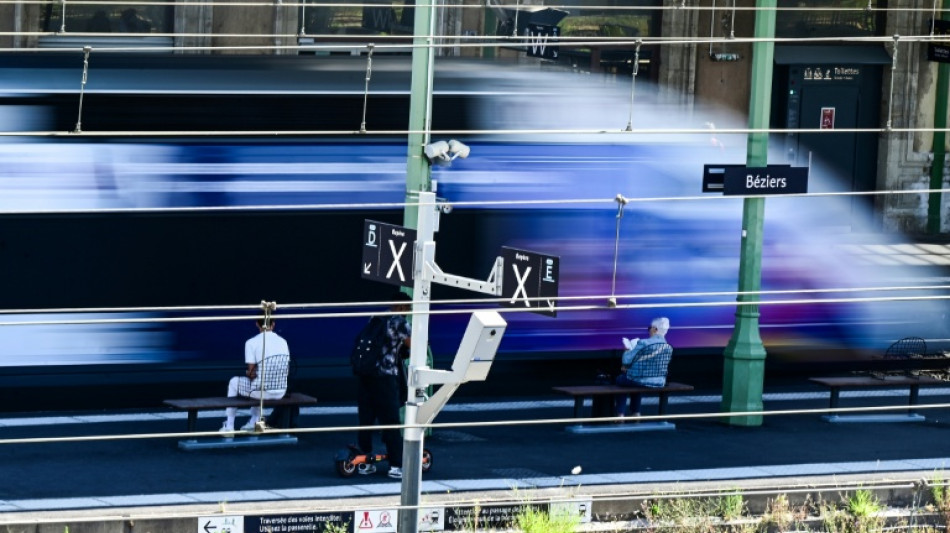
Why the heat is wreaking havoc on Europe's trains / Photo: © AFP

The extreme heat baking much of Europe this week is exposing the limits of rail infrastructure made during cooler times, leading to delays and cancellations along with warnings to travellers with health problems to avoid trips if possible.
Overhead power lines that expand and droop, tracks that widen even just a few millimetres when hit by the Sun and overtaxed air-conditioning systems are the main problems dogging train lines where maintenance investments have often lagged.
- Why are trains being cancelled? -
More recent high-speed lines notwithstanding, much of the network and rolling stock in France and Belgium, where service cuts have been more prevalent, is several decades old.
If they do have air conditioning, the system often cuts off automatically if the wagons get too hot, prompting operators to pre-emptively cancel trains on the most exposed routes.
Belgium's national operator SNCB has removed trains without AC from service during rush hours, while France's SNCF withdrew 10 percent of Paris region trains to avoid overheating tracks that can be permanently deformed.
The overhead power lines, known as catenaries, can also sag as the metal expands under the heat, raising the risk they snag on passing trains.
A broken power line is "very strongly suspected" as the cause of a massive freight train outage at Paris Gare de l'Est station on June 18, said Severine Lepere, the SNCF's director for the greater Paris region.
- What makes this heatwave different? -
Unlike a shorter spike in temperatures, the current heatwave is exceptional because the extreme heat has plateaued for several days without cooling meaningfully at night -- with forecasts of several days at or above 40C still to come.
And track temperatures can soar even higher, reaching 60C, causing the metal to dangerously stretch or widen, similar to the risk for power lines.
"Track buckles and dewirements are what really worry engineers," said John Lawrence, chair of the Railway Technical Network at the UK's Institution of Engineering and Technology.
"That brings derailment risks, and overhead lines can sag and catch on pantographs, halting train movements or forcing lengthy reroutes," he said, referring to the roof-mounted systems that collect current from the lines.
Electronic signalling equipment can also fail under the extreme heat.
- Why in Europe and not other hot areas? -
Trains run in the high heat of India and Africa, for example, but they have few high-speed trains like the French TGVs that can reach speeds of 320 km/h (200 mph).
"The high speeds we have in Europe require extremely reliable tracks and and better quality network -- you can't have the slightest gap" in tolerances, said Pierre Plaindoux, a rail expert at the consulting firm MC2I.
He also noted that in the United States and Canada, where passenger train travel is much less extensive, overhead power lines are hardly ever used.
"The vast majority of rolling stock is diesel trains on major lines," he said.
- What are possible solutions? -
Improved tracking of track temperatures could let operators impose speed limits instead of protectively cancelling trains.
Plaindoux said that in countries with cheaper labour costs, inspectors fan out across the network -- but in France, for example, the plan is to install more sensors.
Another option is to paint tracks white so that they reflect the sun and heat instead of absorbing it, a practice increasingly common in countries including Britain and Italy.
"Reflective paint can shave five to 10 degrees Celsius of rail temperature," said Antonios Kanellopoulos, associate professor in innovative construction materials and director of the Centre for Engineering research at the University of Hertfordshire in England.
Another option is to install rigid power lines that would not face sagging risks in heat like wire catenaries.
"In France, they've installed these over a couple dozen kilometres on high-traffic lines, and there will be more of them, but not over long distances -- it would be too expensive," Plaindoux said.
H.M.Hernandez--TFWP