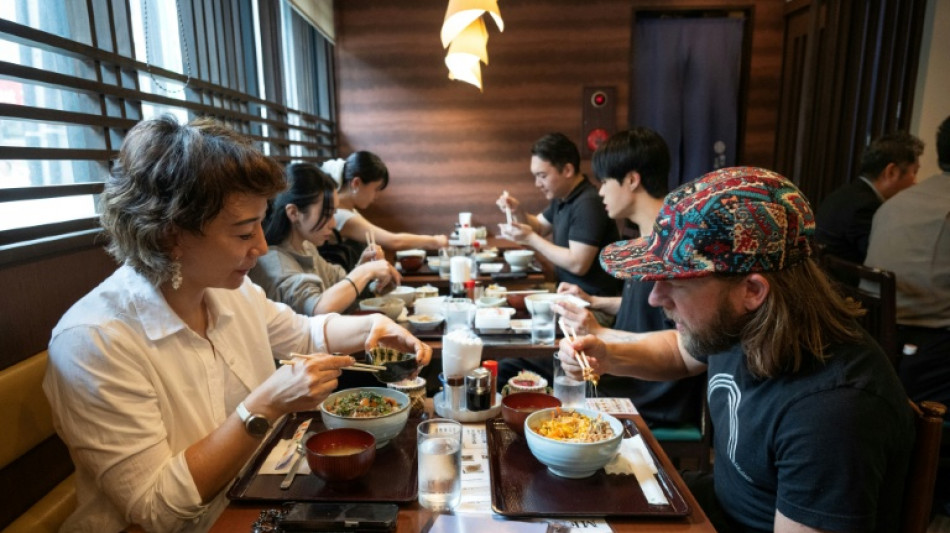
Slimy beans: Japanese natto disgusts and delights the world / Photo: © AFP

Sticky, translucent strings dangle from Wesley Smith's chopsticks as the American tourist relishes his natto, the loved-and-hated Japanese fermented soybean superfood going global one slimy mouthful at a time.
The latest trade statistics show Japan's exports of the highly nutritious gooey beans tripled from 2017 to 5,248 tonnes in 2025, with China and the United States topping the list of destinations.
The delicacy infused with beneficial bacteria remains a traditional Japanese breakfast staple, but their pungent aroma, viscous texture and yeasty taste divide even their homeland.
"I thought it was a little funky at first," Smith told AFP during his recent lunch at Sendaiya, a Tokyo restaurant that serves all-you-can-eat natto menus -- an idea of hell for some people, heaven for others.
But over the years, the mushy yellow-brown legumes "became an acquired taste like a strong cheese can, because you know how cheese can smell like dirty socks," the 47-year-old Arizonan said.
Recent years have seen natto join a series of fermented foods, from kimchi to kombucha, that have surged in popularity worldwide as Americans in particular seek better digestive health following the Covid-19 pandemic.
Regular consumption of the high-fibre, protein-packed snack is often linked to stronger immune systems, improved digestion, and greater bone density.
In China, too, the "trend toward health-consciousness especially among the middle and upper-income classes" is igniting interest in Japanese foods, the Japan External Trade Organisation said in a recent report.
- Curious in California -
In Los Angeles at Japanese restaurant Suehiro, owner Kenji Suzuki has noticed more non-Japanese clients taking the plunge.
"When social media started talking about natto and that it's a superfood, I think then more and more people wanted to see what it is, wanted to taste it -- 'is it as bad as people say it is?,'" Suzuki told AFP.
"Some people maybe don't like it, but other people, you know, they love it," the second-generation owner said.
During her lunch in Tokyo, tourist Smith's wife Maya Bourdeau, 46, likened natto to "natural wine" with "that slightly different taste."
While she vigorously stirred her bowl of bibimbap topped with natto, Smith knew that this would only make it even stringier.
"Subconsciously, I didn't want to have natto just dripping from my beard," he said, laughing.
Whisking, he said, also "really maximises the sliminess," which he believes is so off-putting for many Americans he doubts natto -- for all its recent hype -- will ever go mainstream.
"I can't think of anything in American cooking that's common with that slimy texture."
- Proud -
But Daisuke Tsujimoto is all for it, having travelled hundreds of kilometres from Osaka to Tokyo to fill his boots at Sendaiya.
"It really is a food culture Japan can be proud of," the 31-year-old told AFP.
"I truly hope people around the world will continue to eat it."
Aside from its supposed health benefits, natto -- dubbed the "star student of pricing" -- has long been loved in Japan for its stunning affordability.
A pack of three natto cups -- each 40 to 50 grams -- typically sells for around 100 yen ($0.60) or even less at supermarkets. Each typically contains little plastic sachets of mustard and soy sauce.
Even the perennial budget champion, however, hasn't evaded a "wave of price hikes", Yoshihiro Noro, former head of the Japan Natto Cooperative Society Federation, told AFP.
This is because of shortages of naphtha -- a byproduct of oil -- caused by the Middle East war, he said.
At the same time, Noro sees the price rise as natto's chance to outgrow its reputation as "poverty food" deemed "unsellable if priced at more than 100 yen."
"Very few foods can be called as truly healthy a superfood as natto is," said Noro, also the 72-year-old owner of his family-run business.
"I hope an era will come when people will collectively see high-quality, high-end natto as worth shelling out their money on."
- Stringy in Singapore -
And that is exactly what his company's Kamakurayama Natto, touted as "extremely stringy" but minus "stinkiness and bitterness," seeks to achieve.
At his factory west of Tokyo, workers in hygienic uniforms wash, steam -- and lavishly spray bacteria on -- soybeans that machines then meticulously assemble in cups, before fermenting them for 18 hours.
While around three times more expensive than average, Kamakurayama Natto has in recent years secured international orders including from Hong Kong, Shanghai, Singapore and even Norway.
"I've heard that in some countries, people have been told natto is good for their health, so they force themselves to eat it even though they strongly dislike the taste," Noro said.
"But keep eating it, and you will definitely get hooked."
F.Garcia--TFWP