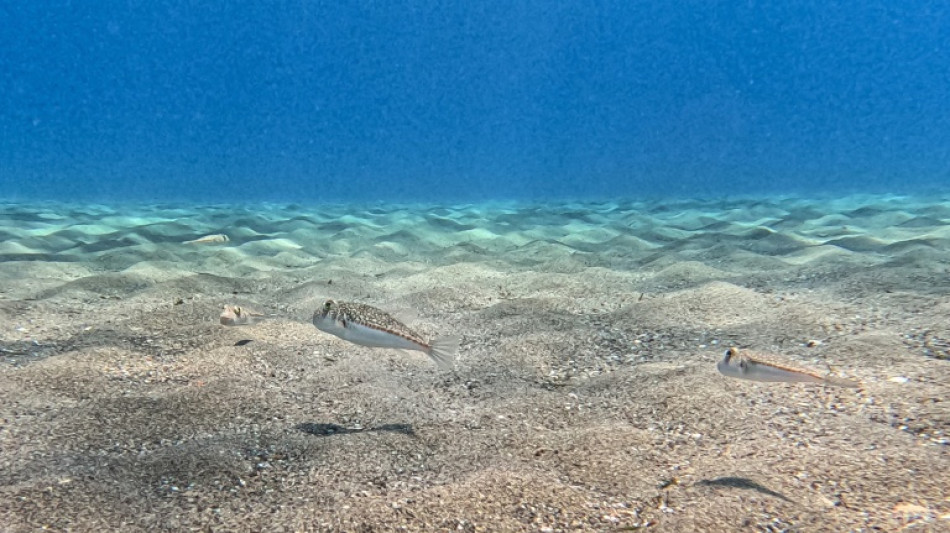
Greek fishermen struggle to keep up with pufferfish invaders / Photo: © AFP

On his fishing boat moored in the Greek port of Ierapetra in southwestern Crete, Alexis Charlambakis pries open the mouth of a freshly-caught pufferfish to reveal two massive teeth on each jaw.
"If one of these bites you, it will take your finger clean off," the 43-year-old said. "They are the destruction of the sea. They leave nothing behind."
Proof of the damage is visible on a neighbouring boat deck: a ray, a common seabream and another fish netted that day lie half shredded.
Pufferfish, a warm-water invasive species, were first spotted in Greek waters some 20 years ago and are wreaking havoc with the country's fishing industry, a pillar of the nation's agricultural exports.
Off the coast of Crete, Greece’s largest island, fishermen are seeing their catch dwindle because of the silver-cheeked Lagocephalus sceleratus menace, which typically measures between 40 and 60 cm.
"It’s an omnivorous fish that eats everything it encounters," said 65-year-old fisherman Giannis Giankakis.
"Nothing seems to bother it, because it has no natural predators among other fish," he added.
- Southern invaders -
The pufferfish explosion in Greek waters is the latest example of how warming oceans are changing ecosystems and upturning their reliant economies.
Of the nearly 200 species of pufferfish living in the world’s warm waters, three are currently found in the eastern Mediterranean Sea.
Scientists recorded them for the first time in Greece in June 2005, said Nota Peristeraki of the Hellenic Centre for Marine Research (HCMR).
Present in the Red Sea and in the Indian and Pacific oceans, the silver-cheeked pufferfish entered the Mediterranean via the Suez Canal, according to Université Côte d’Azur, which records non-native Mediterranean species.
Originally located near Crete and the Dodecanese islands, it has since spread to other areas, Peristeraki said.
- 'We cannot survive' -
In addition to their powerful toxin that makes them deadly to eat, these members of the Tetraodontidae family have a beak-like mouth strong enough to bite through wood and metal.
They not only ravage the fishermen's daily catch, but leave their nets in tatters too.
"If this wasn't my boat, I'd quit this profession for good," Charlambakis said.
"The situation is dire...we cannot survive," he told AFP.
After five days at sea, Charlambakis said his nets become useless and difficult to repair.
"It took me two days to fix these nets. I took them out this morning, another 20 holes," he said.
Feasting on other fish, crustaceans and squid, pufferfish cause around 8,500 euros’ ($9,800) worth of damage and lost income per year to fishing boats, said Peristeraki, the HCMR marine biologist.
The predator also contains tetrodotoxin, "an extremely dangerous toxin if ingested," warns HCMR marine biologist Thekla Anastasiou.
"It causes heart failure and stops the lungs from functioning," Anastasiou said.
- 'Worse every year' -
"It is imperative to reduce their population," Peristeraki said.
That's easier said than done, fishermen say.
"The job gets worse every year," said 53-year-old fisherman Kostis Zevelekakis.
"The state isn’t doing enough to help us deal with these fish (...) We can control their numbers if we’re given the right framework to hunt them," he added.
WWF in April released a responsible seafood guide (www.fishguide.wwf.gr) with over a hundred species found on the Greek market.
Among them are 13 invasive species which were not on the previous guide in 2015.
The newcomers include the Atlantic shrimp (Penaeus aztecus) and blue crab (Callinectes sapidus) in the northern Aegean Sea, and the lionfish (Pterois miles) in waters further south.
The fishermen want the state to subsidise them to hunt pufferfish, a programme already running in neighbouring Cyprus.
"They should give us an incentive to round them up," said 25-year-old Babis Doriakis.
"I have taken on my father's fishing boat, but I won't be able to continue without assistance," he said.
Then deputy agriculture minister Christos Kellas in February told parliament that authorities were examining a support programme for fishermen.
- Waste not -
Scientists in the meantime are trying to find ways to neutralise the fish's deadly toxin -- which can cause paralysis, respiratory failure, and death -- in order to make it marketable.
"At present, pufferfish are considered class 1 waste," the equivalent of potentially threatening industrial waste, said Elkethe chemist Manolis Mandalakis.
Under EU rules, the appropriate way to treat this waste is incineration, he said.
"We are trying to find alternative ways...that are less energy-consuming," said Mandalakis.
Potential uses could include fertiliser or fish feed, he said.
L.Holland--TFWP