The Fort Worth Press - South Asia monsoon risks both floods and drought: experts

USD -
AED 3.672499
AFN 66.467862
ALL 82.156949
AMD 365.453748
AOA 917.50406
ARS 1477.717624
AUD 1.429858
AWG 1.8
AZN 1.698411
BAM 1.714862
BBD 2.013854
BDT 123.410785
BHD 0.377115
BIF 2986.146427
BMD 1
BND 1.291276
BOB 10.873301
BRL 5.080498
BSD 0.999912
BTN 96.611135
BWP 13.625603
BYN 2.882245
BYR 19600
BZD 2.01096
CAD 1.40878
CDF 2258.497158
CHF 0.81238
CLF 0.023767
CLP 935.390103
CNY 6.76605
CNH 6.774305
COP 3230.16
CRC 453.660675
CUC 1
CUP 26.5
CVE 96.68128
CZK 21.183301
DJF 178.053485
DKK 6.55306
DOP 58.202543
DZD 133.13027
EGP 51.339902
ERN 15
ETB 161.385883
EUR 0.87657
FJD 2.221802
FKP 0.747809
GBP 0.748001
GEL 2.62008
GGP 0.747809
GHS 11.613327
GIP 0.747809
GMD 73.000038
GNF 8773.345024
GTQ 7.627356
GYD 209.188952
HKD 7.840415
HNL 26.776852
HRK 6.605902
HTG 130.732135
HUF 318.978502
IDR 17908
ILS 3.06365
IMP 0.747809
INR 96.49215
IQD 1309.864095
IRR 1375175.000272
ISK 125.370173
JEP 0.747809
JMD 158.693555
JOD 0.708987
JPY 163.068975
KES 129.419827
KGS 87.450342
KHR 4039.456379
KMF 432.000029
KRW 1480.384982
KWD 0.31004
KYD 0.833231
KZT 467.470408
LAK 22618.149934
LBP 89539.237177
LKR 336.282332
LRD 180.982025
LSL 16.478562
LTL 2.95274
LVL 0.60489
LYD 6.416484
MAD 9.387111
MDL 17.582639
MGA 4266.549759
MKD 53.993862
MMK 2099.348112
MNT 3589.011374
MOP 8.074967
MRU 39.944761
MUR 47.289966
MVR 15.4502
MWK 1733.800964
MXN 17.423499
MYR 4.087002
MZN 63.898139
NAD 16.478562
NGN 1373.801643
NIO 36.799649
NOK 9.595805
NPR 154.577817
NZD 1.71882
OMR 0.384491
PAB 0.999912
PEN 3.401578
PGK 4.473477
PHP 61.771989
PKR 277.791495
PLN 3.795599
PYG 6060.499781
QAR 3.645243
RON 4.591499
RSD 102.908992
RUB 78.378476
RWF 1471.284524
SAR 3.762597
SBD 8.074664
SCR 13.37301
SDG 600.501534
SEK 9.71037
SGD 1.29121
SLE 24.349728
SOS 571.416046
SRD 37.712503
STD 20697.981008
STN 21.481806
SVC 8.748794
SZL 16.462955
THB 33.806947
TJS 9.248926
TMT 3.5
TND 2.95993
TRY 47.217797
TTD 6.784744
TWD 32.476496
TZS 2639.998013
UAH 44.775449
UGX 3739.5879
UYU 40.122753
UZS 12049.97808
VES 736.310502
VND 26313.5
VUV 119.457233
WST 2.741971
XAF 575.148619
XAG 0.016853
XAU 0.000242
XCD 2.702551
XCG 1.802017
XDR 0.715269
XOF 575.148619
XPF 104.568172
YER 238.550207
ZAR 16.47517
ZMK 9001.202768
ZMW 18.372644
ZWL 321.999592
  • RYCEF

    0.2000

    18.25

    +1.1%

  • NGG

    1.4300

    83.49

    +1.71%

  • CMSC

    -0.0800

    21.995

    -0.36%

  • VOD

    0.3400

    15.61

    +2.18%

  • CMSD

    -0.0500

    22.2

    -0.23%

  • GSK

    0.4400

    51.21

    +0.86%

  • BP

    0.6500

    43.41

    +1.5%

  • BCE

    0.1150

    21.755

    +0.53%

  • RELX

    0.4800

    33.21

    +1.45%

  • RIO

    1.9150

    92.46

    +2.07%

  • BTI

    0.9000

    62.3

    +1.44%

  • JRI

    -0.0400

    12.91

    -0.31%

  • RBGPF

    0.0000

    67.35

    0%

  • BCC

    1.7400

    76.27

    +2.28%

  • AZN

    0.3900

    169.74

    +0.23%

South Asia monsoon risks both floods and drought: experts
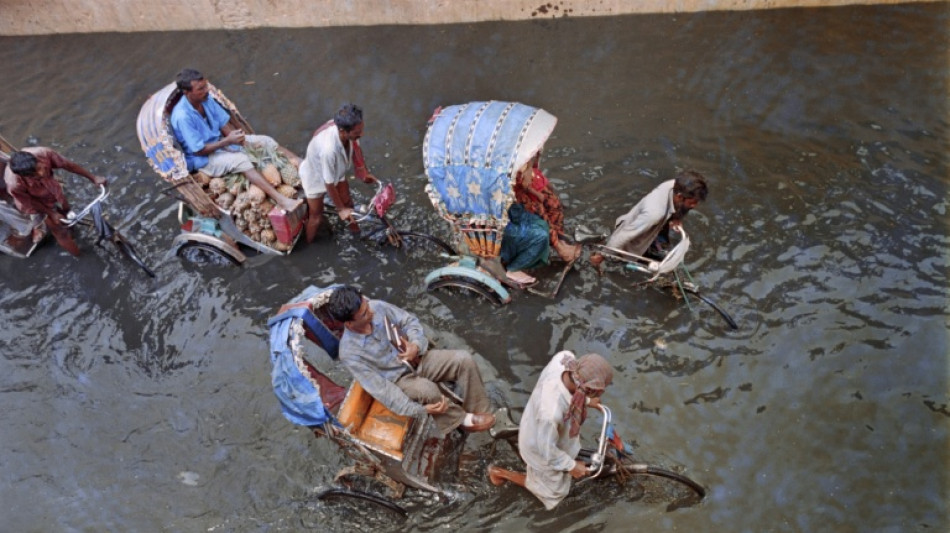
South Asia monsoon risks both floods and drought: experts / Photo: © AFP

South Asia monsoon risks both floods and drought: experts

South Asian communities face "serious hazards" from intense rains this season, even though the approaching monsoon is expected to bring lower than normal rains overall, risking drought, experts warned on Thursday.

Text size:

The Hindu Kush-Himalayan range, which stretches from Afghanistan to Myanmar, holds the largest reserves of ice and snow outside the Arctic and Antarctica and feeds at least 10 major Asian river systems that underpin water, food and energy security across the continent.

"The outlook points to a drier monsoon overall, but that does not mean lower risk," said Manish Shrestha, a hydrologist at the Kathmandu‑based International Centre for Integrated Mountain Development (ICIMOD).

"Short, intense rainfall events can still trigger serious hazards."

Long, dry spells followed by extreme rainfall events, ICIMOD warned, raised the risk of floods and landslides.

Deadly weather-related disasters are common during the monsoon season from June to September but experts say climate change, coupled with urbanisation, is increasing their frequency and severity.

The summer monsoon, which brings South Asia 70-80 percent of its annual rainfall, is vital for agriculture and therefore the livelihoods of millions of farmers and food security in a region home to around two billion people.

Lower levels of snow in the mountains -- or "snow persistance", the time that snow remains on the ground -- meant the region was starting with a "weaker seasonal water buffer", said Sher Muhammad from ICIMOD.

"Warmer temperatures, combined with reduced rainfall, could limit the recharge of rivers, springs and other water systems," he said.

Experts said stronger early warning systems were needed.

"Drought and flood risks can no longer be managed separately," said Arun Bhakta Shrestha, a senior adviser at ICIMOD said in a statement.

"Early warning systems, short-term forecasts, and locally driven preparedness need to work together to address increasingly complex hazards."

Melting glaciers can also add to the volume of water, while unregulated construction in flood-prone areas exacerbates the damage.

F.Carrillo--TFWP