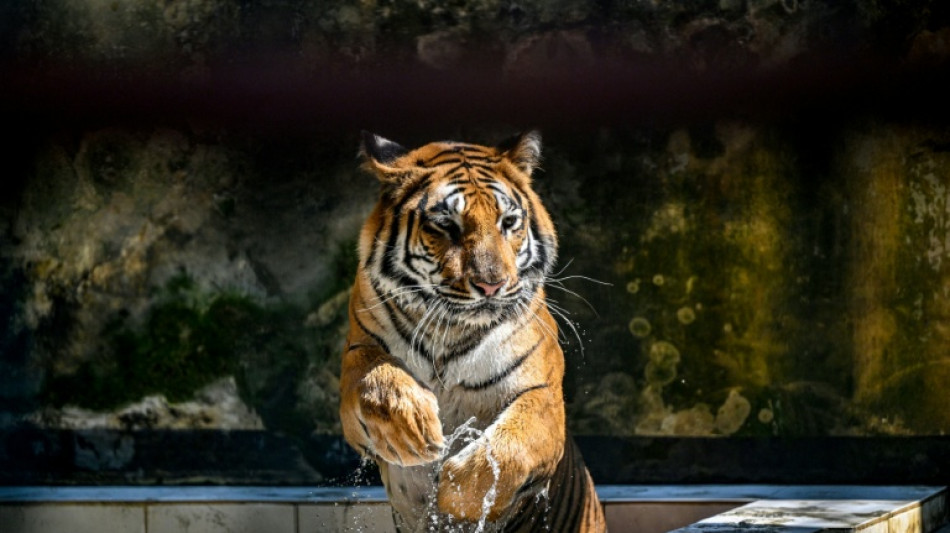
Bangladesh's tigers stalk uncertain future in Sundarbans / Photo: © AFP

Tigers are so feared in Bangladesh's vast Sundarban mangroves that locals invoke spirits to protect against them. But experts say it is the big cats themselves that need defending.
Abdul Goni Gazi was among the first to raise the alarm for the creatures struggling to grow their numbers under pressure from habitat loss, poaching and climate change.
Known locally as "Goni Tiger", the 45-year-old devoted his life to promoting coexistence between the big cats and the people living on the forest's edge.
Despite the danger, this activist claims to have saved 36 Bengal tigers from guns or traps -- and 106 local residents from the animals' jaws.
He has pulled furious villagers back from the brink of killing tigers -- and, in some cases, dragged home the dismembered bodies of others.
"If we want the Sundarbans and the thousands of people dependent on it to survive, we need the Bengal tigers," he said.
Stretching 10,000 square kilometres (3,900 square miles) across sprawling mangrove forests and tidal rivers, the UNESCO-listed World Heritage site straddles both Bangladesh and India.
Tigers eat grazing animals in the forest, which has the knock-on effect of allowing mangroves to grow and thus help protect coastlines from erosion and storms.
"If a tiger is killed in the Sundarbans, it creates a turmoil in the ecosystem," said Mohammad Abdul Aziz, a zoology expert at Bangladesh's Jahangirnagar University.
The creatures' power is also deeply embedded in people's culture, prompting them to seek the blessings of dozens of spirits before entering the forest.
"If someone chants the name of Mother Bonbibi, she will save his life from tigers, snakes, and crocodiles," said villager Ashutosh Mandal, 63, referring to a deity whose idol is worshipped at temples.
A blend of Islamic and Hindu beliefs has long served as a conservation code, with supernatural guardians believed to punish anyone who plunders the forest for greed.
- 'Safeguard the ecosystem' -
"If the Sundarbans had 400-500 tigers, they themselves would safeguard the ecosystem -- without the need for human intervention," Goni told AFP.
The South Asian nation of 170 million people pledged in 2010 to double its tiger population, then placed at 414.
But a more rigorous camera-trap census in 2015 revised the population down to 106, followed by counts of 114 in 2018, and 125 in 2024 -- a rise of roughly two tigers per year.
The slow growth has drawn scrutiny over the effectiveness of the nation's conservation efforts, including the latest $4.2 million tiger project.
Chief Conservator of Forests Amir Hossain Chowdhury said habitat loss remains the core challenge.
Rising sea levels and surging tides from increasingly powerful storms -- resulting in an increase in soil salinity -- have degraded agricultural lands, pushing people into tiger territory.
"Human encroachment has pushed (the Sundarbans tigers) into a corner, creating conditions that are not suitable for most species, let alone tigers," Chowdhury said.
Storms, rising tides, and shifting water systems have widened some rivers beyond what tigers can swim, limiting their range.
Chowdhury said earth mounds have been built to provide refuge for tigers and other animals during highwater.
- 'Kill tigers on demand' -
Tigers also face other, more direct threats.
Poachers and villagers still kill tigers, undeterred by penalties of a 12-year jail term or $15,000 fine.
"Sometimes they kill tigers on demand -- from home and abroad," said wildlife trafficking expert Nasir Uddin.
"And sometimes they do it for their own safety, so that tigers cannot attack them, when they anchor their boats near forest canals."
Some of the armed bandits who prowl the forests have even used freshwater ponds dug to help the tigers as a trap.
"Poachers sometimes lure thirsty animals there by placing poisoned bait," Chowdhury said.
Several people are arrested every year selling or buying tiger hides, teeth, claws and bones, prized in traditional Chinese medicine.
Tiger parts are smuggled to India, Myanmar, China, Malaysia, and even further to buyers in Australia, Britain and Germany, Uddin said.
The hunting of their favourite prey also threatens the future of the tigers -- especially that of deer, which make up 80 percent of their diet.
A 2013 study estimated that 11,000 deer are killed illegally every year for meat.
"Killing spotted deer indiscriminately creates food insecurity... and can push tigers into human settlements, leading to attacks on villagers," Aziz, the zoology professor, said.
But despite the challenges, Abishek Harihar from wild cat conservation organisation Panthera said there is "hope for the species" globally.
"Conservation efforts since the 1970s have prevented a tremendous collapse of tiger numbers," he said, saying that had "possibly placed the species on a trajectory of recovery and long-term survival."
F.Carrillo--TFWP