'Transnational repression' worsened last year: report / Photo: © AFP/File

Authoritarian governments that reach across borders to persecute their own citizens did so at a greater rate last year, particularly in Southeast Asia and East Africa, a human rights group charged Thursday.
The phenomenon of so-called transnational repression exploded into public awareness with the horrific murder of Saudi journalist Jamal Khashoggi at his country's consulate in Istanbul in 2018.
In an annual report on transnational repression, the rights group Freedom House said China was the world's "leading perpetrator" in 2025, followed by Vietnam and Russia.
And six countries joined a long list of violators for the first time: Afghanistan, Benin, Georgia, Kenya, Tanzania and Zimbabwe.
The new additions raised to at least 54 the number of countries known to carry out this kind of rights violation since 2014, Yana Gorokhovskaia, a co-author of the report, said in an interview with AFP.
That's more than a quarter of the world's countries.
"Collaboration among authoritarian governments fueled transnational repression in Southeast Asia and East Africa in 2025," the report states. "Over half of the incidents recorded last year -- 69 of 126 -- occurred in these two regions."
"The trend that's emerging is that a lot of those governments, Kenya, Uganda and Tanzania, are cooperating to sort of trade dissidents back and forth to help arrest them," said Gorokhovskaia.
She explained that this kind of government behavior tends to happen when such regimes are under election-related stress.
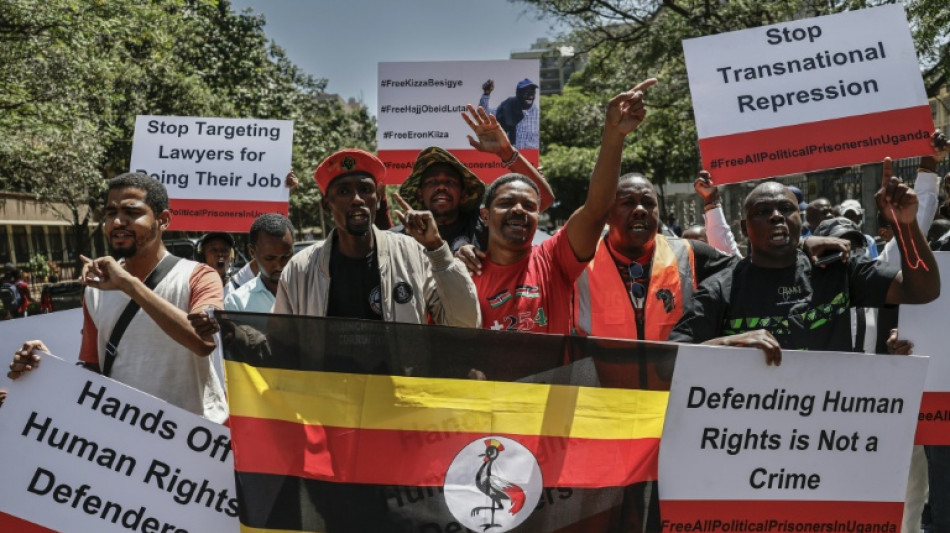
In November 2024 Ugandan opposition leader Kizza Besigye was abducted in Kenya and taken to Uganda, where he now faces charges of treason.
And in January 2025, renowned Tanzanian rights activist Maria Sarungi Tsehai was kidnapped on the streets of Nairobi but released following a swift intervention by rights groups that triggered a media uproar.
-'Authoritarian neighborhoods' -
In Southeast Asia, Thailand yielded to pressure from China and Vietnam to turn over representatives of ethnic minority groups, fearing reprisal and economic punishment from Beijing, the study said.
Because of immigration restrictions around the world, "dissidents tend to actually not be able to get very far from their own region," said Gorokhovskaia, citing as examples Cambodians who seek refuge in Thailand and Russians who go to Turkey.
"And so what that means is that there's a lot more transnational repression in these authoritarian neighborhoods, because that's where the dissidents can make it to," she said.
"With 49 incidents, detention was the most ubiquitous tactic of transnational repression documented last year. It was followed closely, with 48 incidents, by unlawful deportation," the report said.
Among its recommendations the rights group said countries with democracies should slap sanctions on foreign leaders who favor transnational repression through forced returns of dissidents back to their home countries.
These rule-of-law countries should impose sanctions and visa bans against foreign government officials who facilitate transnational repression via forced returns, Freedom House said.
It added that democratic governments should also seek accountability from government officials in host countries who facilitate and enable such rights abuses.
"Transnational repression is a low-cost way of maintaining a regime by cracking down on dissent," said Gorokhovskaia.
She argued that, although countries that engage in this kind of repression may be hit with sanctions, this punishment tends to be short-lived -- as in the case of the outcry against Saudi Arabia after the murder and dismemberment of Khashoggi, a US resident who had been critical of Crown Prince Mohammed bin Salman.
"There was an instant reaction, but that pressure wasn't maintained, and eventually the relationship sort of normalized," said Gorokhovskaia.
J.P.Cortez--TFWP