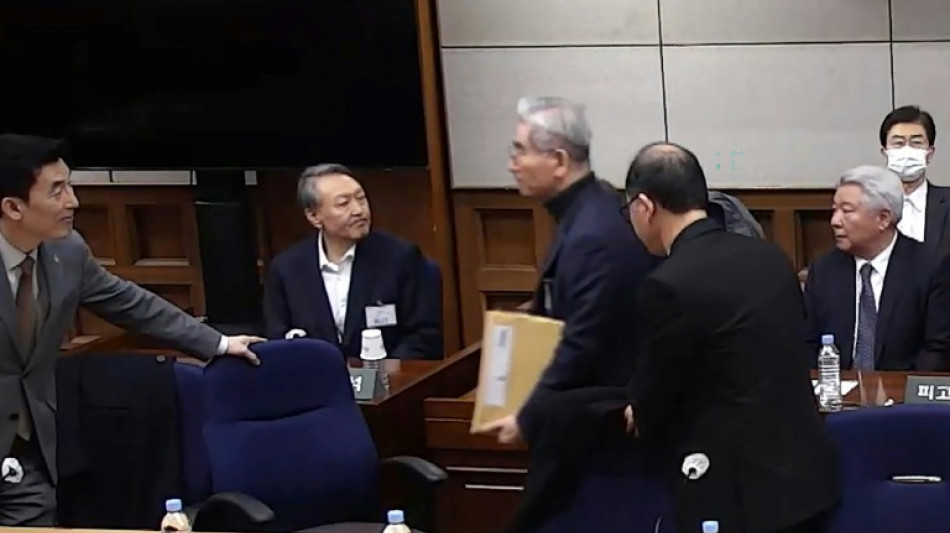
Ex-South Korea leader apologises for martial law crisis / Photo: © YONHAP/AFP

South Korea's disgraced former president Yoon Suk Yeol apologised Friday for the "hardship" caused by his 2024 martial law decree, one day after he was sentenced to life in prison for insurrection.
The Seoul Central District Court on Thursday found Yoon guilty of leading a December 2024 insurrection designed to "paralyse" the National Assembly.
Although Yoon acknowledged his bid to impose military rule had caused "frustration", he maintained it was a measure taken "solely for the sake of the nation".
"I deeply apologise to the people for the frustration and hardships I have caused them, due to my own shortcomings, despite my resolve to save the nation," Yoon said in a statement shared through his lawyer.
Yoon lashed the court's verdict as "difficult to accept" -- but did not give any indication as to whether he would appeal.
It was not clear when 65-year-old Yoon would be eligible for parole, although most inmates serving life terms can typically apply after 20 years.
Presiding judge Ji Gwi-yeon said Yoon sent troops to the National Assembly building in an effort to silence political opponents who had frustrated his attempts to govern.
"The court finds that the intention was to paralyse the assembly for a considerable period," Ji told the Seoul Central District Court.
"The declaration of martial law resulted in enormous social costs, and it is difficult to find any indication that the defendant has expressed remorse for that," the judge said.
The declaration triggered flash protests, sent the stock market into panic and caught key military allies such as the United States off guard.
Prosecutors had sought the harshest penalty for Yoon's insurrection charges, urging the court to sentence him to death.
South Korea has an unofficial moratorium on capital punishment, with the last prisoners executed in 1997.
Yoon was an unpopular president at the time of the martial law crisis.
His party was vastly outmuscled in South Korea's National Assembly, which had voted to block budget measures and impeach key figures in his administration.
- Legislative dictatorship -
With support from senior military figures, Yoon dispatched troops to seize control of the assembly building and arrest critics.
Yoon has consistently denied wrongdoing, arguing he acted to "safeguard freedom" against an opposition-led "legislative dictatorship".
Prosecutors accused him of leading an "insurrection" driven by a "lust for power aimed at dictatorship and long-term rule".
Yoon broke into late-night TV on December 3, 2024, to deliver a shock address to the nation.
Pointing to vague threats of North Korean influence and dangerous "anti-state forces", he declared the suspension of civilian government and the start of military rule.
Martial law was lifted around six hours later, after lawmakers raced to the assembly building to hold an emergency vote.
A.Williams--TFWP