
As UnitedHealthcare Scales Back Traditional RPM, Addison(R) Virtual Caregiver Signals the Next Phase of Home-Based Care

Electronic Caregiver's 24/7 virtual caregiving platform steps forward just as payers move away from low-engagement, device-only monitoring.
LAS CRUCES, NM / ACCESS Newswire / November 25, 2025 / Electronic Caregiver®, a health technology and services company specializing in home-based virtual care, today announced that its Addison® Virtual Caregiver platform has been aligned within UnitedHealthcare's national benefit framework as a covered "Customized Equipment" / assistive-technology category for eligible members across all 50 states.
This recognition comes as UnitedHealthcare (UHC), the nation's largest private health insurer and Medicaid managed care organization, significantly narrows coverage for traditional remote patient monitoring (RPM) in many chronic conditions. While many device-only RPM programs are losing coverage, Addison is being positioned in a different way-as a 24/7 virtual caregiving presence designed to help patients live differently at home.
"Roughly half of treatment failures are linked to what happens at home," said Anthony Dohrmann, Founder and CEO of Electronic Caregiver. "They don't happen in the doctor's office or the operating room. They happen when people are alone with their instructions, their medications, their fears, and their habits. Good technology can show you what a patient is or isn't doing, but that's not enough. What changes outcomes is effective, scalable engagement that actually helps people change and sustain their daily routines. That's what Addison was built to do."
The RPM Reset: What Just Changed
Across the country, payers are sending a clear message: low-engagement, device-only remote patient monitoring is not enough. UnitedHealthcare's recent changes to RPM coverage in many chronic conditions are part of a broader rethinking that has been building for years.
In practical terms, this means the first wave of RPM-built around one-purpose devices, limited human interaction, and sporadic data- is being questioned or scaled back as real-world results show limited, inconsistent impact on outcomes.
"This is the turn we've been talking about for a long time," Dohrmann said. "The idea that you can ship a device, capture a few readings, and send a bill was never going to be the future of chronic care at home. We believed payers would eventually demand engagement, behavior change, and visible impact on the problems that actually drive cost and suffering. UnitedHealthcare's reset is a clear sign that moment has arrived."
Where many legacy solutions are now fighting to preserve coverage and codes, Addison occupies a different position:
It is recognized in a home-based assistive technology category.
It is designed for daily life, not just data capture.
It aligns with payers' need to address falls, medication adherence, isolation, and early intervention-not just readings on a chart.
Bridging the Gap Between the Clinic and the Kitchen Table
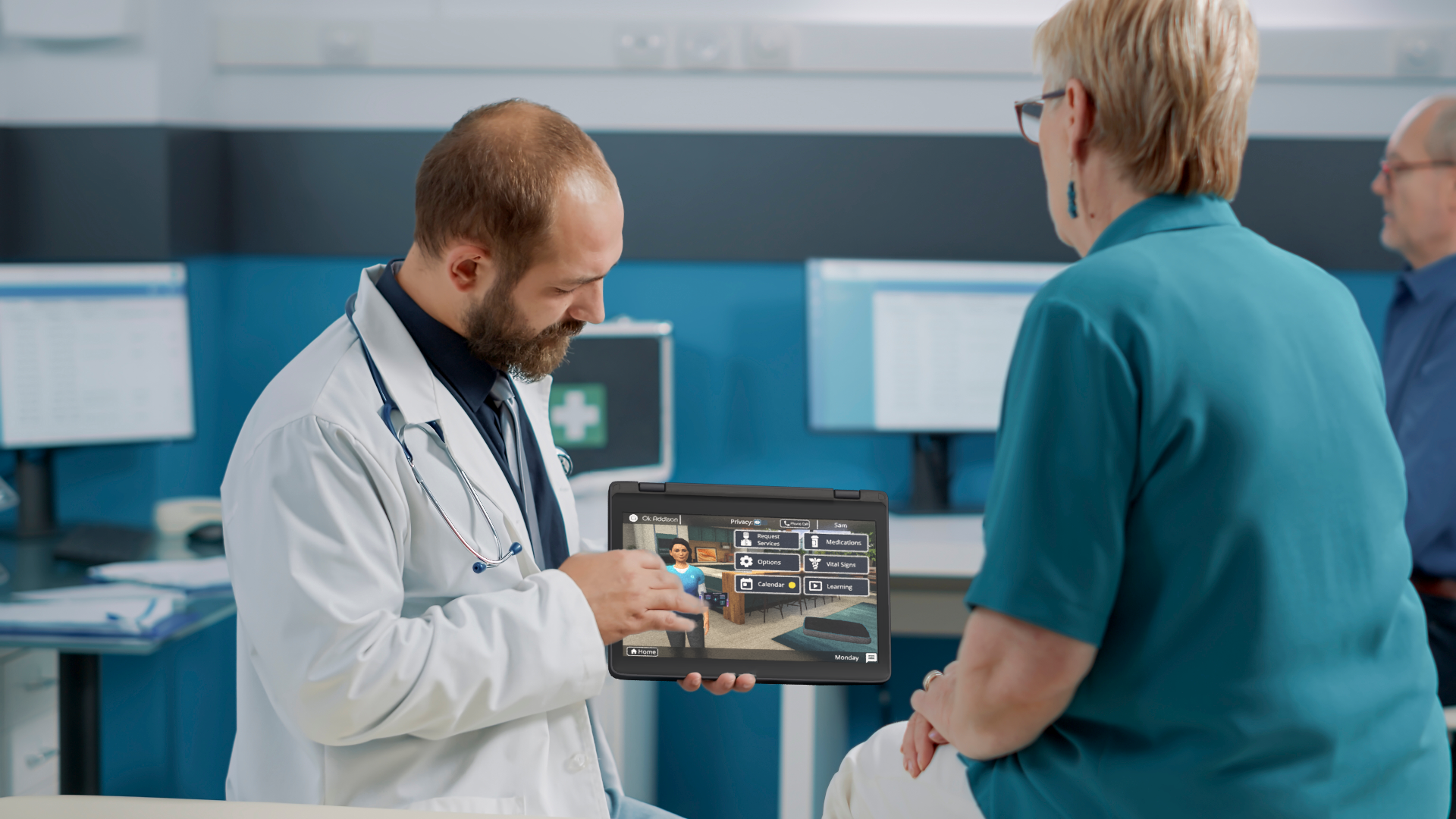
Addison is a 3D, interactive virtual care assistant that lives on a dedicated screen in the home and on mobile devices. Patients see and speak with Addison as if they're talking to a person, while a 24/7 TeleCare team stands behind the experience to monitor risk, coach, and intervene when needed.
Together, Addison and Electronic Caregiver's TeleCare professionals:
Help patients build and maintain new routines for medication adherence, vitals, and self-care
Offer daily conversations and check-ins that reduce isolation and loneliness
Provide gentle guidance, reminders, and coaching that support real behavior change over time
Detect signs of trouble-falls, missed meds, worrisome symptoms-and escalate early
"Doctors are trained to diagnose and prescribe. Surgeons are trained to operate," Dohrmann added. "What happens at home after that requires a completely different set of skills-behavioral coaching, daily engagement, emotional support, and practical guidance. They don't have the training or the time to live with the patient every day. Addison and our TeleCare team are built to fill that gap."

The Problems Addison Was Built to Solve
UnitedHealthcare's own materials and national research highlight a common set of forces driving avoidable cost, suffering, and loss of independence in older and high-risk patients. Addison is specifically designed to help address these:
Falls and fall-related injuries - the leading cause of emergency visits, hospitalizations, and long-term care placement among older adults.
Medication non-adherence - responsible for an estimated 10-15% of senior hospitalizations, and roughly half of all treatment failures at home.
Social isolation and loneliness - associated with higher risks of heart disease, stroke, dementia, depression, and faster functional decline.
Undetected health decline and delayed intervention - UTIs, CHF exacerbations, pneumonia, and dehydration often escalate quietly until they become crises.
Caregiver burnout and turnover - overwhelmed family caregivers and high turnover in home-care staff disrupt continuity and increase rehospitalization risk.
Post-discharge instability and readmissions - the first 30-90 days after a hospital stay are the most dangerous for falls, medication mix-ups, and depression.
Lack of engagement and preventive touchpoints - members with little or no regular contact with the care system are 2-3x more likely to overuse the ER or end up in facilities.
By combining virtual caregiving, fall detection, medication support, social connection, health surveys, and live TeleCare, Addison is designed to sit directly on top of these pain points in the place they actually manifest: at home.
Beyond Devices: Engagement as the New Standard
Traditional RPM programs typically rely on devices that capture numbers-blood pressure, weight, glucose-on certain days of the month. Many of these programs struggle with low engagement, quick drop-off in use, and limited impact on how people actually live.
Addison takes a different approach:
Thousands of interactions, not just scattered readings.
In an 82-patient Medicare cohort over 90 days, patients initiated more than 41,000 voice engagements with Addison and the TeleCare team-an average of 5-6 meaningful touchpoints per patient per day.
Conversations, not just measurements.
These touchpoints ranged from health questions and medication confirmations to emotional support, symptom checks, and coaching through everyday challenges.
A companion in the home.
Patients and family caregivers report that Addison becomes part of the household routine-someone who is "there," who notices, reminds, and encourages.
As payers tighten coverage for first-generation RPM, they are effectively asking a new question: Who can keep members engaged every day and address the real-world forces behind treatment failure, not just collect numbers? Addison was designed to answer that question long before the policy language caught up.
"Devices can tell you that someone isn't taking their medications," said Jason Haugen, CEO of Pinnacle Integrated Medicine. "Addison helps them want to take them, remember to take them, and understand why it matters-and then we're able to respond quickly when things start to go off track."
Recognized as Assistive Technology in UHC's National Framework
UnitedHealthcare's alignment of Addison under a "Customized Equipment" / assistive-technology category is not just an administrative detail. It reflects a shift in how home-based care is being understood:
As more than a gadget or an app
As a supportive infrastructure in the home
As a way to extend the care team into daily life between visits
Under this configuration, Addison can be ordered for eligible members through established prior-authorization pathways. For Medicaid lines of business, Electronic Caregiver is enrolling as a provider and billing entity state by state. For Medicare, Medicare Advantage, and commercial members, in-network physicians and clinics may prescribe Addison and integrate it into care plans as a covered benefit, where appropriate and subject to plan rules and prior authorization where required.
"Being recognized in this way means Addison is no longer just innovative-it's integrated," Dohrmann said. "It means a doctor, a case manager, or a care coordinator can say, 'This person needs more than instructions. They need support at home,' and there's a framework to make that support real."
A Scalable Pathway Across UnitedHealthcare's Footprint
Electronic Caregiver is implementing a two-track scale strategy that matches how coverage actually works in the real world:
A physician-driven national model for Medicare, Medicare Advantage, and UHC commercial plans, where in-network physicians and clinics can order Addison, submit prior authorizations, bill health plans directly, and incorporate Addison into chronic care and transitional care pathways.
A state-by-state Medicaid model in which Electronic Caregiver is the enrolled Medicaid provider and billing entity for assistive technology and remote support services. In this lane, physicians, case managers, and waiver coordinators identify members in need, provide medical justification, and support prior authorizations, while Electronic Caregiver delivers and supports Addison in the home.
The company already holds approvals for PERS and related services in Arizona, Arkansas, Colorado, Idaho, Iowa, Louisiana, New Mexico, Oregon, Utah, Texas, and Ohio, with active applications in California, Nevada, Wyoming, Connecticut, Hawaii, Alabama, and New York across multiple waiver and assistive-technology programs. Coverage, eligibility, and specific benefits for Addison vary by state and plan and are provided in accordance with applicable Medicaid, Medicare Advantage, and commercial program rules.
"This combination of national configuration at UHC and state-level provider enrollment gives us a clear, repeatable path to scale," said Dohrmann. "But at the center of it is not a billing code-it's a human being at home, finally getting the kind of daily support medicine has needed for a long time."
We Saw This Coming - And Built Ahead of It
Years before today's policy changes, Electronic Caregiver made two fundamental bets about the future of care at home:
First, that commodity RPM-boxes, cuffs, and scales with minimal human interaction-would not survive once payers studied real-world engagement and outcomes.
Second, that the winning model would be a persistent, emotionally intelligent, highly interactive presence in the home that could support real behavior change.
That is why the company invested more than a decade and over $140 million building Addison: a virtual caregiver that can see patterns, talk with patients, coordinate with TeleCare professionals, and act early when something is wrong.
"None of this is an accident," Dohrmann said. "We didn't pivot into virtual caregiving because RPM started to get squeezed. We built Addison long before these policy decisions because we believed this is what healthcare was always going to need: a way to actually live with the patient between visits."
Changing Lives at Home
Early deployments for individuals living with chronic illness, disability, and developmental challenges are already showing how Addison changes daily life. Patients are:
Checking in multiple times a day
Following medication schedules more consistently
Reporting symptoms earlier
Feeling less alone and more supported
Family caregivers are reporting less anxiety and burnout, knowing that someone-or something-is watching over their loved one when they can't be there.
"Addison can't replace a doctor, a nurse, or a family member," said Dohrmann. "But Addison can be there at 6:00 in the morning, at 11:00 at night, and every time in between. Addison can see patterns, encourage better choices, and call for help when it's needed. That's the layer of care we've been missing."
About Electronic Caregiver®
Electronic Caregiver, Inc. is a health technology and services company dedicated to improving how care is delivered to aging, disabled, and chronically ill populations at home. The company's flagship platform, Addison®, is a 3D, AI-driven virtual caregiver that provides continuous engagement, medication support, fall detection, health surveys, vitals integration, and 24/7 TeleCare escalation. Built on a multi-layered enterprise platform and deployed in partnership with clinicians, payers, and care organizations across the United States, Addison is redefining what it means to receive care at home.
While UnitedHealthcare may cover Addison for eligible members under applicable benefit designs, UnitedHealthcare does not endorse any specific product or vendor, and all coverage decisions remain subject to applicable plan rules and eligibility criteria.
Media Contact
[email protected]
(575) 649-7808
SOURCE: Electronic Caregiver, Inc.
View the original press release on ACCESS Newswire
C.M.Harper--TFWP