The Fort Worth Press - Bolivia says US drug agency to return to aid cocaine battle

USD -
AED 3.672499
AFN 63.000238
ALL 83.169003
AMD 376.6209
ANG 1.790083
AOA 917.000092
ARS 1368.052397
AUD 1.451716
AWG 1.8025
AZN 1.69793
BAM 1.695271
BBD 2.011918
BDT 122.564316
BGN 1.709309
BHD 0.376989
BIF 2967.20061
BMD 1
BND 1.283718
BOB 6.917863
BRL 5.237198
BSD 0.998895
BTN 94.130496
BWP 13.733504
BYN 2.999805
BYR 19600
BZD 2.009058
CAD 1.38535
CDF 2285.509878
CHF 0.794702
CLF 0.023516
CLP 928.540171
CNY 6.91145
CNH 6.91897
COP 3689.09
CRC 463.12669
CUC 1
CUP 26.5
CVE 95.576763
CZK 21.245955
DJF 177.883719
DKK 6.477905
DOP 60.224672
DZD 133.026736
EGP 52.70043
ERN 15
ETB 154.382647
EUR 0.866896
FJD 2.257398
FKP 0.747836
GBP 0.749905
GEL 2.695064
GGP 0.747836
GHS 10.920706
GIP 0.747836
GMD 73.501546
GNF 8757.194369
GTQ 7.641634
GYD 208.983427
HKD 7.82568
HNL 26.524801
HRK 6.531698
HTG 130.816171
HUF 336.210143
IDR 16931.95
ILS 3.124096
IMP 0.747836
INR 94.16635
IQD 1308.600776
IRR 1313300.000453
ISK 124.339829
JEP 0.747836
JMD 156.993954
JOD 0.708981
JPY 159.669885
KES 129.709928
KGS 87.449854
KHR 4000.242702
KMF 426.999823
KPW 900.057798
KRW 1509.249757
KWD 0.30721
KYD 0.83247
KZT 481.23605
LAK 21576.267146
LBP 89453.008863
LKR 314.161267
LRD 183.30119
LSL 17.089302
LTL 2.95274
LVL 0.60489
LYD 6.378746
MAD 9.32633
MDL 17.545669
MGA 4163.217544
MKD 53.427703
MMK 2099.983779
MNT 3583.827699
MOP 8.049494
MRU 39.846405
MUR 46.630413
MVR 15.459802
MWK 1732.116931
MXN 17.91723
MYR 3.999878
MZN 63.910338
NAD 17.089302
NGN 1384.759801
NIO 36.760627
NOK 9.697715
NPR 150.60914
NZD 1.735915
OMR 0.384501
PAB 0.998891
PEN 3.457024
PGK 4.316622
PHP 60.219872
PKR 278.822545
PLN 3.706645
PYG 6539.1033
QAR 3.642258
RON 4.417598
RSD 101.817979
RUB 81.375355
RWF 1458.729712
SAR 3.751912
SBD 8.041975
SCR 13.744945
SDG 601.00022
SEK 9.427865
SGD 1.28598
SHP 0.750259
SLE 24.549949
SLL 20969.510825
SOS 570.871346
SRD 37.562019
STD 20697.981008
STN 21.236391
SVC 8.740763
SYP 111.44287
SZL 17.084534
THB 32.979571
TJS 9.559625
TMT 3.51
TND 2.939203
TOP 2.40776
TRY 44.4593
TTD 6.780072
TWD 31.945008
TZS 2572.214879
UAH 43.832448
UGX 3715.935095
UYU 40.496498
UZS 12167.15207
VES 466.018145
VND 26351
VUV 119.023334
WST 2.74953
XAF 568.580406
XAG 0.014521
XAU 0.000227
XCD 2.70255
XCG 1.800334
XDR 0.707132
XOF 568.580406
XPF 103.373552
YER 238.650021
ZAR 17.09465
ZMK 9001.256834
ZMW 18.754849
ZWL 321.999592
  • RBGPF

    -13.5000

    69

    -19.57%

  • CMSD

    0.0700

    22.75

    +0.31%

  • RYCEF

    -0.6000

    15.3

    -3.92%

  • CMSC

    -0.0900

    22.82

    -0.39%

  • BCE

    -0.0200

    25.47

    -0.08%

  • RIO

    -1.7500

    85.79

    -2.04%

  • GSK

    -0.7600

    53.94

    -1.41%

  • BCC

    -0.3600

    74.29

    -0.48%

  • NGG

    -1.8900

    82.4

    -2.29%

  • BTI

    -0.1900

    58.26

    -0.33%

  • VOD

    -0.0900

    14.63

    -0.62%

  • JRI

    -0.0300

    12.07

    -0.25%

  • RELX

    -0.4000

    32.07

    -1.25%

  • AZN

    -3.7400

    183.4

    -2.04%

  • BP

    0.7600

    46.17

    +1.65%

Bolivia says US drug agency to return to aid cocaine battle
Bolivia says US drug agency to return to aid cocaine battle / Photo: © AFP

Bolivia says US drug agency to return to aid cocaine battle

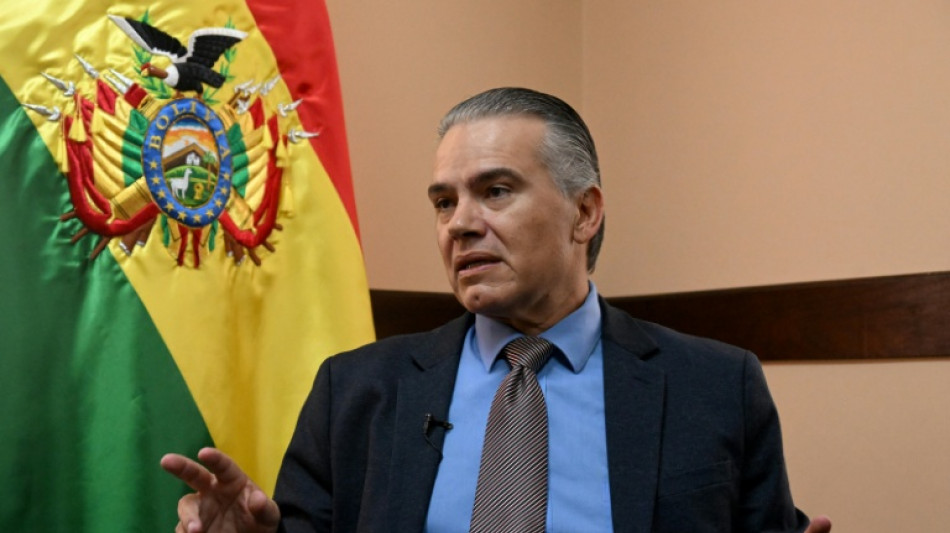
Bolivia's brand-new narcotics czar, Ernesto Justiniano, told AFP Friday the US Drug Enforcement Administration, expelled in 2008, will be returning to bolster the South American country's anti-cocaine campaigns.

Text size:

Justiniano is part of the new administration of President Rodrigo Paz, a pro-business conservative who took office on November 8 after two decades of leftist rule.

Paz, 58, is aiming for a sharp political, economic, social and diplomatic shift away from the policies of leftist leaders blamed by many for Bolivia's economic collapse, with dollars in short supply and annual inflation over 20 percent.

In an interview with AFP Friday, Justiniano said "there is a political commitment" for the DEA to return to Bolivia, where he said cocaine production has spiraled out of control.

"International cooperation is fundamental," he added. "We will no longer be an isolated country, a country that is self-absorbed and acts solely out of political necessity."

The new government has set for itself the tasks of eradicating coca leaves -- the raw material for cocaine production -- and going after drug cartels.

According to United Nations data, Bolivia is the world's third-largest producer of coca and cocaine, after Colombia and Peru.

Ties with the United States were severed under former socialist leader Evo Morales, in office from 2006 to 2019.

Bolivia took a sharp turn to the left under Morales, nationalizing energy resources and making alliances with China, Russia and fellow leftists in Cuba, Venezuela and elsewhere in Latin America.

In 2008, Morales expelled the US ambassador and DEA officials, accusing them of interference in Bolivia's affairs. USAID officials followed in 2013.

Washington expelled Bolivia's ambassador in retaliation, and the envoys were never replaced.

Paz, an economist-turned-senator, vowed the day after his election victory to renew ties with Washington.

- No money for eradication -

Justiniano -- whose official title is deputy minister of social defense and controlled substances -- said Bolivia's cocaine production levels were alarming, with estimated annual production of about 300 tons.

The UN says Bolivia has 31,000 hectares of coca crops. Of these, about 22,000 hectares are legal -- grown to be chewed as a stimulant, brewed into a tea thought to combat altitude sickness or used in religious rituals.

Justiniano, 56, said modern processes had reduced the amount of coca required to make one kilogram (2.2 pounds) of cocaine by about half.

"With one hectare of illegal coca, I can produce more than double the cocaine than twenty years ago," he told AFP.

He added that Bolivia's ability to address the problem was limited, with helicopters and planes grounded due to a lack of money for insurance or spare parts.

"All incursions... are conducted by land," he stated.

"And once on site, they must travel on foot, even lacking fuel for vehicles."

Bolivia's economy is in recession, according to the World Bank.

A.Nunez--TFWP