The Fort Worth Press - Nigerian chef aims for rice hotpot record

USD -
AED 3.672497
AFN 64.50286
ALL 80.938098
AMD 360.576387
ANG 1.789785
AOA 917.999539
ARS 1545.633672
AUD 1.447136
AWG 1.8025
AZN 1.701814
BAM 1.743425
BBD 2.008887
BDT 123.879606
BGN 1.747831
BHD 0.376622
BIF 2990.256817
BMD 1
BND 1.276598
BOB 11.853793
BRL 5.526602
BSD 0.997402
BTN 93.614366
BWP 13.704149
BYN 2.9865
BYR 19600
BZD 2.006035
CAD 1.412805
CDF 2290.999683
CHF 0.82066
CLF 0.024624
CLP 969.009573
CNY 6.672804
CNH 6.668125
COP 3278.17
CRC 451.767894
CUC 1
CUP 23.937993
CVE 98.289855
CZK 21.691597
DJF 177.613956
DKK 6.66415
DOP 60.687368
DZD 136.277909
EGP 53.349399
ERN 15
ETB 161.149904
EUR 0.89146
FJD 2.252798
FKP 0.745155
GBP 0.744805
GEL 2.589836
GGP 0.745155
GHS 11.655012
GIP 0.745155
GMD 74.000313
GNF 8836.612261
GTQ 7.621578
GYD 209.09492
HKD 7.84458
HNL 26.806973
HRK 6.76901
HTG 130.734569
HUF 323.695002
IDR 18082
ILS 3.161897
IMP 0.745155
INR 93.53935
IQD 1515
IRR 1902285.504285
ISK 122.309972
JEP 0.745155
JMD 158.448586
JOD 0.708979
JPY 158.240059
KES 129.920253
KGS 87.449806
KHR 4070.189826
KMF 439.000344
KPW 899.999961
KRW 1339.395022
KWD 0.31086
KYD 0.831242
KZT 447.498028
LAK 22499.999726
LBP 89319.272786
LKR 331.641135
LRD 169.5645
LSL 16.46935
LTL 2.95274
LVL 0.604889
LYD 6.409256
MAD 9.744659
MDL 17.9789
MGA 4595.000043
MKD 54.855386
MMK 2099.696522
MNT 3601.450067
MOP 8.055785
MRU 40.486176
MUR 46.920012
MVR 15.410277
MWK 1729.518682
MXN 18.504685
MYR 4.0564
MZN 63.910224
NAD 16.469858
NGN 1347.040036
NIO 36.619979
NOK 9.44344
NPR 149.780494
NZD 1.77625
OMR 0.3845
PAB 0.997491
PEN 3.432117
PGK 4.489499
PHP 62.89503
PKR 276.600203
PLN 3.913225
PYG 6234.539563
QAR 3.646056
RON 4.763602
RSD 104.852986
RUB 82.749964
RWF 1475.64438
SAR 3.760416
SBD 8.097299
SCR 13.816124
SDG 601.503007
SEK 9.788525
SGD 1.278304
SHP 0.744075
SLE 22.95008
SLL 20969.504398
SOS 570.058343
SRD 37.551965
STD 20697.981008
STN 21.839608
SVC 8.727821
SYP 13001.999685
SZL 16.397096
THB 33.458498
TJS 9.156323
TMT 3.51
TND 3.0075
TOP 2.40776
TRY 50.23234
TTD 6.76493
TWD 32.931001
TZS 2643.122988
UAH 45.437804
UGX 4084.37961
UYU 40.220535
UZS 11964.539608
VES 897.18025
VND 25600
VUV 120.001108
WST 2.780103
XAF 584.759536
XAG 0.019088
XAU 0.000245401182
XCD 2.70255
XCG 1.797623
XDR 0.707052
XOF 584.759536
XPF 106.750307
YER 236.502059
ZAR 16.39324
ZMK 9001.200226
ZMW 20.272505
ZWL 321.999592
SSP 5745.814556
MXV 2.079722
  • RIO

    -0.3300

    97.04

    -0.34%

  • CMSC

    -0.0400

    20.67

    -0.19%

  • RELX

    0.0000

    33.41

    0%

  • RBGPF

    0.0000

    67.95

    0%

  • BCE

    -0.0700

    21.99

    -0.32%

  • BCC

    -0.0300

    75.66

    -0.04%

  • GSK

    0.8600

    51.08

    +1.68%

  • JRI

    -0.0300

    11.52

    -0.26%

  • NGG

    -0.1200

    76.68

    -0.16%

  • CMSD

    0.0900

    20.54

    +0.44%

  • BTI

    -0.0800

    55.75

    -0.14%

  • AZN

    2.0200

    168.1

    +1.2%

  • BP

    -1.4200

    43.16

    -3.29%

  • RYCEF

    0.4600

    19.7

    +2.34%

  • VOD

    0.0700

    17.02

    +0.41%

Nigerian chef aims for rice hotpot record
Nigerian chef aims for rice hotpot record / Photo: © AFP

Nigerian chef aims for rice hotpot record

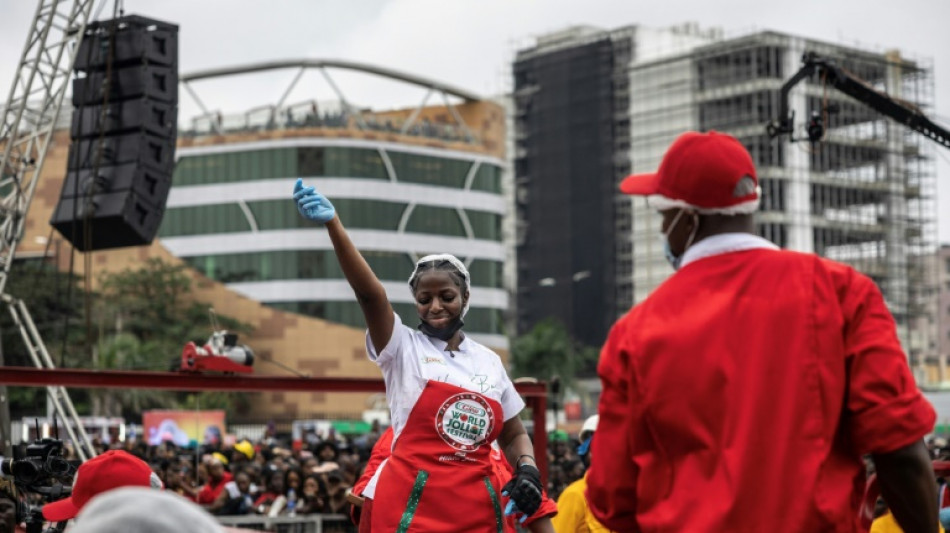
With more than five tonnes of rice, tomato concentrate, cooking oil and onions, Nigerian chef Hilda Baci attempted on Friday to conjure up the biggest rice jollof ever made.

Text size:

The popular west African dish features rice simmered in a tomato sauce, accompanied by meat or fish.

Thousands of people gathered to watch the latest record attempt by the 28-year-old chef and restaurateur, who once held the world record for the longest cooking marathon -- more than four days.

Baci said she poured 4,000 kilogrammes (8,800 pounds) of basmati rice, 500 cartons of tomato concentrate, 750 kilos of oil and 600 kilos of onions into a giant steel cauldron to produce the mammoth dish.

"It's six metres wide and six metres deep," she proudly told AFP of the cooking pot.

To validate her achievement with Guinness World Records, Baci and her team must now produce evidence of their concoction, including photos and videos.

It took several hours to make her record-seeking version of the dish. All of it was to be given away after the attempt.

Baci was aided by 10 assistants in red uniforms wielding huge wooden spoons to sift in and stir the ingredients as the crowd hailed the dish's popularity.

"Nigerians eat it all the time --i at home, at restaurants, even parties -- there's always a jollof rice," beauty retailer Bello Fatima Temitope, 31, told AFP as she helped her restaurateur friend with the outsize endeavour.

"It's easy to eat, people like the taste and its texture. Personally, I like the taste of the tomatoes," she added.

- Diversity of flavours -

On a stage near the large pot, Baci's friends, including influencer Enioluwa Adeoluwa and actress Tomike Adeoye, kept the crowd entertained with music and dance.

While jollof has a common recipe base, different countries -- often even each house -- have their own signature flavour.

In Nigeria, it is generally spicy and often accompanies grilled meat. In Ghana, it is less spicy and can contain carrots and peppers, hence its version has a more reddish hue.

Liberians often add shrimps and other seafood, whereas in Mali some communities add banana for a unique sweet-sour mix.

Jollof rice has its roots in the ancient Wolof empire, which stretched from what is today Senegal to Mauritania and Gambia.

In the 14th century, the region was renowned for its rice cultivation.

Inhabitants would prepare a dish made with rice, fish, seafood and vegetables, known as thiebou dieune.

With the migration of the Wolof people across west Africa, the culinary tradition spread.

Today, there is jollof rivalry, particularly between Nigeria and Ghana, which both claim they have the best recipe.

The dispute is often amplified on social media and at culinary competitions.

In 2021, Senegalese jollof rice was placed on UNESCO's Intangible Cultural Heritage List.

M.Cunningham--TFWP