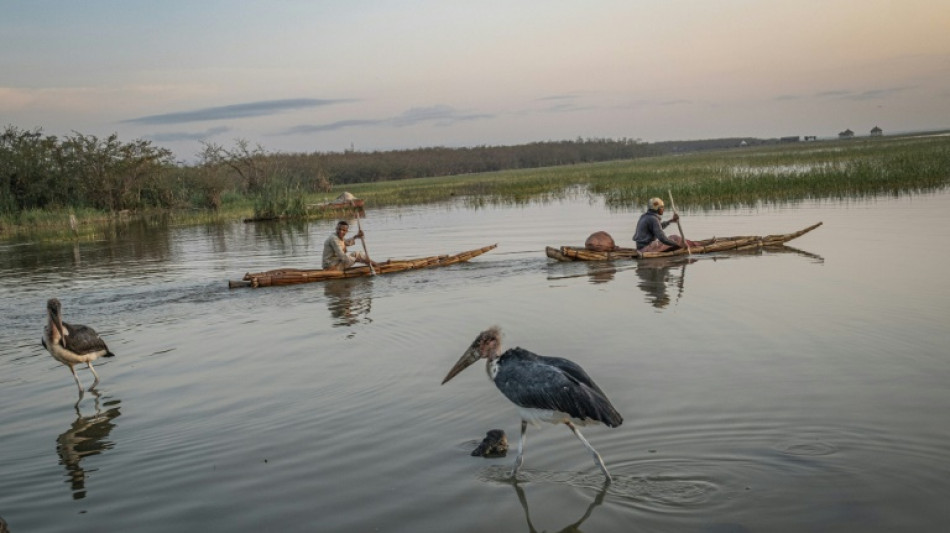
Ethiopia's vast lake being pumped dry / Photo: © AFP

There is a constant hum around Ethiopia's enormous Lake Dembel -- the sound of its water steadily being sucked out by pumps.
The pumps irrigate farms all around the lake, which is four times the size of Manhattan, and are vital for hundreds of thousands of people.
Ethiopia has already lost at least one large lake -- Haramaya, in the east of the country -- to over-pumping.
Now it risks losing another.
Lake Dembel's depth has halved since 1990 from four metres to two (13 feet to over six), according to Wetlands International, an NGO.
"If things continue like this, the lake could disappear," said its project manager Desalegn Regassa.
Pumping by farmers and industry is not the lake's only problem. Heavy pesticide use is also killing its fish, locals and the NGO say.
Belachew Derib has been fishing the lake since the 1980s but says stocks are disappearing.
"I built my house thanks to the income from fishing and support my three children through this work," Belachew, 60, told AFP as he rowed his small boat out to pull up his nets.
"Previously, we could catch 20 to 30 fish a day. Nowadays, young fishermen are lucky to catch two or three," he said.
Just a few dozen metres (yards) from the shore, AFP found Habib Bobasso, 35, liberally covering his small onion plot with pesticides from a pump strapped to his back.
"There are many worms that can damage the plants... we could lose the entire harvest," he said as he sprayed, with just a shawl to cover his face.
He knows the pesticides are harmful but sees no alternative.
"The fertilisers and pesticides we use degrade the soil. We spend too much money on fertilisers and chemicals for a low yield," he said.
- Degradation -
Water management is essential for Ethiopia, a land-locked giant in east Africa with a rapidly growing population already estimated at more than 130 million and often hit by droughts.
But a lack of funds and government oversight has allowed bad practices to continue for decades.
A recent report by the Stockholm International Water Institute blamed Ethiopia's "lacklustre policy frameworks" for "the demise of Lake Haramaya, the shrinking of Lake Abijata (and) the pollution of Awash River and Ziway and Hawassa Lakes."
Lately, the government has shown signs it is taking the problem seriously.
It passed a law earlier this year imposing a fee to extract water from Lake Dembel, which lies around 120 kilometres (75 miles) south of the capital Addis Ababa.
A local official, Andualem Gezahegne, told AFP he hoped this would curtail the pumps.
It cannot come too soon -- Wetlands International said there were some 6,000 pumps installed around the lake last year, running 24 hours a day, and "maybe more today".
AFP witnessed two huge tanker trucks filling up for a nearby highway project during a recent visit.
Keeping fishing under control is another challenge, said Andualem.
"Unfortunately, the peak fishing activity coincides with the fish spawning periods, from January to May," he said.
On the surface, the lake is still full of life -- from hippos to marabou storks.
But as the fishermen head out at dawn, the steady hum of the pumps strikes an ominous note for the future.
W.Matthews--TFWP