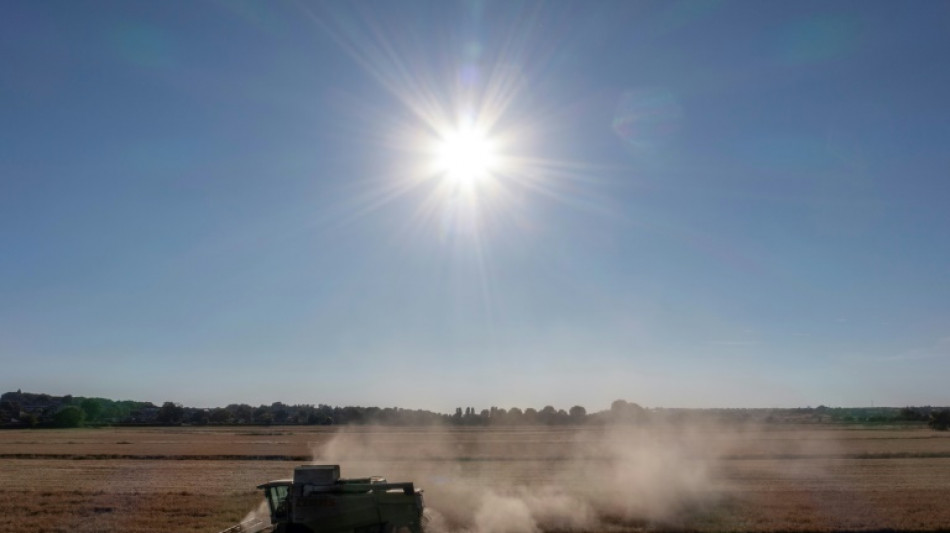
Fears for crops as drought hits northern Europe / Photo: © AFP

Parts of northern Europe have seen their worst drought in decades in recent weeks, with farmers from Scotland to the Netherlands fearing the dry spell will dent harvests if it continues.
Water shortages can stunt the growth of crops such as wheat, corn, rapeseed and barley, Nicolas Guilpart, a lecturer in agronomy at the Agro Paris Tech research institute, told AFP.
Countries including France, Belgium, Britain and Germany have seen much lower levels of rainfall than usual in some areas this spring, leaving the soil parched and dusty.
The unusually dry weather has already delayed the life cycle of crops that would normally have sprouted by now.
Luke Abblitt, a farmer in eastern England, said he was "praying for the rain" as Britain suffers its driest spring in well over a century.
The weather is going from "one extreme to the other," he told AFP.
"We're having a lot of rain in the wintertime, not so much rain in the spring or summer time," he said. "We need to adapt our cultivation methods, look at different varieties, different cropping possibly to combat these adverse weather conditions."
According to the Environment Agency, levels in Britain's reservoirs have fallen to "exceptionally low".
Some farmers have begun irrigating their crops earlier than usual, the National Farmers' Union said, calling for investments to improve water storage and collection systems.
- High sun levels -
In the Netherlands, it has not been this dry since records began in 1906, and Germany's environment minister warned in April of a high risk of forest fires and poor harvests due to a "worrying" lack of rain.
From February 1 to April 13, Germany saw 40 litres of rainfall per square metre, the its lowest level since records began in 1931, according to the German Weather Service (DWD).
And in early May, the Danish Meteorological Institute (DMI) warned that the previous three months had been exceptionally dry, with just 63 millimetres of rainfall.
Since 1874, there have only been seven times when less rain fell during the period from February to April, it said.
Denmark has also seen above-average temperatures for the time of year.
The country's drought index, which runs on a scale of one to 10, has been above nine since May 15, the first time this has happened so early in the year since the index was established in 2005.
The Federation of Swedish Farmers said it was "too early to say what the impact on farming will be this summer" but advised farmers to go over their water planning.
- Irrigation -
In France, groundwater levels remain satisfactory but plants need surface water to grow -- and that means rain.
Northern France has been on drought alert since Monday after seeing the same rainfall between February and early May as it would normally see in a month.
Strong northeast winds have also dried out the soil, with farmers increasingly turning to irrigation.
Between March and May, the village of Beuvry-la-Foret saw eight times less rain than during the same period last year.
Chicory farmer Sebastien De Coninck told AFP that until five years ago, "irrigation was not even considered in the north" -- but these days it can as much as double crop production.
Irrigation can help compensate for low rainfall, Guilpart said, but "you need the resources to do it".
Water for irrigation is primarily obtained from surface water such as rivers, lakes and reservoirs or from groundwater using wells and aquifers.
In France, air temperatures have also been warmer than usual, meaning plants need more water from the soil.
The dry spell in northern Europe contrasts with southern Europe, including Spain and Portugal, where rainfall has been up to twice the usual amount for the time of year.
M.Cunningham--TFWP