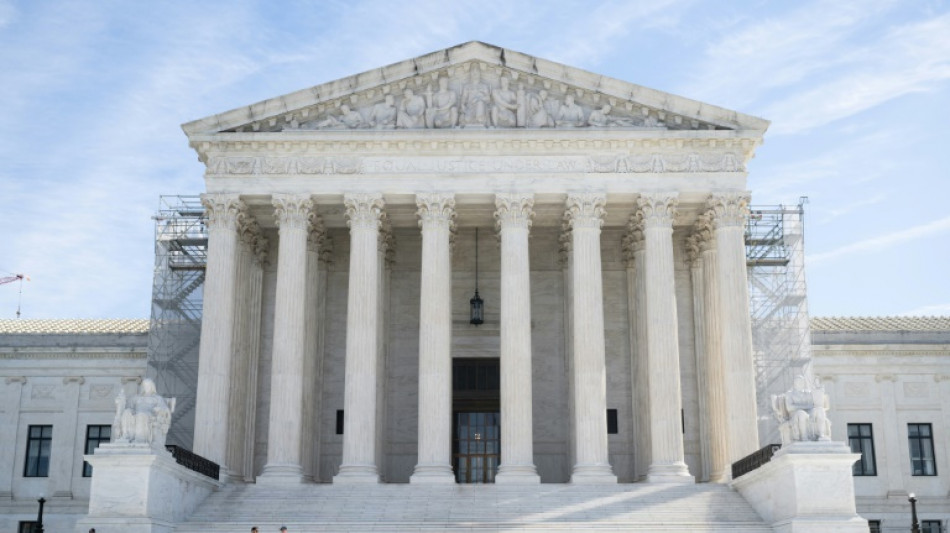
In abortion pill case, US high court may undermine drug regulator / Photo: © AFP/File

If the US Supreme Court, which on Tuesday hears a sensitive case on the availability of abortion pills, ultimately decides to restrict their access, it will impinge on the scientific authority of the federal Food and Drug Administration in unprecedented and consequential ways.
While the case specifically deals with access to mifepristone -- the first of two pills taken in medication abortions -- a broad ruling could threaten access to a number of other drugs used for a wide variety of conditions, experts tell AFP.
The mifepristone pill, first authorized by the FDA in 2000, is now used in nearly two-thirds of all abortions in the United States. It has been deemed safe and legal in dozens of other countries.
In 2016, the FDA eased some restrictions on the drug's distribution, allowing it to be prescribed through the first 10 weeks of pregnancy (up from seven); permitting health professionals including nurses, and not just doctors, to prescribe it; and requiring only one consultation, down from the previous three.
Then, when the Covid-19 pandemic struck, the FDA allowed the pills to be sent by mail, following a single online medical visit.
But after a group of anti-abortion doctors and organizations brought suit, claiming the drug is unsafe and the approval process flawed, an appeals court last year ordered the FDA to return to its pre-2016 standards.
The Supreme Court will take up the case on Tuesday.
"For a judge to second-guess FDA's expert determination is inappropriate, it is unprecedented, and it's also extremely dangerous," Liz Borkowski, a public and women's health expert at George Washington University, told AFP.
"We could see frivolous litigation against all kinds of drugs that people have been using safely for years" -- potentially involving contraception, vaccines or hormonal therapy -- simply because some organization opposes them, she said.
- Black robes v. white lab coats -
From its creation, the FDA, whose decisions are often followed by other countries, has been charged with determining the effectiveness and safety of new medications. It regularly calls on independent experts as part of a carefully regulated review process.
Courts have questioned certain FDA decisions, notably over the interpretation of patents, said Lewis Grossman, a lawyer who has filed a brief in the case with the Supreme Court.
But "imposing restrictions on the availability of a drug based on a disagreement with the scientific experts at FDA," he told AFP, would be "very unprecedented."
"Interpreting science," he added, "is not a legal task."
The anti-abortion plaintiffs argue that when the FDA was reviewing its rules in 2016, it should have studied the impact of all the changes taken together -- an approach that Grossman called "just a made-up requirement by the plaintiffs."
Added Borkowski: "We have decades of evidence about the safety and efficacy of mifepristone.
"If mifepristone cannot stay on the market, as it is, with all these mountains of evidence that we have, then no drug is safe."
- Drugmakers worried -
The pharmaceutical industry strongly opposes a judicial intervention in the matter.
If the appeals court decision is confirmed, it would "inject an intolerable level of uncertainty into the drug approval process," according to a brief filed jointly by dozens of pharmaceutical companies and executives.
And that, the brief argues, would have the effect of "undercutting drug development and investment, and chilling innovation."
Experts said the court's ruling could even open the door for drugmakers to sue the FDA to block rivals from marketing competing medications.
The high court's involvement in rule setting could also place a huge array of agency decisions -- regarding scientific assessments of the environment, workplace safety or many other issues -- at risk of being overturned, according to Grossman.
Borkowski believes the court should take a firm position in the opposite direction, stating clearly that "it's never okay for judges to insert themselves in the science."
She admitted, however, that she worries about the outcome, given some of the conservative court's recent decisions.
Notably, the court in 2022 overturned the long-standing federal protection for abortion rights, leaving it up to each of the country's 50 states to pass its own laws on the matter.
Since then, some 15 Republican-led states have banned abortion -- including through the use of abortion pills. For now, though, women in those states can still receive them -- by mail.
A ruling is expected by summer.
A.Williams--TFWP