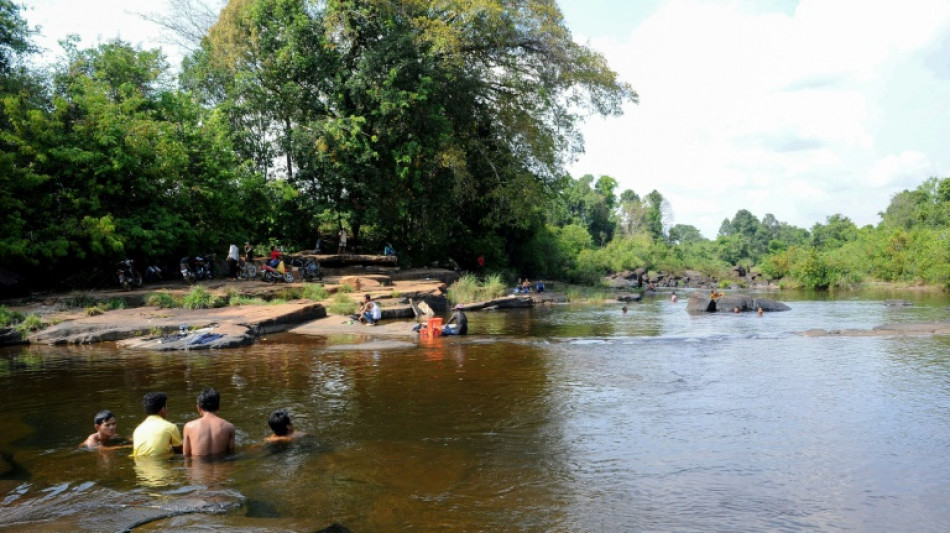
Carbon credit scheme sees Indigenous Cambodians harassed, evicted: report / Photo: © AFP

Indigenous Cambodians living in a protected forest say a carbon credit scheme has led to the destruction of their crops and huts, as a two-year Human Rights Watch investigation released Thursday documented forced evictions and criminal charges.
The scheme, recognised in a 2017 agreement between the environment ministry and conservation group Wildlife Alliance (WA), sees companies buy credits to offset their greenhouse gas emissions, with the revenue going towards preserving one of the world's most biodiverse rainforests.
Chong Indigenous villagers in the southwestern Cardamom Mountains said that while they support preservation, the project has restricted their ability to farm, forage and collect firewood.
"Firstly, people cannot farm freely because rangers and the Wildlife Alliance harass them by destroying their crops, dismantling their huts and burning their rice and other crops," Ven Vorn, a member of the Chumnoab commune in Chhay Areng, told AFP.
He added that villagers worry about violating unknown rules.
"They fear being arrested because they don't understand the law, they don't know what kind of forest products are allowed to be collected and what are not allowed to be collected," he said.
About 3,000 Chong people live in the nearly half a million hectare area where the Southern Cardamom REDD+ conservation project was launched.
Many of them were not properly informed or consulted about the scheme, according to HRW.
The rights group documented six families' evictions from land in the project, and three other incidents where residents were prosecuted.
"Conservation strategies that sideline and punish indigenous peoples to address the global environmental crisis are unacceptable, and counterproductive," said Luciana Tellez Chavez, HRW senior environment researcher.
- Arrests, arbitrary searches -
Globally, carbon credit schemes have proved controversial, with academic studies questioning their ability to offset emissions, and local communities reporting impacts on their livelihoods.
To investigate the effects of the Cardamom Mountains initiative, HRW interviewed almost 100 villagers and analysed satellite imagery, topographic maps and social media.
The rights group said between 2018 and 2021, patrols consisting of environment ministry rangers, gendarmes and WA staff "arrested and mistreated" villagers in the area.
Villagers also told HRW that rangers would "arbitrarily search their homes".
Home to dozens of threatened species, including Asian elephants, sun bears and pangolins, the Cardamom Mountains rainforest falls among roughly 40 percent of Cambodia designated a nature preserve.
Yet the country has one the highest rates of deforestation in the world, according to HRW, with much of the trade lubricated by violence and bribery of forestry officials and border guards.
The REDD+ effort bills itself as a way to prevent deforestation due to widespread rampant logging, slash and burn cultivation practices and illegal poaching that had put the Cardamoms on the brink of destruction.
WA founder and CEO Suwanna Gauntlett said in an email to AFP that while her organisation respects HRW's work, the rights group "presents a fundamentally misleading and distorted picture" of the REDD+ project.
She said HRW focused on only six of the 29 villages, and that there was "overwhelming support" from the Chong community, which had benefited from new schools, roads, medical centres, wells, scholarships and ecotourism.
WA said it had also taken a raft of measures in response to HRW's findings, including appointing staff to help locals understand the rules of the protected area.
Cambodia's Ministry of Environment said the Indigenous community had been sufficiently consulted, and lawbreakers would be punished.
"Cambodia has reached a point: Preserving forests in order to increase its revenue," Environment Ministry spokesman Khvay Atitya told AFP.
- 'Not happy' -
In Chhay Areng, villagers noted the project had brought some benefits, including two roads a wells.
But one man, who asked to remain anonymous, told AFP his community was overall "not happy" about it.
Ven Vorn from Chumnoab said while he ultimately supports the scheme, he wished locals could have had more say in it.
When it started, "huts, rice were burned and other crops were destroyed," he said.
"We face difficulties that we cannot do our traditional rotating farming.
"That's hard to accept."
P.Navarro--TFWP