The Fort Worth Press - Costa Rica coffee farmers innovate as rainfall plummets

USD -
AED 3.6725
AFN 64.498083
ALL 81.66238
AMD 360.406323
ANG 1.790403
AOA 918.000003
ARS 1560.626007
AUD 1.505004
AWG 1.8025
AZN 1.705413
BAM 1.781807
BBD 2.009341
BDT 124.174373
BGN 1.77347
BHD 0.376446
BIF 3004.902563
BMD 1
BND 1.287048
BOB 11.65581
BRL 5.958103
BSD 0.997615
BTN 92.467544
BWP 14.224132
BYN 2.995043
BYR 19600
BZD 2.006427
CAD 1.432075
CDF 2279.999886
CHF 0.839095
CLF 0.025984
CLP 1022.65036
CNY 6.67775
CNH 6.67113
COP 3504.91
CRC 446.546434
CUC 1
CUP 23.960279
CVE 100.455519
CZK 22.241701
DJF 177.655177
DKK 6.797398
DOP 60.185902
DZD 136.05579
EGP 53.8625
ERN 15
ETB 163.742614
EUR 0.90944
FJD 2.29155
FKP 0.764341
GBP 0.761975
GEL 2.599053
GGP 0.764341
GHS 11.755113
GIP 0.764341
GMD 73.99991
GNF 8844.481872
GTQ 7.630848
GYD 208.864392
HKD 7.83874
HNL 26.815546
HRK 6.831965
HTG 130.826061
HUF 338.24956
IDR 18188.6
ILS 3.331602
IMP 0.764341
INR 92.813406
IQD 1513.506127
IRR 1937364.502594
ISK 124.769891
JEP 0.764341
JMD 158.034649
JOD 0.708988
JPY 158.934057
KES 130.129579
KGS 87.450194
KHR 4070.447604
KMF 448.999728
KPW 900.00035
KRW 1347.230098
KWD 0.31178
KYD 0.831959
KZT 455.400173
LAK 22505.352344
LBP 89404.637179
LKR 332.009293
LRD 167.220881
LSL 17.451373
LTL 2.95274
LVL 0.60489
LYD 6.454726
MAD 9.983601
MDL 18.299094
MGA 4521.059891
MKD 56.078896
MMK 2100.263653
MNT 3609.734672
MOP 8.060128
MRU 40.664403
MUR 46.789604
MVR 15.399088
MWK 1729.947242
MXN 19.08705
MYR 4.117601
MZN 63.909182
NAD 17.451373
NGN 1361.220055
NIO 36.716207
NOK 9.733345
NPR 147.84283
NZD 1.826025
OMR 0.381411
PAB 0.998315
PEN 3.426958
PGK 4.490976
PHP 63.850116
PKR 275.773182
PLN 4.050685
PYG 6290.854136
QAR 3.649342
RON 4.865104
RSD 107.165308
RUB 81.332109
RWF 1473.830831
SAR 3.744281
SBD 8.124013
SCR 13.883515
SDG 601.494963
SEK 10.197415
SGD 1.289325
SHP 0.764263
SLE 22.850058
SLL 20969.503664
SOS 570.177435
SRD 37.363495
STD 20697.981008
STN 22.304663
SVC 8.735025
SYP 13002.000337
SZL 17.435122
THB 34.016504
TJS 9.179702
TMT 3.5
TND 3.023915
TOP 2.40776
TRY 50.5992
TTD 6.776295
TWD 32.896601
TZS 2667.442998
UAH 44.804286
UGX 4218.102309
UYU 40.595818
UZS 11951.897235
VES 917.61775
VND 25832.5
VUV 120.821201
WST 2.823282
XAF 596.553359
XAG 0.023426
XAU 0.000275977408
XCD 2.70255
XCG 1.799299
XDR 0.707052
XOF 596.553359
XPF 108.650298
YER 236.602255
ZAR 17.43279
ZMK 9001.20406
ZMW 20.541323
ZWL 321.999592
SSP 5775.741752
MXV 2.137928
  • RIO

    -0.3300

    97.04

    -0.34%

  • CMSC

    -0.0400

    20.67

    -0.19%

  • RELX

    0.0000

    33.41

    0%

  • RBGPF

    0.0000

    67.95

    0%

  • BCE

    -0.0700

    21.99

    -0.32%

  • BCC

    -0.0300

    75.66

    -0.04%

  • GSK

    0.8600

    51.08

    +1.68%

  • JRI

    -0.0300

    11.52

    -0.26%

  • NGG

    -0.1200

    76.68

    -0.16%

  • CMSD

    0.0900

    20.54

    +0.44%

  • BTI

    -0.0800

    55.75

    -0.14%

  • AZN

    2.0200

    168.1

    +1.2%

  • BP

    -1.4200

    43.16

    -3.29%

  • RYCEF

    0.4600

    19.7

    +2.34%

  • VOD

    0.0700

    17.02

    +0.41%

Costa Rica coffee farmers innovate as rainfall plummets
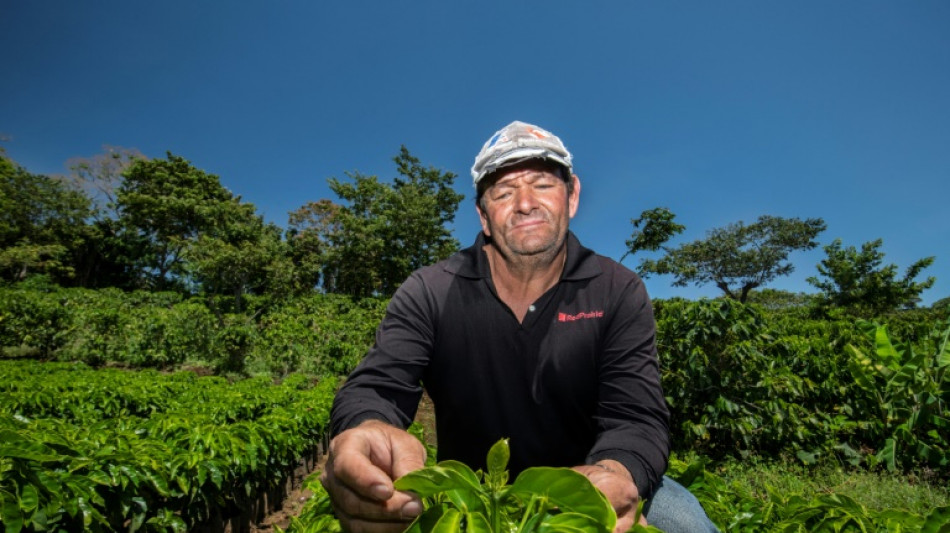
Costa Rica coffee farmers innovate as rainfall plummets / Photo: © AFP

Costa Rica coffee farmers innovate as rainfall plummets

Costa Rican coffee farmers were once blessed with abundant rains but as precipitation grows fickle they are being forced to innovate to keep producing one of the world's favorite brews.

Text size:

The country's lush Central Valley has long boasted the ideal climate conditions for growing the arabica coffee beans, its most emblematic export -- but farmers report this is rapidly changing.

Jesus Valverde, who owns a family plantation in the town of Naranjo, is trying to adapt by planting fruit trees that provide shade and maintain humidity around his coffee plants.

"We have increased production" with this "microclimate," the 59-year-old farmer told AFP.

In addition, the dry leaves that fall from the trees fertilize the soil and reduce heat, a kind of "biological technology" that maintains the humidity of the soil.

"I was ahead of climate change," the coffee farmer says proudly.

The Inter-American Development Bank estimates that rising temperatures could wipe out half of the world's coffee crops by 2050.

While the country is one of the world's smaller coffee producers, the bean has been one of Costa Rica's top exports since the 19th century. Last year, the country shipped 60,000 tons at a value of $350 million.

The industry supports more than 25,000 families.

-'The challenges are constant' -

Data from the University of Costa Rica shows that annual rainfall has steadily dropped from 2,907 millimeters (114 inches) in 2010 to 1,759 millimeters in 2023.

However some years stand out as particularly dry, such as 2016, when only 952 millimeters fell.

With climate change "the challenges are constant," as pests and fungi evolve, said Harold Gamboa, a specialist at the Inter-American Institute for Cooperation on Agriculture.

The Coffee Institute of Costa Rica (Icafe) is working on developing coffee plant hybrids that are more resistant.

"By studying the DNA of different plants, we can speed up the development of the best characteristics in a single plant," said biotechnology engineer Erika Mendez, 28.

In the past, farmers like Johel Alvarado needed to do little more than plant and wait for the country's once-consistent rains.

Now he has had to install a drip irrigation system on his four-hectare coffee plantation.

"Each year it gets a bit harder to produce the same amount," but "by innovating, we see that climate change does not affect us as much," the 52-year-old farmer told AFP.

Eduardo Rojas, who manages a 50-hectare coffee plantation in the town of Sarchi, managed to boost production after investing over $200,000 in irrigation systems and other upgrades.

In 2023, he harvested 43.5 bushels of coffee per hectare, more than double the national average.

"I didn't believe it could be done," said Rojas, who has been in the business for more than 40 years.

"People who have farms like this in very harsh climates... need to get involved in these projects," he said.

S.Weaver--TFWP