The Pakistan women barred from voting by their husbands / Photo: © AFP

Perched on her traditional charpai bed, Naeem Kausir says she would like to vote in Pakistan's upcoming election -- if only the men in her family would let her.
Like all the women in her town, the 60-year-old former headmistress and her seven daughters -- six already university educated -- are forbidden from voting by their male elders.
"Whether by her husband, father, son or brother, a woman is forced. She lacks the autonomy to make decisions independently," said Kausir, covered in a veil in the courtyard of her home.
"These men lack the courage to grant women their rights," the widow told AFP.
Although voting is a constitutional right for all adults in Pakistan, some rural areas in the socially conservative country are still ruled by a patriarchal system of male village elders who wield significant influence in their communities.
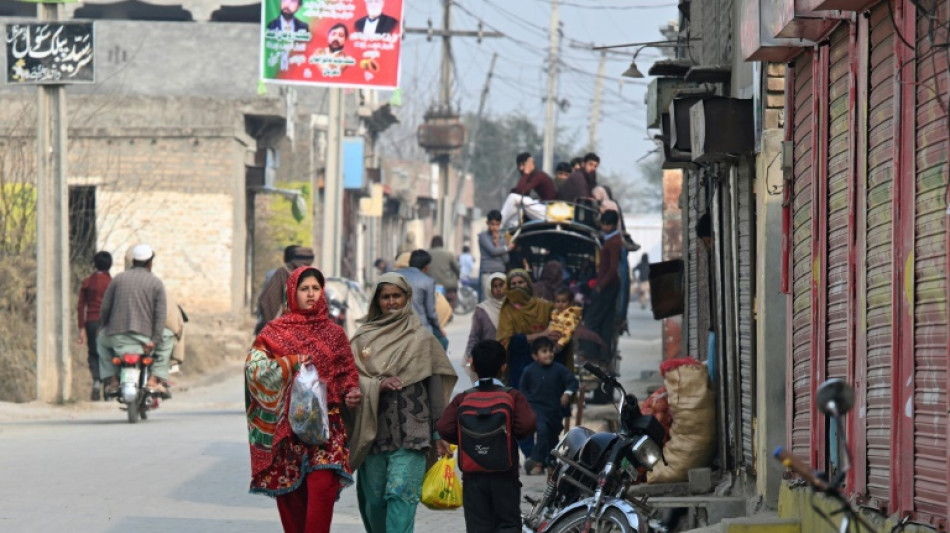
In the village of Dhurnal in Punjab, spread across crop fields and home to several thousand people, men profess myriad reasons for the ban of more than 50 years.
"Several years ago, during a period of low literacy rates, a council chairman decreed that if men went out to vote, and women followed suit, who would manage the household and childcare responsibilities?" said Malik Muhammad, a member of the village council.
"This disruption, just for one vote, was deemed unnecessary," he concluded.
Muhammad Aslam, a shopkeeper, claims it is to protect women from "local hostilities" about politics, including a distant occasion that few seem to remember in the village when an argument broke out at a polling station.
Others told AFP it was simply down to "tradition".
- First Muslim woman leader -
The Election Commission of Pakistan (ECP) has stressed that it has the authority to declare the process null and void in any constituency where women are barred from participating.
In reality, progress has been slow outside of cities and in areas that operate under tribal norms, with millions of women still missing from the electoral rolls.
The elders in Dhurnal rely on neighbouring villages to fill a government-imposed quota which maintains that 10 percent of votes cast in every constituency must be by women.
Those who are allowed to vote are often pressured to pick a candidate of a male relative's choice.
In the mountainous region of Kohistan in Khyber Pakhtunkhwa province home to almost 800,000 people, religious clerics last month decreed it un-Islamic for women to take part in electoral campaigns.
Fatima Tu Zara Butt, a legal expert and a women's rights activist, said women are allowed to vote in Islam, but that religion is often exploited or misunderstood in Pakistan.
"Regardless of their level of education or financial stability, women in Pakistan can only make decisions with the 'support' of the men around them," she said.
Pakistan famously elected the world's first Muslim woman leader in 1988 -- Benazir Bhutto, who introduced policies that boosted education and access to money for women, and fought against religious extremism after military dictator Zia ul-Haq had introduced a new era of Islamisation that rolled back women's rights.
However, more than 30 years later, only 355 women are competing for national assembly seats in Thursday's election, compared to 6,094 men, the election commission has said.
Pakistan reserves 60 of the 342 National Assembly seats for women and 10 for religious minorities in the Muslim-majority country, but political parties rarely allow women to contest outside of this quota.
Those who do stand often do so only with the backing of male relatives who are already established in local politics.
"I have never seen any independent candidates contesting elections on their own," Zara Butt added.
- 'Everyone's right' -
Forty-year-old Robina Kausir, a healthcare worker, said a growing number of women in Dhurnal want to exercise their right to vote but they fear backlash from the community if they do -- particularly the looming threat of divorce, a matter of great shame in Pakistani culture.
She credits part of the shift to access to information as a result of the rising use of smartphones and social media.
"These men instil fear in their women – many threaten their wives," she told AFP.
Robina, backed by her husband, is one of the few prepared to take the risk.
When cricketing legend Imran Khan swept to power in the 2018 election, Robina arranged for a minibus to take women to the local polling station.
Only a handful joined her, but she still marked it as a success and will do the same on Thursday's election.
"I was abused but I do not care, I will keep fighting for everyone's right to vote," Robina said.
B.Martinez--TFWP