A migrant's odyssey from Venezuela to the United States / Photo: © AFP/File

Lying in the jungle with a gun pointed at him, Marcel Maldonado remembered his mother's warning about the dangers of migrating overland to the United States -- and wondered if he'd get out alive.
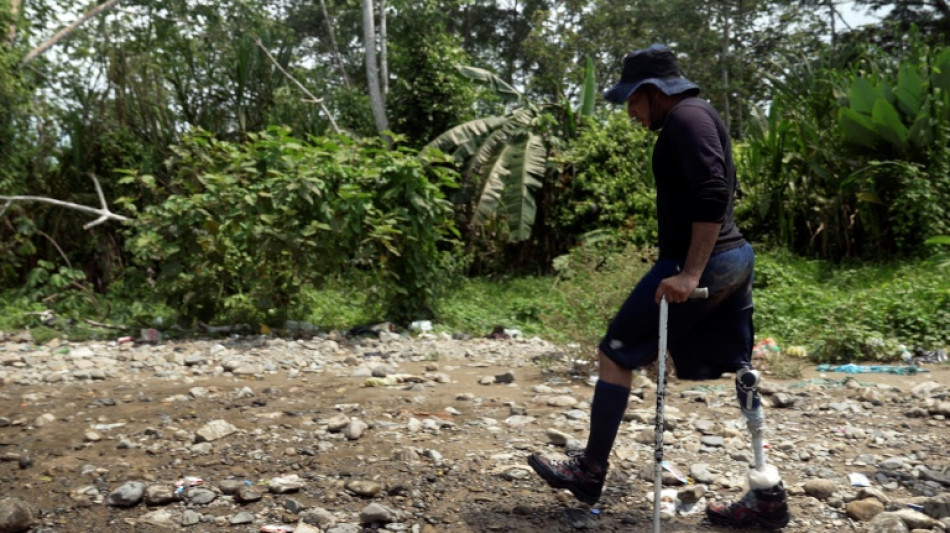
Despite having a prosthetic leg, the 30-year-old Venezuelan had made it with his family as far as the notorious Darien Gap between Colombia and Panama. But when he got held up by criminals he was reminded why this is one of the world's most dangerous migration routes.
"They'll never find my body here," he remembers thinking.
Maldonado had arrived in the remote region of dense rainforest and swamps days after leaving Venezuela on September 15 with his wife Andrea, 27, and adopted son Samuel, eight.
It was one of the darkest moments in their nearly two-month odyssey through nine countries.
More than a dozen AFP journalists in Venezuela, Panama, Costa Rica, Nicaragua, Honduras, Mexico and the United States followed Maldonado's journey, which he made by bus, boat or walking with the aid of a stick.
The data processing technician is one of 7.7 million Venezuelans -- a quarter of the population according to the United Nations -- who since 2014 have left their oil-rich country due to a deep political, economic and social crisis.
Over a decade, he saw his country's economic output shrink by 80 percent.
Maldonado said he saw only "a life of poverty" ahead unless he left Venezuela in search of a better future for his wife and son.
He also feared that he would be unable to replace the prosthesis that he has worn since losing his right leg in a road traffic accident in 2014.
To pay for the journey, Maldonado sold some belongings. His father sold his car to help.
Maldonado left behind a half-built house and some clothes that his mother keeps as a memento.
- Tent, snake repellent -
After arriving at the Venezuelan-Colombian border, the family bought supplies including a tent, a small stove, rubber boots and disinfectant that they hoped would repel snakes.
Migrants -- mostly Venezuelans but also Ecuadorans, Cubans, Haitians, Chinese, Afghans and Africans -- exchanged tips on how to survive in the jungle.
Maldonado paid smugglers $900 to cross the Gulf of Uraba off the coast of northern Colombia by boat and then travel by motorcycle to the entrance to the Darien Gap, an area of dense tropical jungle with no roads.
From there, dozens of men and women advanced in single file along paths and riverbeds with their few belongings on their backs, some carrying children in their arms.
What Maldonado called the "craziness" began when migrants started to descend into Panama through a lawless zone rife with bandits.
"The criminal gangs are hidden between the trees," he said.
According to New York-based Human Rights Watch, organized crime groups like the Clan del Golfo -- Colombia's main drug cartel -- earn tens of millions of dollars from control of the Darien migration route.
- 'Gave them everything' -
Things took a terrifying turn for the worse when a gunman appeared firing into the air, Maldonado said.
"They threw us all to the ground. I was sure they were going to shoot us," he said.
Instead they were beaten with a machete.
"I gave them everything. I'm not going to die for material things," Maldonado said.
The criminals even "searched the women's private parts," he said. "It's horrible because you don't know what could happen."
Between January and October, at least 397 migrants -- 97 percent of them women -- were victims of sexual violence in the Darien jungle, according to medical aid group Doctors Without Borders.
At one point Maldonado saw one of the assailants with his wife's hat and -- with her nowhere in sight -- feared the worst, before she returned from a nearby well with their child.
"We hugged and cried for a long time," he said.
After eight hours the family was released with only their identity documents.
By then Samuel had a fever and they had not eaten all day.
It would be two and a half more days before they emerged from the Darien Gap.
This year more than half a million migrants have followed the same route, according to the Panamanian government -- around twice as many as in 2022.
- 'Guardian angels' -
One last river marked the end of the jungle.
Emaciated but triumphant, Maldonado managed to cross helped by one of his "guardian angels" -- two fellow Venezuelans whom he met in Colombia.
"Without them I wouldn't have made it," he said. "The rivers are strong."
In Panama, the family finally ate a hot meal and found somewhere safe to sleep before setting off again, with money sent by Maldonado's sister after selling her car.
Using an AFP journalist's cellphone, Andrea told her mother-in-law back home about their time in the jungle. During the call, Andrea learned that a niece had lost her baby teeth.
In neighboring Costa Rica, the family slept on cardboard boxes in a bus station.
"All this is to have a better future. In Venezuela, you survive just to eat," said Andrea, a former university employee.
In Honduras and Guatemala, people helped Maldonado by buying candy that he sold on the street.
At every step of the way, they encountered solidarity.
- 'Get ready for Mexico'-
One day another migrant warned Maldonado: "If you think the jungle is bad, get ready for Mexico."
And so it proved.
"It's really the hardest thing," Maldonado said, recalling the high prices, exhausting walking and rampant extortion.
In southern Mexico, Maldonado said that he initially stayed in a government shelter but left because he felt like a "prisoner," preferring to sleep on the street with his wife and son.
To avoid Mexican immigration agents, the family took refuge in the mountains.
Vegetation got in the way of Maldonado's prosthetic leg, making every step a struggle, he recalled.
The family's arrival in Mexico City in early November coincided with the annual Day of the Dead celebrations, bringing a temporary respite as they took photos of colorful decorations and giant skulls.
Maldonado called his father so he could hear mariachi music.
Then it was another bus ride to the northeastern city of Monterrey and from there on to Matamoros across the border from Brownsville, Texas.
Maldonado said that he was extorted multiple times along the way by Mexican security forces who threatened to deport him.
On each occasion he grew more anxious about running out of money -- he needed $60 to pay smugglers to cross the Rio Grande, the river separating Mexico and the United States.
The family arrived in Matamoros at night with a sense of foreboding due to the presence of a powerful drug cartel in the city.
Fear gave way to nostalgia only briefly when Maldonado ate a typical Venezuelan dish prepared by a fellow migrant.
- Smugglers, air mattresses -
Maldonado decided against scheduling an appointment with US authorities to seek asylum through a cellphone application -- a process that can take months due to the huge numbers applying.
In the year to October 2023, more than 2.4 million arrivals were recorded at the southern US border -- a new record.
Maldonado knew that deportations of irregular migrants from Venezuela had resumed, and that US President Joe Biden's opponents were using migration to attack him ahead of the 2024 election.
He decided to cross the river with people smugglers who told the family to bring only their IDs, money and the clothes on their backs.
"I was very afraid. They looked like bad people," he told AFP reporters, who were warned by a masked man to stop filming.
At night, at the edge of the river, Maldonado's prosthesis sank into the mud and cold water came up to his hips. The people smugglers took the family across one by one on small air mattresses.
"They were afraid that the prosthesis would burst the mattress," he said.
- 'What a joy' -
On the other side, helped by his companions, he managed to climb over the barbed wire.
By the time the headlights of a US patrol car lit up the area the family was already on US soil.
"Here we are! What a joy!" Maldonado said in videos to his relatives back home.
It was November 4. The family had traveled around 4,300 kilometers (2,600 miles) and spent $7,000 to reach the United States.
Others have paid with their lives -- in 2022 alone, more than 680 people died or disappeared trying to cross the US-Mexican border, according to the International Organization for Migration.
In Texas, Maldonado was given a DNA test by US authorities to register his identity and a cell phone to keep in contact.
The family was given a residence permit valid until May 2026, when a judge is due to rule on their asylum application.
"They don't deport families," Maldonado said, explaining why he was allowed to stay.
He now sells flowers in the street in Greenville, South Carolina while awaiting a work permit.
Andrea works as a cleaner. Samuel goes to school where he learns English.
Maldonado's head is full of dreams -- working as a taxi driver, having a child, getting a new prosthesis and playing basketball again.
"Nothing's impossible," he said.
P.McDonald--TFWP