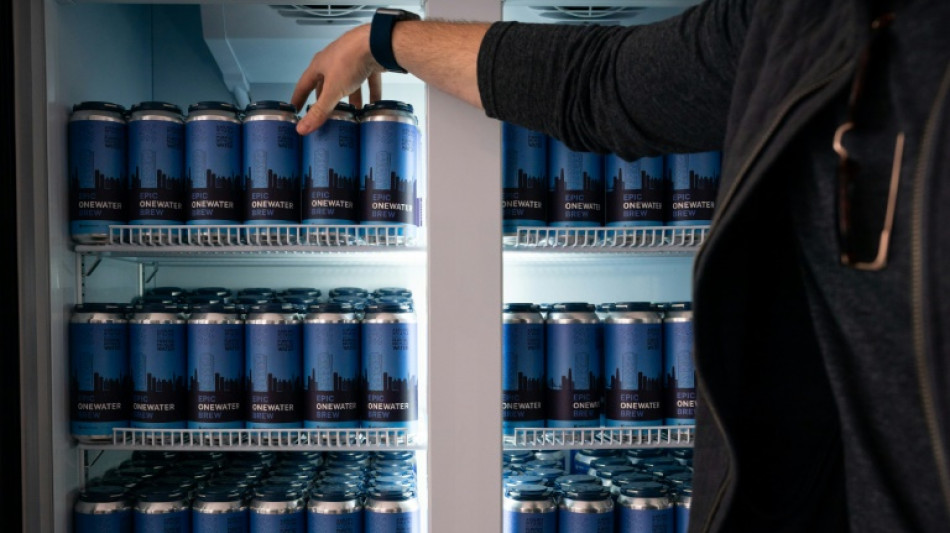
Wastewater beer aims to help quench US drought / Photo: © AFP

With its golden hue and light fruity flavor, the beer being sipped by Aaron Tartakovsky looks and tastes just like many others.
But it contains an unusual ingredient: recycled wastewater from a San Francisco skyscraper.
The beverage was brewed to raise public awareness of the "untapped" potential of water sources that might seem unsavory at first glance, at a time when the American West is struggling with chronic drought exacerbated by global warming, explains Tartakovsky.
"Beer has brought people together basically since the dawn of human civilization," the boss of recycling company Epic Cleantec told AFP.
Manufacturing the drink is an "incredible medium" to show the general public "in this age of climate change... recycled water is a really great way to make sure that our communities are secure for generations to come."
The beer uses water derived from the showers, sinks and washing machines of a San Francisco apartment building containing 550 homes.
Epic Cleantec treats the building's wastewater in the basement, returning much of it to the 40 floors above to be reused in flushing toilets or the irrigation system.
California law prohibits redirecting the treated water to taps for drinking.
But once filtered, the water is transformed from a murky, thick gray to a crystal-clear liquid which will "meet or exceed federal drinking quality standards," says Tartakovsky.
To prove it, he has teamed up with a brewery to create Epic OneWater Brew, a drink inspired by German Kolsch beers.
- 'No difference' -
Epic Cleantec purifies the water in three stages.
Firstly, bacteria target contaminants in the liquid, similar to how microbes in the human stomach work on the food and drink we consume.
Then the water is filtered through membranes measuring just one-thousandth of the diameter of a human hair.
It is finally disinfected with ultraviolet light, and chlorine.
The results surprised Chris Garrett, boss of the Devil's Canyon brewery, which has produced 7,200 cans of beer using water from the building.
In fact, he says, the treated wastewater probably provides "a cleaner slate" than the municipal water he usually uses for brewing beer -- and there is no discernible change in taste.
"There literally is no difference, not discernible by anyone, including people that I know that are beer snobs," said Garrett, who has run blind tastings.
Still, California law currently prevents the two companies from marketing or selling the beer commercially.
They hope that can be changed, and have been distributing cans free of charge during major events such as the recent Climate Week in New York.
"I think what our beer project has shown people is that the public is a lot more ready for recycled water than we give them credit for," says Tartakovsky, who served the beer at his own wedding.
- Direct reuse -
In parts of the United States, such as Scottsdale in Arizona, treated wastewater has long been recycled for watering golf courses and crops.
In Orange County, California, treated water is pumped into the ground, where it enters underground aquifers before eventually being returned to the taps.
But due to chronic drought, the region's water sources are drying up -- including the vital Colorado River, relied upon by millions of Americans.
Authorities are exploring ways to recycle wastewater for direct reuse, without having to first return it to the natural environment.
Following Colorado last year, California plans to adopt new measures to pursue this technology before the end of 2023.
Known as "direct potable reuse" (DPR), the practice has been utilized for decades in Windhoek, a city in the southwestern African desert of Namibia.
But opponents have cropped up in the United States, dubbing the process "toilet-to-tap" in a bid to evoke disgust, while glossing over the recycling technology used.
Nonetheless, a recent Stanford University study found that recycled water may be cleaner than much of the water we drink daily, thanks to the extra efforts taken to purify it.
It also offers other advantages to expensive alternatives, such as treating seawater.
"The public often thinks about seawater desalination is a preferable alternative," said Bill Mitch, co-author of the research.
"But beyond needing to be next to the coasts... it's also much more energy intensive to clean up seawater than municipal wastewater, and about twice as costly."
Mitch, a professor of civil and environmental engineering, hopes that initiatives like Epic Cleantec's can help to change attitudes.
In recent years, other beers using wastewater have been brewed in Arizona and Idaho.
"Any of those actions certainly helps break down the public impression of 'toilet-to-tap'" he said.
F.Garcia--TFWP