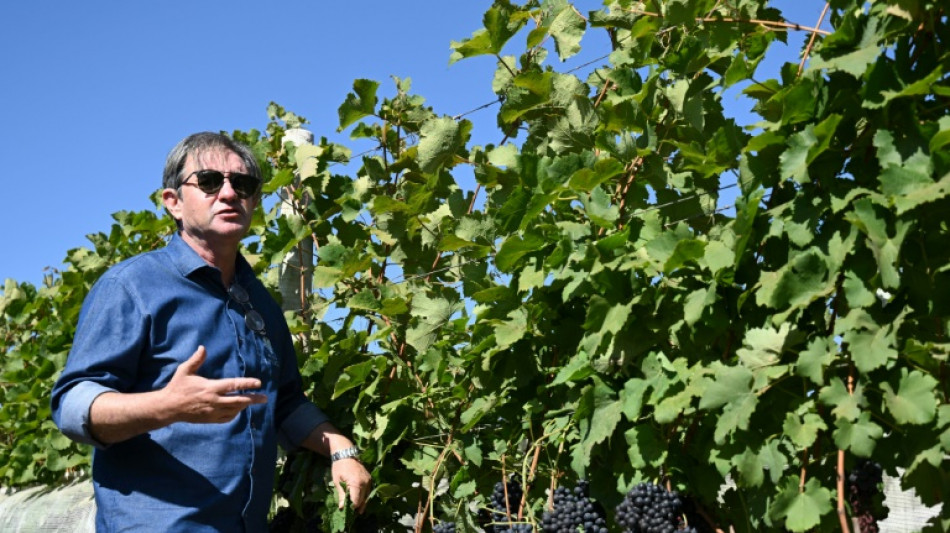
Wine from Brazil's unsung savannah makes a splash / Photo: © AFP

The tropical savannah around Brazil's ultra-modernist capital is not exactly known as wine country, but French enologist Jean-Michel Barcelo gushes as he plucks a ruby-red grape and pops it in his mouth.
"This terroir has real potential," says the 52-year-old wine consultant, who is in the high plateau of central Brazil making his annual visit to Villa Triacca, a vineyard located a 50-minute drive from the sweeping white buildings of the seat of power in Brasilia.
With its predominantly tropical climate, Brazil is far less known for wine than fellow South American producers Argentina and Chile -- never mind France.
But a new production technique developed by Brazilian researchers in the 2000s has helped winemakers in the Brasilia region hack the local climate to harvest in the winter, producing better-quality grapes -- and wines that are starting to make a splash.
"The technique they're using here is different from what you see anywhere else in the world," says Barcelo, a silver-haired Frenchman who takes his wine very seriously.
He lavishes praise on the freshness and complexity of Brazilian highlands wines, and the "exceptional" conditions at Villa Triacca: an altitude of 1,000 meters (3,280 feet) above sea level, a dry climate and a difference of up to 15 degrees Celsius between daytime and nighttime temperatures in winter -- perfect for ripening grapes.
Visitors on a wine tasting at the vineyard are also impressed.
"I was surprised by the quality," says Luciano Weber, a 45-year-old Brasilia resident.
"I had no idea they were making something so good here."
- Unusual technique -
But it was not an obvious choice to grow grapes in central-western Brazil, the heart of the country's powerful soybean, corn and beef industries.
The key is a technique called "double pruning," in which producers prune their vines twice a year, once in winter and once in summer.
That enables them to push their grape-picking season back from autumn, the usual time -- when the region's heavy rains would threaten the harvest -- to July and August, the heart of winter in the southern hemisphere.
The technique also involves using a synthetic hormone that regulates the vines' growth and keep them dormant so the grapes will be ready at the right time.
Producers say the hormone leaves no trace in the final product.
But some wine lovers are dubious.
"We don't know what the effects are. I've never seen a study on it," says Suzana Barelli, resident wine expert at newspaper Estado de Sao Paulo.
Still, she is impressed by the region's wines, praising their "very high quality."
- Dream come true -
The Brasilia region, known as the Federal District (DF), has just 10 vineyards, all opened in recent years.
But the industry is growing.
Farmland devoted to wine production leapt from 45 hectares (111 acres) in 2018 to 88 (217) last year.
Ronaldo Triacca, owner of the namesake vineyard, launched it six years ago.
"I had always dreamed of making wine, but I thought I could only make table wine -- until I learned about inverted pruning," says the 57-year-old farmer, sitting amid his prized vines, his denim shirt rolled up at the sleeves.
"That's when I realized it was possible to make high-quality wine."
He started planting grapes -- Syrah, Cabernet Sauvignon and Cabernet Franc -- on six hectares of land, alongside his existing corn and soy fields.
Now, he sells 15,000 bottles a year, and is part of a collective of regional producers called Vinicola Brasilia.
For now, most of their production is sold to specialty stores and restaurants in the capital.
But they are starting to get noticed.
"A lot of people still think if a wine isn't Argentine, Portuguese or French, it's no good," says Felipe Camargo of regional agricultural agency Emater.
"We're going to change that fast."
T.Mason--TFWP